By Staff Reporter
ISLAMABAD: Prime Minister Shehbaz Sharif on Wednesday renewed calls for “meaningful dialogue” with India to tackle all unresolved issues, including the decades-old Kashmir dispute, a proposal overshadowed by lingering tensions from a deadly attack in the region earlier this year.
The olive branch follows a deadly attack on April 22 in occupied Kashmir’s Pahalgam region, where 26 people were killed. India pointed the finger at Pakistan, alleging it orchestrated the assault, a claim Islamabad flatly rejected while urging a neutral probe. The ensuing military confrontation was halted by a US-brokered ceasefire, capping weeks of heightened tension.
Pakistan has long pushed for talks with India to settle thorny issues like Kashmir and water rights under the Indus Waters Treaty. India, however, has hesitated, often citing allegations of cross-border terrorism linked to its rival.
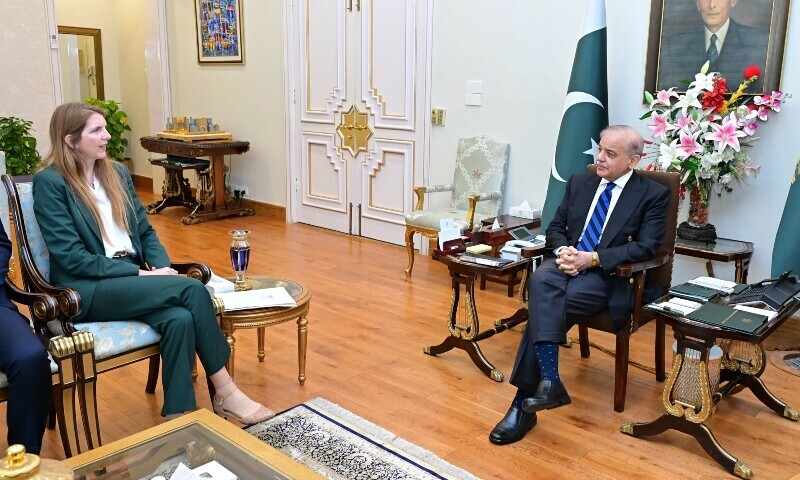
In a separate meeting Wednesday, Sharif hosted British High Commissioner Jane Marriott, praising the United Kingdom’s efforts to cool tensions during the recent Pakistan-India standoff. The discussion underscored a warming in UK-Pakistan ties, spotlighted by London’s recent decision to lift a ban on Pakistan International Airlines (PIA) flights to Britain.
“This [decision] would go a long way in alleviating the hardships faced by the British-Pakistani community as well as enhancing people-to-people exchanges,” Sharif said, according to Radio Pakistan, while commending Marriott’s diplomatic work.
The two also hailed the “positive trajectory” of their countries’ relationship. Sharif noted that recent trade talks promised “mutually beneficial opportunities” and emphasized Pakistan’s teamwork with the UK at the United Nations Security Council, where Pakistan currently holds the rotating presidency. Marriott, fresh from consultations in London, praised Pakistan’s economic strides, pointing to marked improvements in key financial indicators. She also shared Britain’s views on unrest in South Asia and the Middle East.
The UK’s goodwill gestures continued last week with the rollout of e-visas for Pakistani students and workers under an “enhanced” immigration system. That move came a day after both nations inked a Trade Dialogue Mechanism Agreement and launched the UK-Pakistan Business Advisory Council to bolster economic ties.
Meanwhile, at the UN Security Council in New York, Pakistan’s envoy, Ambassador Usman Jadoon, fired back at India’s accusations of cross-border terrorism during a Tuesday debate titled “Promoting International Peace and Security through Multilateralism and Peaceful Settlement of Disputes.” Convened by Pakistan, the session aimed to champion nonviolent solutions to global conflicts.
India’s UN Ambassador Parvathaneni Harish had lashed out, calling Pakistan “steeped in fanaticism and terrorism” and a “serial borrower from the International Monetary Fund,” in response to a speech by Pakistan’s Deputy Prime Minister Ishaq Dar. Dar had stressed the need to resolve the Kashmir issue during a reception honoring Pakistan’s council presidency.
“It is India which actively sponsors, aids and abets terrorism in my country and beyond,” Jadoon told the 15-member council, flipping the script on New Delhi’s narrative. “Rather than being blinded by hubris and a misplaced sense of impunity, and instead of resorting to its tired narrative of victimhood and blame-shifting, India must introspect seriously, change its behavior and comply with its international legal obligations on all counts.”
Jadoon called it “especially regrettable” that India attacked Pakistan on a day when the council had united to uphold the UN Charter’s call for peace and respect for international law. He accused India of illegally occupying Jammu and Kashmir, flouting Security Council resolutions that guarantee Kashmiris’ right to self-determination, and committing “egregious violations of human rights” documented by global watchdogs.
The envoy also slammed India for suspending the 1960 Indus Waters Treaty, a move he said was designed to choke Pakistan’s water supply in defiance of international norms. Turning to the May 7-10 military flare-up, Jadoon said India’s “blatant aggression” targeted Pakistani civilians, including women and children. Pakistan’s “befitting but measured response,” he added, downed six Indian aircraft and inflicted other losses, before US mediation restored calm.
“It is ironic that India, which itself brought the Jammu and Kashmir dispute to the Security Council, refuses to implement the resolutions adopted by the council to peacefully resolve this dispute,” Jadoon said.
The debate, which heard from dozens of high-level delegates, is slated to resume on July 24. It has thrust the Pakistan-India rivalry back into the global spotlight, testing the world’s appetite for diplomacy over discord.
Copyright © 2021 Independent Pakistan | All rights reserved