By Staff Reporter
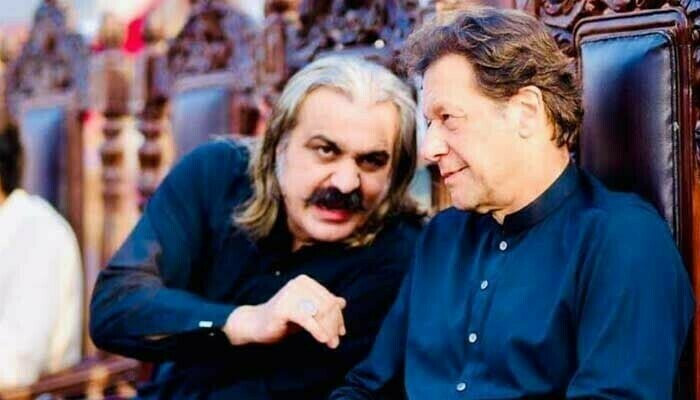
ISLAMABAD: Imran Khan, the jailed founder of Pakistan Tehreek-e-Insaf (PTI), has instructed the chief minister of Khyber Pakhtunkhwa (KP), Ali Amin Gandapur, to prevent any further military operations in the province and its tribal areas.
Khan’s directive, issued from prison, underscores a deepening rift between his party, which governs KP but lacks federal power, and the military-backed coalition government led by Prime Minister Shehbaz Sharif of Pakistan Muslim League-Nawaz (PMLN). It also shows Khan’s standoff with the country’s powerful military, which has backed operations against resurgent militancy in the northwest.
In a message posted on Saturday to Khan’s X account, which he does not personally operate, he instructed Gandapur, the head of KP’s PTI-led government, to resist the federal operation. “I convey a clear message to Ali Amin that the federation must not be allowed to conduct another military operation in KP and the tribal areas,” Khan said. “Confrontation between the army and the people destroys the institution of the army. Operations are not a solution to any problem. Issues should be resolved through dialogue in accordance with the system there.”
Khan, who was ousted as prime minister in a parliamentary vote in 2022 and has been imprisoned on multiple charges since then, remains a potent political force, though. His stance pits him directly against the military, which has endorsed the action to curb a surge in terrorism linked to the Tehrik-i-Taliban Pakistan (TTP).
The TTP, a militant group with ties to the Afghan Taliban, has intensified its attacks since the latter’s return to power in Afghanistan in 2021. Pakistan’s northwest, particularly KP and its tribal districts, has borne the brunt of this violence, with 476 terrorist incidents reported in the first seven months of 2025 alone, according to a provincial police report. The toll includes 121 civilian deaths and heavy losses among security forces.
Earlier this week, security forces launched “Operation Sarbakaf” in Bajaur district’s Lowi Mamund tehsil, deploying gunship helicopters and artillery in a bid to root out militants. The operation, which included a three-day curfew, drew immediate condemnation from PTI.
In a statement following a party meeting, Gandapur vowed to take “stringent measures” to oppose the offensive, including the potential withdrawal of provincial support for security laws. However, he later softened his tone, endorsing a “targeted operation,” a shift that exposed divisions within PTI and drew criticism from Khan himself.
In his message, Khan doubled down on his opposition, warning that military action risks alienating the local population and weakening the army’s standing. “Afghanistan is our Muslim neighbouring country. Relations with them should also be improved, and issues should be addressed through discussions.”
Critics said Khan’s call for dialogue is more because of his uneasy relations with the military, whom he blamed for his ouster in the parliamentary vote, than his critique of the federal strategy, which has leaned heavily on force to counter militancy.
Gandapur, responding to Khan’s directive, convened the first in a series of jirgas, traditional tribal assemblies, on Saturday in Peshawar. The gathering, attended by 150 tribal elders from KP’s Khyber and Orakzai districts, as well as senior provincial officials, produced a set of demands: unity against terrorism, a rejection of civilian displacement due to military operations, and a push for negotiations with Afghanistan.
“Displacement amid the ongoing military operation was unacceptable under any circumstances,” a statement from the chief minister’s office said, adding that “development is linked to peace and it will accelerate when peace is restored.” The jirga also urged Sharif’s government to facilitate talks with Kabul, proposing that a delegation of provincial officials and tribal leaders travel to Afghanistan for direct negotiations. Gandapur announced plans for additional jirgas in Mohmand, Bajaur, North and South Waziristan, and Kurram districts, culminating in a grand assembly under his leadership.
The move, analysts said, signals an attempt by Gandapur’s government to please party supremo Khan by asserting his authority over security matters, even as it defies federal policy. Yet Khan’s criticism of Gandapur’s handling of the crisis has added pressure.
According to sources cited by the private Geo News television channel, Khan privately suggested that Gandapur should resign if he cannot maintain order in the province. “If Ali Amin Gandapur cannot restore peace, he should step down,” Khan reportedly said, adding that “someone else should be given a chance” if governance falters. The remarks, not independently verified, highlight the strain within PTI as it navigates its dual role as a provincial power and a federal opposition.
Since his ouster in 2022, Khan has faced over 200 legal cases and remains in jail, yet his influence endures through PTI’s control of KP and his enduring popularity. His party has repeatedly clashed with the PMLN-led coalition, which took power after his removal and has struggled to stabilise the economy and contain militancy. The military, long a dominant force in Pakistani politics, is leading Sharif’s government’s security operations, viewing them as essential to national stability. But Khan’s warning that such actions could “destroy” the army’s legitimacy reflects an anxiety about the costs of repeated military interventions in the northwest, where past operations have displaced communities and fueled local grievances.
Copyright © 2021 Independent Pakistan | All rights reserved