By Staff Reporter
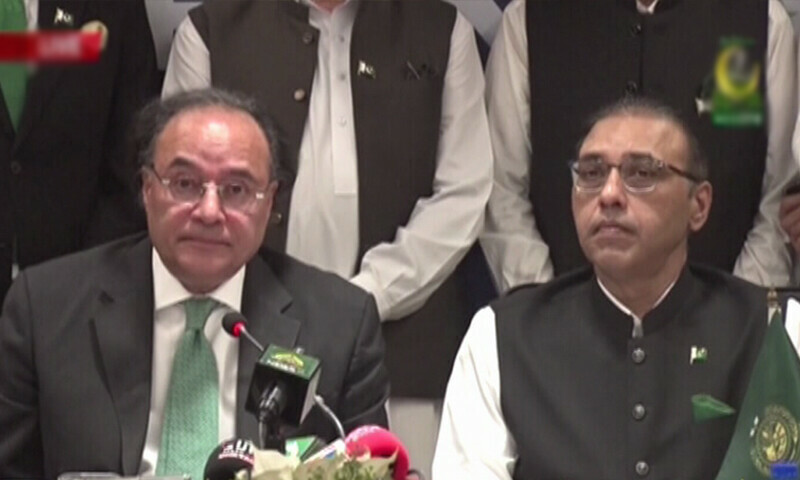
ISLAMABAD: Finance Minister Muhammad Aurangzeb signalled on Wednesday that the central bank could lower interest rates further before the end of 2025, a move aimed at sustaining the country’s nascent economic recovery.
The remarks, delivered at an event in Islamabad, come as businesses clamour for cheaper borrowing to fuel growth, while the government touts progress in stabilising the economy after years of volatility. The State Bank of Pakistan (SBP) has already cut its benchmark rate by 1,000 basis points from 22% since June 2024, bringing it to 11% in May, where it has remained.
The aggressive easing followed a period of tight monetary policy to tame inflation, which has since moderated significantly. Yet, the decision to pause rate cuts has sparked frustration among the business community, which argues that high borrowing costs continue to hamper investment.
Aurangzeb, a former JPMorgan Chase & Co. banker tasked with steering Pakistan’s economy through turbulent times, struck a cautiously optimistic tone. “At present, the policy rate is at 11%. I am always very careful that the policy rate and the market-based exchange rate are very much the purview of the central bank, the State Bank of Pakistan, and the Monetary Policy Committee,” he said.
“Having said that, my own view, and I am giving my personal view here, is that given the current inflation, whether it is the average inflation or the core inflation, I do think there is room to do more in terms of the policy rate, and I am very hopeful that during the course of this calendar year we will see movement in the policy rate going south.”
The finance minister’s comments reflect growing confidence in Pakistan’s economic trajectory, underpinned by a string of positive indicators. “In the past 1.5 years, we have made strong progress on the economic front,” Aurangzeb said, highlighting rising per capita income, a “record decrease” in the fiscal deficit, and improvements in the current account surplus and foreign exchange reserves. Remittances, a critical lifeline for the economy, have also surged, alongside a “double-digit increase” in exports from the textile, IT, and pharmaceutical sectors.
Aurangzeb pointed to a revitalised local business environment, with small and medium enterprise (SME) loans jumping 41% and agricultural lending surpassing 2.5 trillion rupees. “Should it be even higher? The answer is yes. But 41% is not a small or insignificant number,” he said, acknowledging the need for further progress.
Private-sector loans have risen 38%, a sign that banks are increasingly willing to lend to businesses as fiscal discipline reduces the government’s borrowing needs. Fiscal restraint has been a cornerstone of Aurangzeb’s strategy. The minister noted that the government slashed debt servicing costs by 1 trillion rupees in the past year and expects to achieve similar savings in 2025. “God-willing, our debt servicing will go down by more than 1 trillion this year as well,” he said, emphasising that lower public borrowing would free up capital for the private sector. “Once fiscal discipline is achieved, the government’s borrowing requirement will decrease, and banks and other economic institutions will reach out to the private sector.”
The Pakistan Stock Exchange has been a bright spot, crossing 147,000 points on Tuesday, with a 60% gain over an unspecified period. The bourse attracted 65,000 new investors in the past year, while annual company registrations topped 250,000, developments Aurangzeb described as a “big structural change.” These milestones signal growing investor confidence in Pakistan’s economic reforms, even as the country navigates regional tensions, including the recent Marka-i-Haq conflict with India in May.
Aurangzeb praised the “brave armed forces” for their role, underscoring the link between national security and economic stability. “National security and economic stability are correlated,” he said.
Structural reforms are gaining traction, with the government pursuing tariff reductions to lower the cost of raw materials and intermediate goods, a critical step toward building an export-led economy. “For the first time in Pakistan’s history, we are looking at tariff reforms,” Aurangzeb said, framing the initiative as a way to boost competitiveness.
The government is also streamlining 43 ministries and over 400 departments, while accelerating the privatization of state-owned enterprises to reduce fiscal strain. Aurangzeb’s recent discussions with the SBP governor underscore a coordinated push to support the private sector. “We are getting our house in order, which is the federal government,” the minister said. “And therefore, it is important that you also take whatever efforts you are making towards the private sector.”
Pakistan’s economy, once teetering on the brink of default, has stabilised significantly, thanks in part to a $7 billion International Monetary Fund bailout secured in 2024. Yet challenges remain, including the need to sustain export growth and manage external debt obligations.
Copyright © 2021 Independent Pakistan | All rights reserved