By Staff Reporter
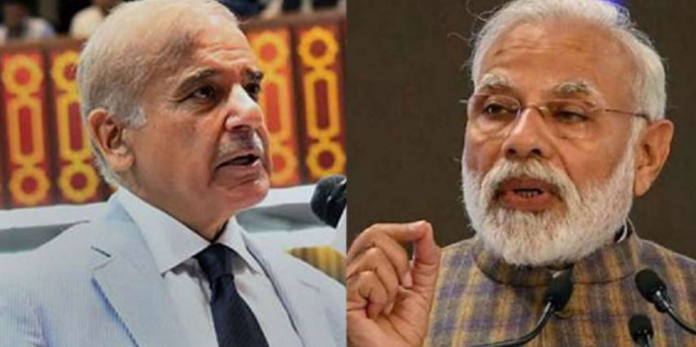
ISLAMABAD: Pakistan’s foreign office on Friday dismissed speculation of a meeting between Prime Minister Shahbaz Sharif and his Indian counterpart, Narendra Modi, on the sidelines of the upcoming Shanghai Cooperation Organization (SCO) Summit in China, as tensions between the nuclear-armed neighbors remain high following a brief but intense military clash earlier this year.
The SCO summit, scheduled for August 31 to September 1 in the northern Chinese city of Tianjin, will bring together regional leaders, including Sharif and Modi, for the fifth time Beijing has hosted the annual gathering. However, Pakistan’s foreign office spokesperson, Shafqat Ali Khan, categorically ruled out any bilateral talks between the two leaders.
“There is no meeting in the works between the Prime Minister of Pakistan and the Prime Minister of India,” Khan told reporters in Islamabad, responding to questions about whether China, the summit’s host, might facilitate dialogue between the South Asian rivals.
Relations between Pakistan and India, long strained by disputes over Kashmir and cross-border militancy, deteriorated further in May when the two nations engaged in a four-day military standoff. The conflict saw both sides deploy fighter jets, missiles, drones, and artillery before a ceasefire, brokered by the United States, took effect on May 10. During the conflict, Pakistan’s armed forces downed six Indian fighter jets, including three Rafale aircraft, and dozens of drones.
US President Donald Trump announced the ceasefire on social media, claiming credit for defusing the crisis through Washington’s mediation. India, however, disputed Trump’s assertion that the ceasefire resulted from his intervention and threats to halt trade talks. Pakistan, on the other hand, has acknowledged Trump’s role, with Islamabad formally recommending him for the 2026 Nobel Peace Prize for his efforts in de-escalating tensions.
The Kashmir dispute has been a flashpoint in India-Pakistan relations for decades, with both nations claiming the region in full but administering separate portions. The recent escalation underscored the fragility of peace between the two countries, which have fought three wars since their partition in 1947.
Pakistan has since expressed willingness to engage in a “composite dialogue” with New Delhi to address all outstanding issues, including Kashmir, terrorism, and trade. However, Indian officials have consistently rejected the prospect of diplomatic engagement, citing concerns over cross-border militancy.
The SCO summit comes at a time of heightened regional tensions and shifting geopolitical alignments. China, which maintains deep defence, diplomatic, and economic ties with Pakistan, has its own recurring border dispute with India, particularly in the Ladakh region. Beijing’s relations with New Delhi have been further complicated by Washington’s efforts to position India as a counterbalance to China’s growing influence in Asia.
Earlier this month, Chinese Foreign Minister Wang Yi visited both India and Pakistan, holding talks with top officials in New Delhi and Islamabad. During his visit to India, Wang urged Indian leaders to view China as a partner rather than an adversary, Arab News reported on Friday.
Meanwhile, the United States has imposed tariffs of up to 50 percent on Indian exports in recent weeks, exacerbating tensions between Washington and New Delhi. The move has added a new layer of complexity to India’s foreign policy calculations as it navigates its relationships with both China and the United States.
In Islamabad, Khan emphasised Pakistan’s openness to third-party mediation to promote regional security and stability. “Despite the current trajectory of ties with India, Pakistan would welcome any efforts to ensure peace in the region,” he said at his weekly news briefing.
Separately, Pakistan’s Deputy Prime Minister and Foreign Minister Ishaq Dar on Friday reiterated Islamabad’s willingness to engage in comprehensive talks with India, including on the long-standing Kashmir dispute.
“Pakistan is ready for comprehensive talks with India,” Dar told journalists at Parliament House in Islamabad, emphasizing that any dialogue must address all outstanding issues, including the Kashmir dispute.
Speaking to reporters, Dar confirmed that the ceasefire along the Line of Control (LoC) is holding. He noted that the initial request for de-escalation had come from India via the United States. “I received a phone call from the United States regarding a ceasefire,” Dar said, adding, “Pakistan never wanted war.”
Dar clarified that Pakistan had not sought external mediation to initiate talks with India but was approached about holding discussions at a neutral venue. He stressed, however, that Islamabad would not accept a limited agenda for talks. “Any dialogue with India must include all outstanding issues, including Kashmir,” he said.
Copyright © 2021 Independent Pakistan | All rights reserved