By Staff Reporter
KARACHI: The flood authorities warned on Thursday that the Indus River is expected to reach “very high flood” levels at the Guddu Barrage in Sindh province within 48 hours, as massive volumes of water draining from devastated areas upstream in Punjab push southward, raising alarms for densely populated regions along the river’s lower reaches.
The shift comes as Punjab, the country’s most populous province and its agricultural heartland, shows signs of gradual improvement after weeks of catastrophic flooding. Officials there reported 79 people dead and nearly 2 million acres of farmland submerged in what they described as the worst deluge in four decades, triggered by record monsoon rains that swelled the Ravi, Chenab and Sutlej rivers simultaneously for the first time in history.
“River Indus at Guddu is expected to attain Very High Flood level during the next 48 hours. River Indus at Sukur is expected to attain High Flood level after 48 hours,” the Flood Forecasting Division said in a statement.
By Thursday evening, the Guddu Barrage was already handling more than 505,000 cubic feet per second, or cusecs, with upstream gauges at Chachran holding steady at nearly 298 feet. Latest irrigation department data showed inflow at Guddu at 502,861 cusecs and outflow at 407,970 cusecs. At the Sukkur Barrage downstream, inflow stood at 440,985 cusecs with outflow at 412,735 cusecs, while the Kotri Barrage farther south recorded inflow of 257,754 cusecs and outflow of 254,354 cusecs.
Guddu and Sukkur serve as critical control points, channeling Indus waters into central and southern Sindh while shielding urban centers below.
Sindh Chief Minister Murad Ali Shah said the Sukkur Barrage had managed over 1.1 million cusecs in recent days. “Sukkur Barrage is a great masterpiece of 1932 and was built by the best engineers of that time,” Shah said, adding that “climate change has made it necessary to enhance the capacity of barrages.”
He noted reinforcement efforts at 45 vulnerable sites province-wide.
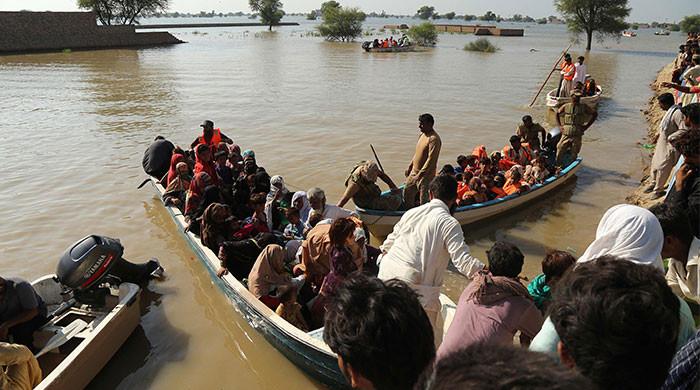
The incoming surge from Punjab has already inundated riverine areas, flooding villages and prompting intensified rescue operations by local authorities. Officials have called on residents in flood-prone zones to evacuate to safer ground.
“Our first and foremost priority is to protect human life. We need the cooperation of people living in Kacha (riverine) areas to evacuate when advised. This is a time for unity and collective action,” Shah said.
Shah also pressed the federal government to issue a flash appeal for relief and rehabilitation, echoing Pakistan Peoples Party Chairman Bilawal Bhutto Zardari’s push for international aid amid widespread devastation. “The entire country is facing a severe flood situation. The federal government must act swiftly and announce a flash appeal for relief and rehabilitation immediately,” Shah told reporters. He said Prime Minister Shehbaz Sharif had pledged full support and planned to meet with the four provincial chief ministers to address the climate crisis.
In Punjab, rivers remained swollen on Thursday. The Chenab carried over 150,000 cusecs through the Trimmu control point and more than 90,000 at Qadirabad downstream. The Sutlej pushed above 120,000 cusecs at the Sulemanki and Islam headworks, while the Ravi had eased to lower flows. Officials said the drainage pattern indicated continued heavy southward movement into the Indus.
Climate Change Minister Musadik Malik, in a briefing with NDMA Chairman Lt. Gen. Inam Haider Malik, said a second wave of flooding had reached or would soon hit the Panjnad Headworks.
“Military personnel, district administration, welfare groups, provincial officials — they are all out there and putting their lives at risk,” the minister said, noting that 2,000 tonnes of aid from nongovernmental organizations had been distributed. He described the floods’ path from Sialkot and Narowal through Shahdara, Lahore, Jhang and Sargodha.
The minister emphasized Pakistan’s vulnerability to climate change and affirmed Sindh’s readiness to handle the inflows. “We will, God willing, manage the floodwater flowing,” he said. “Within a month, we will present our next plan.”
NDMA Chairman Lt. Gen. Inam Haider Malik reported that 2.4 million people had been evacuated from Punjab to safe zones, with 150,000 relocated overall, a figure that could rise. “Once the water recedes, we will start rehabilitation work on over 5,000 villages and fields,” the chairman said. “It will take some time, around four to five weeks, for the water to dry. Once roads, communications and infrastructure are improved, the rehabilitation work will start.”
The NDMA had issued early warnings weeks earlier, he added, cautioning that such events would intensify over time, including hill torrents in northern regions. “These are the early warnings we shared some weeks ago with the relevant authorities and both provincial governments,” Lt. Gen. Malik said. “For the nation, this is an early warning: that these events will become far more intense with time, like the hill torrents in the northern areas.”
The chairman described the current monsoon as the season’s final spell, with southward flows “losing steam” over the past two days. He explained the water arriving in two layers — one at Guddu, the other at Panjnad — and predicted stabilization in two to three days.
“The unusual flow in the Sutlej, Chenab and Ravi Rivers, which we saw at the start of these floods, have now stabilised,” he said. “However, we have seen very stressful flow over the past three to four days, due to which hydraulic structures and embankments have been strengthened.”
Nationwide, the NDMA reported 932 deaths and 1,057 injuries from rains and floods. The toll includes 527 men, 153 women and 252 children among the dead, and 449 men, 288 women and 320 children among the injured.
Punjab suffered the most with 246 deaths and 658 injuries, followed by Khyber Pakhtunkhwa at 504 deaths and 218 injuries. Sindh recorded 68 deaths and 87 injuries, Balochistan 26 deaths and five injuries, Gilgit-Baltistan 41 deaths and 52 injuries, Azad Jammu and Kashmir 38 deaths and 34 injuries, and Islamabad nine deaths and three injuries.
Minister Malik highlighted how advance data on flood volumes enabled evacuations of up to 2.5 million people. “It takes time for water to reach Sindh, but since August 25 till today, there have been constant reports about how much floodwater there is,” he said. “We will do whatever we can to protect our people and children.”
Copyright © 2021 Independent Pakistan | All rights reserved