By Staff Reporter
PESHAWAR: The military sharply rebuked the provincial government in Khyber Pakhtunkhwa on Friday for what it described as governance failures fueling a terrorism resurgence, urging officials to prioritise protecting residents over seeking security assistance from neighboring Afghanistan.
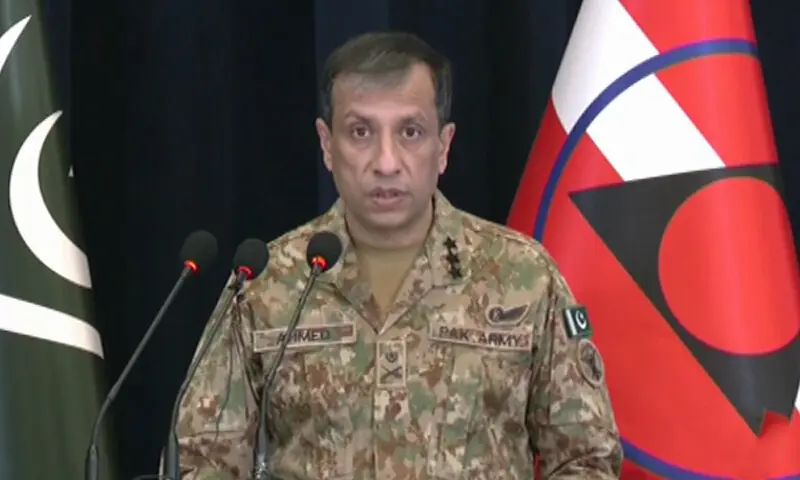
In an unusually pointed press conference, Lt. Gen. Ahmed Sharif Chaudhry, director general of the military’s Inter-Services Public Relations wing, accused provincial leaders of appeasing terrorists and their facilitators, a stance he said the state would not tolerate. “Appeasement of terrorists and their facilitators is never and not a policy,” Chaudhry said, emphasising that the state and its institutions would remain undeterred by “any political distortions.”
The comments seemed directed at Imran Khan, the imprisoned former prime minister whose Pakistan Tehreek-e-Insaf party governs Khyber Pakhtunkhwa. Without naming Khan, Chaudhry called him “singularly the most responsible person for bringing terrorism back to KP.” “The state and its people will not and cannot be left to the whims of any single person who is singularly the most responsible person for bringing terrorism back to KP,” he said.
Chaudhry added that governance lapses in the province were being paid for in the blood of security forces. He expressed hope that the government would refocus on its duties. “We also hope that instead of begging Afghanistan for security, you will protect this province and its people,” he said.
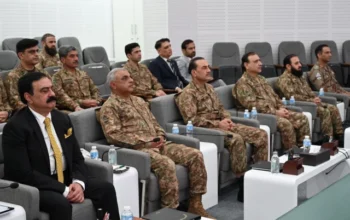
Held at Peshawar Corps Headquarters, the briefing began with Chaudhry honoring the “brave sons of soil” of Khyber Pakhtunkhwa on behalf of the armed forces. He outlined the province’s security challenges, noting that Pakistan, especially Khyber Pakhtunkhwa, has battled terrorism for two decades.
Chaudhry detailed counterterrorism operations: In 2024, 14,535 intelligence-based missions killed 769 terrorists, including 58 Afghans, but cost the lives of 272 army and Frontier Corps personnel, 140 police officers and 165 civilians. Through Sept. 15, 2025, another 10,115 operations had killed 970 terrorists while claiming 311 army lives, he said. As terrorist incidents rose in 2021, so did responses, Chaudhry noted. “And more number of kharijis were killed in subsequent years,” he said, using “kharijis” to refer to extremists.
He traced the crisis to the 2014 Army Public School attack in Peshawar, after which forces pursued a strategy to eradicate terrorism. “We reached close to [realising] the dream of a peaceful Khyber Pakhtunkhwa. [But], unfortunately, as part of a plan, terrorists and their facilitators were then provided space here,” Chaudhry said. “Governance and public welfare were deliberately weakened and attempts were made to build a misleading narrative. The people of Khyber Pakhtunkhwa are paying its price with their blood and sacrifices even today.”
Among factors driving militancy, he cited incomplete implementation of the National Action Plan (NAP); politicisation of terrorism; India’s use of Afghanistan for anti-Pakistan operations; modern weapons supplied to Afghan-based terrorists; and a “terrorism-crime nexus” backed locally and politically.
Post-2014, all parties agreed on the NAP’s necessity, Chaudhry said. But in 2021, the government revised it, removing provisions despite gains, and pledged to enact all 14 points. Highlighting a graphic, he affirmed progress on kinetic operations. “Just in KP, are law enforcement agencies not conducting more than 40 intelligence-based operations?” Yet he challenged efforts on other points. “Today, are we all standing under one narrative? Do you not hear voices calling for talks with these terrorists? Are we following this NAP?” Chaudhry asked. “Does the solution to all problems lie in dialogue? You tell me. If the solution for every problem is in dialogue, then when India fired missiles on Pakistan on May 6 and 7 … why didn’t the people of this country say let’s hold talks?” If dialogue sufficed, wars would cease, he stressed.
On breaking the terror-crime nexus, Chaudhry noted plans to bolster the judiciary. But in Khyber Pakhtunkhwa anti-terrorism courts, no convictions had occurred, with 34 cases pending. “This is the judicial system that was to be strengthened. The political government of the time decided it, we did not,” he said. He questioned the adequacy of the 3,200-strong provincial police amid ongoing threats. “The terrorism (situation) is before you all. Is this [number] enough?”
Chaudhry criticised the politicisation of Afghan refugee repatriation, with “misleading things” said about it. Post-2021 US withdrawal, abandoned weapons were now arming terrorists, he said, citing recoveries from Khyber Pakhtunkhwa operations.
Asked how NAP implementation could improve, he replied: “We know how things will change … they will change once we work on this NAP with clarity and in unison. There will be change when those who play politics are asked why they are playing with people’s lives and property and why they are supporting the statements of terrorists.”
Chaudhry addressed reports of a Kabul explosion the prior night, amid claims of a Pakistani strike on TTP leader Noor Wali Mehsud. He acknowledged social media buzz and a Taliban statement. “Afghanistan is a neighbourly, Islamic country. We have historical connections, cultural connections. Pakistan has hosted Afghan refugees for four decades. We only say one thing to the Afghan government: do not allow your soil to be used for terrorism against Pakistan,” he said.
Bilateral trade and medical visits persist, but Pakistan’s demand is reasonable, Chaudhry asserted: “Don’t let your soil be used by non-state actors and terrorist groups.” “Is it wrong to ask? It is absolutely fair, it is correct, it is rational, it is our right. And for this, we also engage them at multiple levels,” he said.
Pakistan communicates terrorist details to Kabul, he added. “Yes, we engage [with Afghanistan], but at the same time, we are doing and will continue to do whatever is necessary to protect the lives of Pakistan’s people and its territorial integrity.” Pressed on strikes, Chaudhry reiterated: “I have made it clear that Afghanistan is being used as a base of operations for carrying out terrorism in Pakistan. There is also evidence of this. And I have also said that all the necessary steps for protecting the people’s lives and property are being taken and will continue to be taken.”
On Saudi Arabia’s recent defense pact and potential mediation with Afghanistan, Chaudhry said engagements with Riyadh and allies like the UAE, China, the US and Turkey predated it. “We engage the Afghans directly at multiple levels and also through allied countries such as Saudi Arabia, UAE, China, US, Turkiye and many more. They all understand that the space being given to non-state actors in Afghanistan is not just against Pakistan,” he said.
Afghanistan hosts “every alphabet” of terrorists, including TTP, IS-K and BLA, he said, mercenaries without ideology. “If you allow these elements space in your country, then every kind of terrorist organisation will be found. That is why we are engaging them because all of them are concerned because this threat from non-state actors is not only a danger to Pakistan or to the region but it is becoming a threat to the whole world,” Chaudhry said.
Kabul must choose against becoming a terrorist haven, he warned, as such groups historically betray hosts and threaten Afghans too. Pakistan engages while defending itself, Chaudhry said.
On an international anti-terror coalition, consultations continue, but “we know that your security cannot be granted by external players, while we keep on engaging them, the responsibility to protect your life and property and people is of Pakistan’s state and institutions and military and that is where our first and foremost focus is.”
Queried on whether Afghan non-state actors stem from Taliban governance shifts or foreign meddling like India’s, he said: “Perhaps it is the clout and influence of these non-state actors in Afghanistan that has grown beyond control. Perhaps it is the factions within Afghan government who cannot agree on how to resolve this problem. But that is for them to decide.”
On past TTP talks and Khyber Pakhtunkhwa’s leadership change, with Ali Amin Gandapur stepping down as chief minister, Chaudhry highlighted advocates for dialogue over action. “Who is saying today that there should be talks and not operations against them (terrorists). Where is this voice coming from? Who is saying this? Who is that person who is carrying out this whole campaign of talking to them and stopping operations,” he said. “Who is [the one] saying that he cannot accept his provincial government that does not stand against operations. It is for everyone to see that today, or five years back or six or seven or eight or in any timeframe, who is that person and political thought that says there should be talks with terrorists.”
That individual, once in power, persists, Chaudhry said. “It is absolutely clear that this stance and confusing the people through it that the solution to this problem is not in counterterrorism or operations but in talking to the people who slaughtered your children … is for everyone to see.”
Forces and civilians bear the cost of this “perverted and criminal thinking,” he added. Talks, including Doha accords with the Afghan Taliban, yielded no results. The leadership shift does not signal anti-state leanings, Chaudhry said, as the military is integral to the state. “The state of Pakistan is very strong and I’ve already said, our war against terrorism and counter-terrorism activities will continue without all these political distractions. This war is going on at every time and moment.”
Copyright © 2021 Independent Pakistan | All rights reserved