By Staff Reporter
ISLAMABAD: Pakistan’s Foreign Office on Saturday sharply criticised Afghanistan’s acting foreign minister, Amir Khan Muttaqi, for comments made during a visit to India, accusing him of deflecting responsibility for terrorism and failing to uphold obligations for regional peace.
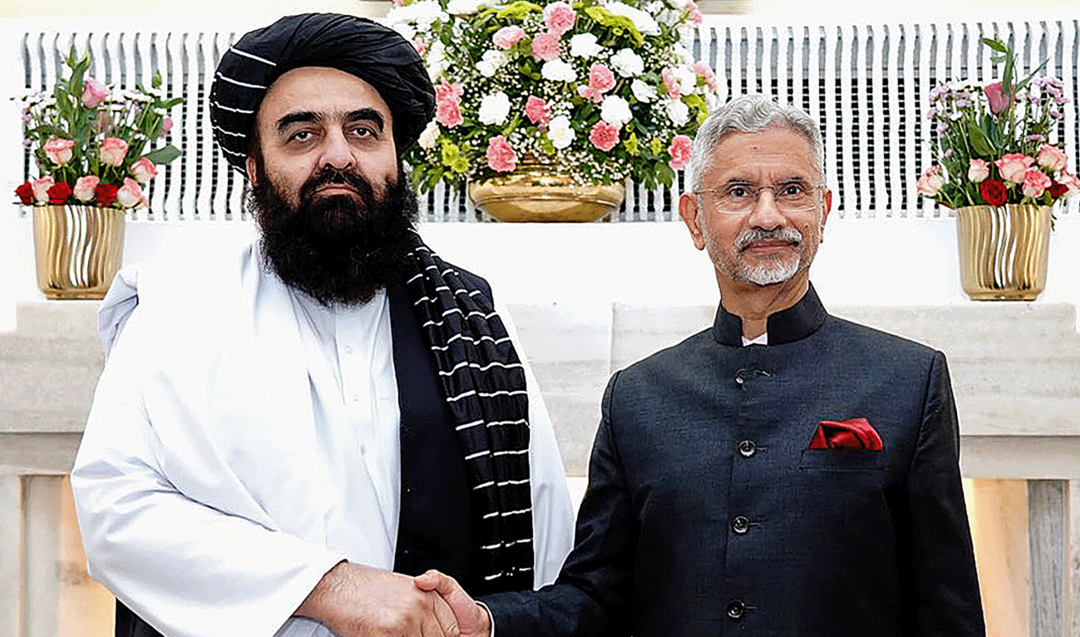
The rebuke came amid heightened strains between the two neighbours, fueled by recent cross-border accusations, deadly attacks on Pakistani security forces and claims of airspace violations. It followed Muttaqi’s trip to India earlier this week, the first high-level engagement between New Delhi and the Taliban government since it seized power in 2021.
Speaking at a news conference in New Delhi on Friday, Muttaqi addressed a Thursday night explosion in Kabul, condemning the incident and placing the blame on Pakistan. “Whatever the problems are in each country should be solved by themselves,” he said. Muttaqi asserted that no terrorist organisations remained in Afghanistan. “If other countries achieve peace themselves as we did in Afghanistan, then there will be peace in the entire region,” he added. “Since the last eight months, there has not been even a small incident in Afghanistan. In four years, no one has been harmed from Afghanistan’s soil. So this is the best proof that we have presented.”
In a statement issued on Saturday, the Foreign Office said it had summoned Afghanistan’s ambassador to Pakistan and conveyed strong reservations through the additional foreign secretary for West Asia and Afghanistan. “Pakistan also strongly rejected the Afghan acting foreign minister’s assertion that terrorism is Pakistan’s internal problem,” the statement said. It emphasized that Pakistan had repeatedly shared evidence of terrorist groups operating from Afghan soil, including those it refers to as Fitna al-Khawarij — a term for militants from the banned Tehreek-i-Taliban Pakistan — and Fitna al-Hindustan, which highlights what Islamabad alleges is India’s role in supporting Balochistan-based groups involved in terrorism and destabilisation.
“It was emphasised that by deflecting the responsibility of controlling terrorism towards Pakistan cannot absolve the Interim Afghan Government of its obligations towards ensuring peace and stability in the region and beyond,” the Foreign Office said. The statement also outlined objections to a joint India-Afghanistan declaration issued during Muttaqi’s visit. “It was conveyed that the reference to Jammu and Kashmir as part of India is in clear violation of the relevant UN Security Council resolutions and the legal status of Jammu and Kashmir,” it said. “The joint statement is highly insensitive to the sacrifices and sentiments of the people of Indian Illegally Occupied Jammu and Kashmir in their just struggle for the right to self-determination.”
Pakistan highlighted its long history of hosting Afghan refugees, noting that it had “generously” sheltered nearly four million Afghans for over four decades “in the spirit of good neighbourliness and Islamic brotherhood.” With peace returning to Afghanistan, the Foreign Office said, it was time for unauthorised Afghan nationals in Pakistan to repatriate. “Like all other countries and in line with international norms and practices, Pakistan has the right to regulate the presence of foreign nationals residing inside its territory,” the statement said. “At the same time, along with the repatriation of Afghan nationals, Pakistan has also been generously issuing medical and study visas to address the medical and educational needs of Afghan nationals. In the spirit of Islamic brotherhood and good neighbourly relations, Pakistan will continue to extend humanitarian support to the people of Afghanistan.”
The Foreign Office reiterated Pakistan’s desire for “a peaceful, stable, regionally connected and prosperous Afghanistan,” pointing to measures it has taken to facilitate trade, economic ties and connectivity. But it stressed the government’s duty to protect its citizens, concluding that Pakistan “expects the interim Afghan government to play its due role in supporting Pakistan to achieve this noble objective by taking concrete measures to prevent its territory from being used” by terrorist elements against Pakistan.
The tensions have been exacerbated by ongoing issues, including militants using Afghan soil for attacks on Pakistan and frequent border clashes. Islamabad has long urged the Taliban authorities to curb such activities, but relations have deteriorated further in recent weeks amid a spate of incidents. Pakistan reported losses among its security forces in intelligence-based operations, while Afghanistan accused Islamabad of infringing on its sovereignty.
Copyright © 2021 Independent Pakistan | All rights reserved