By Staff Reporter
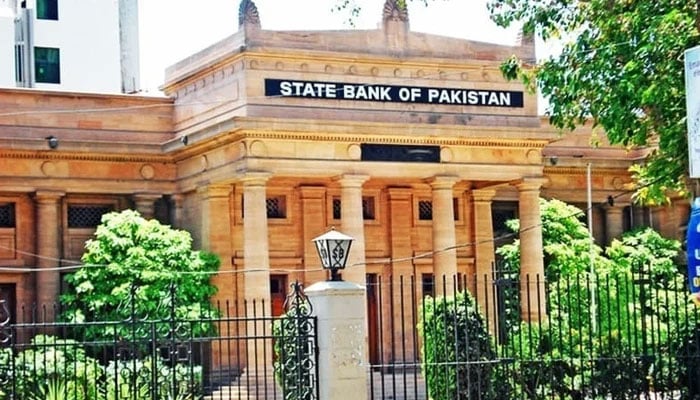
KARACHI: Pakistan’s central bank left its benchmark interest rate unchanged at 11% on Monday as policymakers assessed the impact of recent floods on food prices and the broader economy, extending a pause in monetary easing for a fourth straight meeting.
“The MPC decided to keep the policy rate unchanged at 11% in its meeting today,” the State Bank of Pakistan said in a statement.
The decision aligns with market expectations, as all 10 analysts surveyed in a poll anticipated no change. The hold comes amid a surge in headline inflation to 5.6% in September from 3% in August, driven by flood-induced increases in food prices, an uptick in energy costs, and sticky core inflation at 7.3%.
Floods in August swamped Punjab’s farmland and industrial hubs, killing more than 1,000 people, displacing 2.5 million and damaging crops and factories. Since October 11, border closures with Afghanistan following clashes have disrupted trade and deepened food shortages, intensifying inflationary pressures on staples like tomatoes and apples.
The central bank has lowered rates by 1,100 basis points since June 2024, when they peaked at 22% after inflation neared 40% the year before. Its last 100-basis-point cut came in May, followed by holds in June, July and September amid uncertainty over energy and food prices.
The MPC noted that headline inflation rose significantly to 5.6% in September, whereas core inflation remained unchanged at 7.3%. “The MPC assessed that the impact of the recent floods on the broader economy appears to be somewhat lower than anticipated at the time of its previous meeting. The crop losses are likely to be contained, whereas supply disruptions turned out to be minimal,” the statement said. “Moreover, economic activity gained further momentum, as depicted by robust growth in high-frequency economic indicators. Based on these developments, the overall macroeconomic outlook has improved from the previous assessment.”
The committee noted some key developments since its last meeting. “First, real GDP growth in FY25 was revised by PBS to 3% from the previous estimate of 2.7%,” the statement said. “Second, initial estimates of major Kharif crops by the Federal Committee on Agriculture remained close to last year’s production, despite the recent floods…Third, despite the repayment of a $500 million Eurobond, SBP’s FX reserves continued to increase. Fourth, Pakistan reached a staff-level agreement with the IMF on the EFF and the RSF reviews. Fifth, inflation expectations of both consumers and businesses eased in the latest SBP-IBA sentiment surveys. Lastly, global commodity price movements depicted mixed trends, with oil prices displaying heightened volatility.”
The MPC was of the view that the real policy rate remains adequately positive to stabilise inflation within the target range of 5–7% over the medium term. On the inflation outlook, the MPC highlighted that the headline inflation rose significantly to 5.6% in September from 3% in August. “This largely reflected the expected flood-induced increase in food prices; an uptick in energy prices, and sticky core inflation,” the statement said. “The MPC observed that, unlike previous flood episodes, the recent surge in food prices appears to be milder than anticipated earlier. This is reflected by the recent slowdown in price increases of major food items in high-frequency SPI data, such as wheat and allied products, sugar, and perishable items. Nonetheless, the committee expects inflation to exceed the upper bound of the target range for a few months in H2-FY26, before reverting to the target range in FY27.”
At its previous meeting on September 15, 2025, the MPC decided to keep the policy rate unchanged at 11%, citing the adverse impact of recent floods on the near-term macroeconomic outlook. In that meeting, the committee noted that inflation remained relatively moderate in both July and August, whereas core inflation continued to decline at a slower pace. Since the last MPC meeting, several key economic developments have occurred. The rupee has appreciated by 0.2%, while petrol prices have declined by 0.6%. Internationally, oil prices have reduced by nearly 2% since the last MPC, hovering around $62 per barrel.
In addition, Pakistan’s current account posted a significant surplus of $110 million in September, a sharp contrast against $52 million deficit recorded in the same month last fiscal. Foreign exchange reserves held by the central bank rose by $14 million on a weekly basis, reaching $14.45 billion as of October 17, 2025. Total liquid foreign reserves stood at $19.85 billion, while net foreign reserves held by commercial banks were recorded at $5.40 billion.
Analysts say the next cut was likely in the last quarter of FY26, starting July 2026 as the central bank has room to stay on hold as real interest rates remain comfortably positive after inflation eased earlier this year. “While receding flood risks and lower global oil prices have improved the near-term inflation outlook, last year’s low base is expected to push monthly readings higher,” said Amreen Soorani of Al Meezan Investments. “Given the central bank’s preference to keep a real interest margin of around 300 basis points, there is little room for a rate cut.”
Copyright © 2021 Independent Pakistan | All rights reserved