By Staff Reporter
ISLAMABAD: Negotiations between Pakistan and Afghanistan aimed at curbing cross-border terrorism have broken down without agreement, plunging the fragile dialogue into an indefinite hiatus, Pakistan’s defence minister said on Friday, even as a tenuous ceasefire along their shared border holds for now.
“Right now, as we speak, negotiations are over,” Defense Minister Khawaja Asif said in an interview on a private television channel. The minister said the talks had “entered an indefinite phase” after negotiators failed to bridge deep differences.
The impasse came during the third round of talks, which began on Thursday in Istanbul and were intended to last two days. Officials confirmed that the discussions stalled without resolution. “The talks in Istanbul are deadlocked,” a senior security source told reporters.
Asif said the Afghan Taliban delegation arrived “without any programme” and refused to commit to a written agreement. “They said that they would only respect the verbal agreement, but there is no room to do that,” he said.
In earlier rounds, the sides had pushed for additional meetings, Asif noted. “Even after the talks in Istanbul failed, they committed that they would participate in the next round.” The defence minister expressed frustration over the outcome. “Our returning empty-handed reinforces a lack of faith in Afghanistan,” he said. “The situation, God forbid if it flares up, if there are attacks on us from their soil, then we will respond depending on the gravity of the situation.”
He emphasised that the ceasefire remained in place but warned of consequences for any breach. “The moment there is a ceasefire violation from their side, we will respond befittingly.” Pakistan’s core demand throughout the process has been straightforward: an end to attacks launched from Afghan territory. “If they have put forward any unacceptable demand, then it is a means of escape, since they knew they would be unsuccessful, they can turn around and say that Pakistan denied our demands,” the minister added.
The Pakistani delegation was led by Lt. Gen. Asim Malik, director general of the Inter-Services Intelligence agency, and included senior military, intelligence and Foreign Office officials. The Afghan side was headed by Abdul Haq Waseq, chief of the General Directorate of Intelligence, and featured Suhail Shaheen, Anas Haqqani and Deputy Interior Minister Rehmatullah Najib.
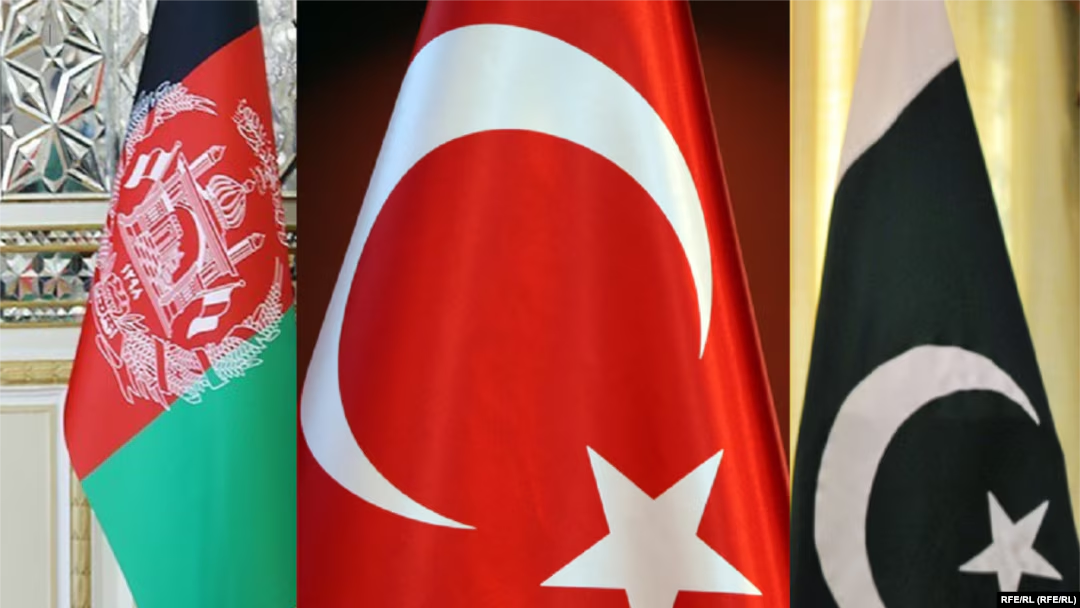
Turkey and Qatar mediated the process, with the first round in Doha yielding a fragile ceasefire. The second round, also in Doha, produced only a general agreement to create a compliance verification mechanism and a pledge to continue talks. The Istanbul session was meant to finalise the details of that monitoring system.
There was no direct meeting between the delegations on Friday; they had convened face to face the previous day with Qatari and Turkish mediators present. While Director General Malik and some Pakistani officials left Istanbul, others remained, and the Pakistani side has not entirely ruled out resuming the process.
Officials said efforts would be made to resolve the deadlock, with some senior officials staying behind to coordinate with mediators. For much of Friday, mediators met separately with the Afghan delegation, conveying Pakistan’s positions.
The talks followed weeks of shuttle diplomacy after deadly border skirmishes last month, which drove relations between the neighbors to their lowest ebb since the Taliban took control in Kabul in 2021. Hostilities erupted on the night of October 11 with an attack on Pakistan from Afghanistan, following Taliban accusations of Pakistani airstrikes into Afghan territory — claims that Islamabad has neither confirmed nor denied. Pakistan has repeatedly urged the Taliban to prevent terrorist groups from operating on Afghan soil, an allegation the Taliban rejects.
In response to the initial clash, further skirmishes occurred along the border. Pakistan conducted strikes targeting camps of the Gul Bahadur group in Afghanistan. A ceasefire was agreed upon on the evening of October 15
Amid the diplomatic strain, arrests and detentions of Afghan nationals in Pakistan jumped 146 percent in a single week, according to a joint report by the United Nations Refugee Agency and the International Organisation for Migration. The increase was tied to the reopening of border crossings. A total of 7,764 Afghan nationals were arrested and detained in the week ending November 1, up sharply from the prior week. Of those, Afghan Citizen Card holders and undocumented Afghans made up 77 percent, with Proof of Registration card holders accounting for the remaining 23 percent.
The report highlighted that 86 percent of the arrests occurred in Balochistan. From January 1 to November 1, 2025, the top districts for arrests were Chaghi, Attock and Quetta. Returns and deportations also spiked: returns rose 101 percent and deportations 131 percent compared to the week of October 19-25. Figures increased from 18,630 returns (including 3,341 deportations) to 37,448 returns (including 7,733 deportations) in the week ending November 1.
“This notable increase is primarily attributed to the reopening of the Chaman border, with Torkham also reopening on Nov 1,” the report stated.From September 15, 2023, to November 1, 2025, a total of 1,667,713 individuals have returned to Afghanistan.
For returns from October 26 to November 1, Proof of Registration holders comprised 47 percent, undocumented individuals 44 percent and Afghan Citizen Card holders 8 percent. Deportees in that period were 93 percent undocumented.
The report found that fear of arrest drove 93 percent of returns among undocumented individuals and Afghan Citizen Card holders, and 39 percent among Proof of Registration holders, since April 1, 2023.The surge follows government directives this year affecting Afghan nationals. In July, authorities ordered the repatriation of Proof of Registration card holders after their validity expired on June 30, setting a September 1 deadline for departure.
Pakistan continues to confront terrorism, suffering casualties among security forces in intelligence-based operations.
Copyright © 2021 Independent Pakistan | All rights reserved