By Staff Reporter
ISLAMABAD: The coalition government pressed forward Saturday with a controversial overhaul of the nation’s constitution, introducing legislation in the Senate to establish a specialised constitutional court, revamp judicial appointments and bolster military powers — moves that critics decried as an attempt to concentrate authority in the executive and armed forces while eroding provincial autonomy and judicial independence.
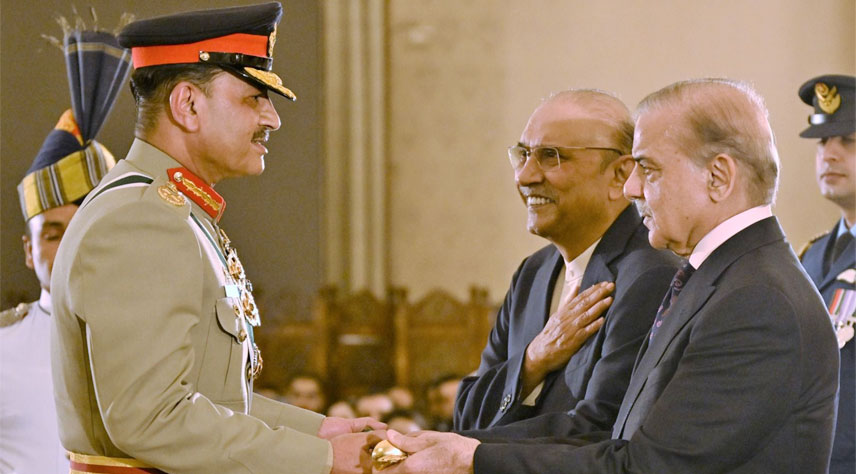
The measure, cleared by the federal cabinet earlier in the day, would create a Federal Constitutional Court to handle constitutional disputes, overhaul the selection and transfer of high court judges, expand provincial cabinets and restructure military leadership. Among the most notable shifts: eliminating the chairman of the Joint Chiefs of Staff Committee after the current term, designating the army chief as chief of defence forces and amending Article 243 to phase out the Joint Chiefs chairmanship after Nov. 27, 2025. The bill would also codify lifetime honors, such as the field marshal title, for figures including Army Chief Gen. Asim Munir.
In a joint meeting of the parliamentary standing committees on law and justice, chaired by Pakistan Peoples Party Sen. Farooq H. Naek, lawmakers approved roughly 80 percent of the proposed 27th Constitutional Amendment Bill, including key judicial reforms. Debate on the field marshal provision under Article 243 was deferred to Sunday. The session proceeded despite a boycott by two members of the right-wing Jamiat Ulema-i-Islam-Fazl (JUI-F) party, Sen. Kamran Murtaza and lawmaker Aliya Kamran, who protested the revival of clauses excised from the prior 26th Amendment. The JUI-F members walked out, denouncing it as a “breach of trust.”
Law Minister Azam Nazeer Tarar, who introduced the bill, defended the process as inclusive and deliberate. “We even asked the opposition to be a part of the session,” he said. He portrayed the amendment as the culmination of discussions spanning 10 to 15 years, including pledges from the 2006 Charter of Democracy and unfinished business from the 18th and 26th Amendments. Tarar argued that the constitutional benches set up under the previous reform — proposed by JUI-F leader Maulana Fazlur Rehman as a stopgap — had burdened judges with split duties, delaying ordinary cases. “The fact of the matter is that five to six percent of cases take 40 percent of the court’s time and the rest of the cases remain as is,” he said. The new court, he added, would draw judges from all provinces with expertise in constitutional matters, resolving complaints about a “court within a court” and speeding resolutions for litigants. “Till the time we do not reach a consensus, from all members of both Houses, the discussions will continue,” Tarar said.
In Senate debate, Sen. Ali Zafar of former prime minister Imran Khan’s Pakistan Tehreek-e-Insaf (PTI) party objected to the accelerated pace, citing the lack of an opposition leader and the eleventh-hour sharing of the draft. “We cannot debate something we have not read,” Zafar said, proposing the full chamber act as a committee for wider review. The PTI boycotted the committee meeting, branding the amendment a “conspiracy against the Constitution.” Zafar condemned the secretive haste: “These amendments strike at the very foundation of the constitutional structure by undermining the independence of the judiciary and eroding the delicate balance of powers that the 1973 Constitution so carefully created.”
Resistance extended outside parliament, with the Tehreek Tahafuz Ayeen-i-Pakistan alliance announcing nationwide protests beginning Sunday. Leaders Mahmood Khan Achakzai and Sen. Allama Raja Nasir Abbas urged citizens to oppose what they called “black and dangerous” alterations that further empower the elite. Abbas said democratic institutions in Pakistan have been “paralyzed” and called on the public to intervene. “In this hour, it is the responsibility of the people of Pakistan to take a stand and speak against such an extremely dark and extremely dangerous constitutional amendment, which is the 27th (amendment),” he said, accusing the government of granting “even more power to the powerful.”
Achakzai, the alliance chairman and opposition-designated leader, stressed that the protests would reflect the “will of the people” as the final authority. “I have given an oath, at least on five different occasions, that I will safeguard the Constitution. Our parliament is attacking our Constitution,” said the Pashtunkhwa Milli Awami Party leader. He noted that with parliament representing the populace, the alliance was appealing directly to citizens. “The way they are attacking the parliament, and the manner in which they are shaking the foundations of the Constitution and Pakistan, we are left with no other option.” Achakzai invited all parties to participate and said the campaign would launch Sunday night. “Every night, with a new slogan, we will awaken the consciousness of the people. The slogan of the people is the supremacy of the Constitution,” he added.
Local media reports amplified concerns from legal experts that the 27th Amendment’s initial draft could subordinate the Supreme Court, shifting its core functions to the proposed Federal Constitutional Court. A senior counsel, speaking anonymously to Dawn newspaper, said: “Left with a limited jurisdiction of deciding ordinary civil, criminal and statutory appeals, the Supreme Court has now become all the more a ‘Supreme District Court.’” He warned that the government might amend laws like the Elections Act 2017 to route appeals to the FCC instead, and described the revision to Article 175 as “virtually the end of the judiciary as we knew it,” contending the Supreme Court had been “amended out of the Constitution by making it irrelevant.”
Former additional attorney general Tariq Mehmood Khokhar highlighted two pivotal components: the new Chapter 1A, which he said enhances executive control over the superior judiciary via expanded judge-transfer powers and establishes an FCC by “empowering by disempowering the Supreme Court”; and the update to Article 243, which merges the chief of defense forces role with the army chief and guarantees the field marshal rank for life. Another anonymous lawyer noted that while the senior-most of the two chiefs would lead the Judicial Commission of Pakistan, “for all other purposes, the FCC will be in the commanding position.” He pointed out that oaths for FCC judges precede those for Supreme Court judges, indicating precedence. Under the amended Article 175A, the FCC chief justice is named first and serves until age 68, versus 65 for Supreme Court judges. “It is clear now which court is higher in terms of hierarchy,” he said.
Copyright © 2021 Independent Pakistan | All rights reserved