By Staff Reporter
ISLAMABAD: The government will present a bill for the 27th Constitutional Amendment in the Senate on Saturday, proposing the establishment of a federal constitutional court, new rules for judicial transfers, adjustments to provincial cabinet sizes and changes to military command structures, amid fierce criticism from opposition parties and lawyers who see the measures as a rollback of provincial powers granted in 2010.
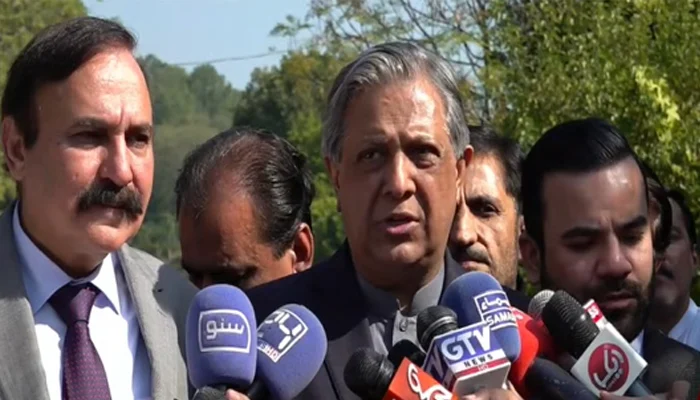
Law Minister Azam Nazeer Tarar announced the plan after a federal cabinet meeting on Saturday, which Prime Minister Shehbaz Sharif chaired by video link from Baku, Azerbaijan. The cabinet was briefed that the bill would be introduced in the upper house the same day.
“This bill will be presented in the Senate of Pakistan, and then it was desire to refer it to a joint committee was expressed so that members of the Senate and National Assembly law and justice committees … so that a satisfactory conversation can be held on the bill’s provisions,” Tarar told reporters in Islamabad.
The move follows days of consultations by Sharif with the government’s coalition allies, including meetings on Thursday with leaders from the Pakistan Muslim League-Quaid (PML-Q), the Istehkam-i-Pakistan Party (IPP), the Muttahida Qaumi Movement-Pakistan (MQM-P), the Balochistan Awami Party, the Awami National Party (ANP) and PML-Zia president Ijazul Haq.
Tarar emphasised that the proposals stemmed from broad agreement. “After all this detailed consultation, the points on which consensus has been reached concern the old promise in the Charter of Democracy regarding the formation of a constitutional court,” he said. “Now, the suggestion of a separate federal constitution court will be referred to Parliament in the form of a bill, and Parliament will decide on it after a debate.”
Among the key provisions, the bill addresses the transfer of judges, a topic that has sparked considerable debate. “It has been proposed in the bill that the transfer of judges be handled by the Judicial Commission of Pakistan … it has been added in the bill that the chief justices of both high courts from which a judge wishes to transfer to would be included in the consultations,” Tarar said.
The amendment also seeks to resolve disruptions in Senate elections, particularly in Khyber Pakhtunkhwa, where past court proceedings and provincial assembly decisions have affected the process. Noting that the Senate’s six-year terms cannot be dissolved like those of the National Assembly, Tarar highlighted the need for clarity on elections for the chamber’s chairman and deputy chairman every three years. “To solve this issue, there is a need to make appropriate amendments in that specific article to clarify that members of the Senate elected this time or who will be elected in the future — whose six-year term has somehow been wasted — they will be considered as being members so that elections can be held across the country at one time.”
Smaller provinces like Khyber Pakhtunkhwa and Balochistan have pushed for changes to bolster their governance structures. “So on their suggestion, it has been proposed to make it 13pc from 11pc,” Tarar said, referring to an increase in the provincial cabinet threshold to ensure departments are not left incomplete. He added that the limit on provincial advisers would rise from five to seven.
A significant portion of the bill focuses on Article 243, which states that the federal government “shall have control and command of the armed forces.” Tarar pointed to ongoing debates over strategic and defence matters in the region, invoking lessons from recent conflicts. “The recent Pak-india war has also taught us a lot of lessons, and we have found out that the contours of war have changed,” he said. “So regarding this, appointments and their processes, which were in the Army Act but could not be discussed at the time of the 1973 constitution, one of which is the role of the field marshal … it has been deemed necessary to discuss this.”
He elaborated that the bill proposes treating certain military awards as lifetime ceremonial titles for national heroes, while command structures would continue under existing laws. “And it has been suggested that the awards you give to national heroes, this is also a ceremonial title alongside being a rank, so it has been suggested that this should remain with them for lifetime,” Tarar said. “As far as their command is concerned, it will continue to be regulated as per the law, and the appropriate amendments on this will be presented before Parliament.”
The cabinet also directed that a pending MQM-P bill on Article 104A, introduced in the Senate earlier and supported by Tarar at the prime minister’s behest, be considered alongside the new amendment. “As that bill is already pending, the cabinet has also directed me today that when today’s bill is referred to the committee after being presented in the senate, the committee should also mull over [the one tabled by the MQM-P],” he said. The MQM-P has advocated for additions to strengthen and autonomous local governments nationwide.
Even as the draft of a proposed 27th Amendment to Constitution remains undisclosed, its potential ramifications are already rippling through the nation’s highest judicial institutions, prompting pointed exchanges in courtrooms and a rush of behind-the-scenes preparations for a new Federal Constitutional Court.
On Friday, the amendment faced sharp criticism in the Supreme Court, where a judge dismissed concerns over relocating judicial functions by declaring that a mere “change of building” would not diminish the court’s authority.
At the same time, administrative maneuvers at the Islamabad High Court suggested that groundwork was being laid for the Federal Constitutional Court, one of the key elements reportedly included in the legislative package.
These developments unfolded against a backdrop of uncertainty in the country’s judiciary, where the proposed changes have stirred debates over the balance of power among the courts. Officials described the shifts as part of broader administrative realignments, but they have fueled speculation about the amendment’s intent to reshape constitutional oversight.
At the Islamabad High Court, signs pointed to the possibility that the FCC could be established at the premises currently occupied by the Federal Shariat Court. Discussions were underway to relocate the Shariat Court to the third floor of the High Court building. The Shariat Court is operating with only three judges, including the chief justice, out of a sanctioned strength of eight. All its judges could be accommodated on a single floor of the High Court, officials said.
The process of vacating the third floor was already in motion, with equipment and office materials being moved to alternative locations. An office order issued by the High Court’s judicial department on Nov. 7 outlined internal reorganisations related to record management, reflecting the ongoing adjustments.
The tensions spilled into the Supreme Court during a hearing on Civil Service Rules before a constitutional bench. Justice Aminuddin Khan, who was presiding, asked senior counsel Faisal Siddiqui how much time he would need to wrap up his arguments.
Siddiqui responded that it might take some time, adding that he wished “the case should end today, since I have no intention of advancing arguments while standing inside the Shariat Court building.” He went on: “If the possession of the building has to be taken, then why the FSC only. Why the adjacent building (a reference to PM Secretariat) is not an option if at all a building is to be taken over?”
Justice Jamal Khan Mandokhail, smiling, noted that there had been some progress in the counsel’s favor the previous night. Siddiqui expressed a strong conviction that nothing adverse would befall the Supreme Court. “If this is the spirit, then why worry?” Justice Mandokhail replied. “We are bound to follow whatever Constitution dictates,” Justice Khan added.
Siddiqui continued, “How grand the judges look while sitting in the Supreme Court’s courtroom.” He added that everybody knows why the Federal Shariat Court was created. It was at this juncture that Justice Mandokhail asserted, “a change of building would not reduce any of the court’s powers.”
Copyright © 2021 Independent Pakistan | All rights reserved