By Staff Reporter
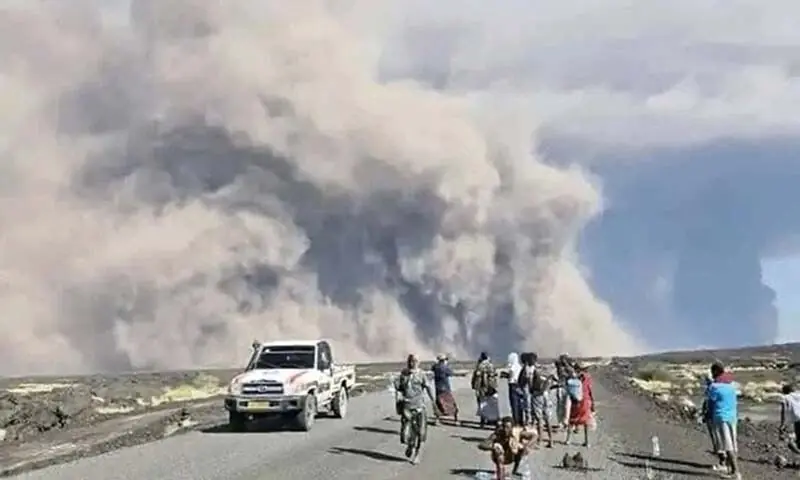
KARACHI: An eruption at the Hayli Gubbi volcano in northeastern Ethiopia, the first in nearly 12,000 years, has propelled a vast ash cloud across the region, with projections showing it drifting over Yemen and Oman before reaching southern Pakistan, according to the Toulouse Volcanic Ash Advisory Centre.
The volcano, situated in the Afar region about 800 kilometers northeast of this capital city and near the Eritrean border, erupted on Sunday for several hours. Thick plumes of smoke rose up to 14 kilometers into the sky, blanketing nearby villages and pushing toward the Arabian Sea. The mountain, which rises about 500 meters, lies within the Rift Valley, a geologically active zone where two tectonic plates converge.
In Pakistan, officials downplayed immediate threats to major population centers. Anjum Nazeer Zaighum, a spokesperson for the Met Office, said the ash cloud’s effects would not reach Karachi and would instead pass over the Arabian Sea. “The projections are from last night, and the impact would be felt in the deep Arabian Sea, in Oman, and within the Mumbai FIR (flight region),” Zaighum said. He added that the ash cloud would traverse the area at an altitude of 50,000 feet. He said the impact had been observed 60 nautical miles south of Gwadar on Monday. The office has issued a warning to relevant authorities, which remains in effect.
Local accounts from Ethiopia painted a scene of sudden chaos. A resident told The Addis Standard that the eruption took place eight kilometers from the main mountain. Afar TV described a “massive eruption” late in the morning, noting that the force and sound of the blast were stronger than any previous events recalled by residents .“We were extremely shocked by the sound and engulfed in fear,” one resident said. Phone interviews by the station indicated that the sound and its effects were felt as far away as Djibouti, Tigray and towns in the Wollo area. The explosion triggered tremors in surrounding areas and could be heard in Djibouti, The Standard reported. The ash cloud that followed plunged nearby settlements into “near-darkness.”
Citing the Dutch news agency BNO News, The Standard said the eruption began at 8:30 am UTC (1:30 pm Pakistan time) with explosions continuing through the afternoon. An advisory from the Toulouse Volcanic Ash Advisory Centre stated that ash rose to about 45,000 feet (13.7 kilometers) before the activity subsided. According to the latest update received by the Ethiopian outlet, the eruption had stopped.
The Smithsonian Institution’s Global Volcanism Program noted that Hayli Gubbi has had no known eruptions during the Holocene epoch, which began around 12,000 years ago at the end of the last Ice Age. Simon Carn, a volcanologist and professor at Michigan Technological University, confirmed on the social media platform Bluesky that Hayli Gubbi “has no record of Holocene eruptions.” An update from the flight tracking service FlightRadar at 3:31 a.m. on Monday showed the ash cloud’s projected path blowing toward the Arabian Peninsula and the Arabian Sea.
Pakistan lies directly in its trajectory, the service said in a post, adding that the cloud would arrive in approximately 18 hours. The event underscores the unpredictable nature of volcanic activity in the Rift Valley, a hotspot for tectonic shifts. While no immediate casualties were reported, the ash’s potential to disrupt air travel has prompted advisories across the affected regions.
Copyright © 2021 Independent Pakistan | All rights reserved