By Staff Reporter
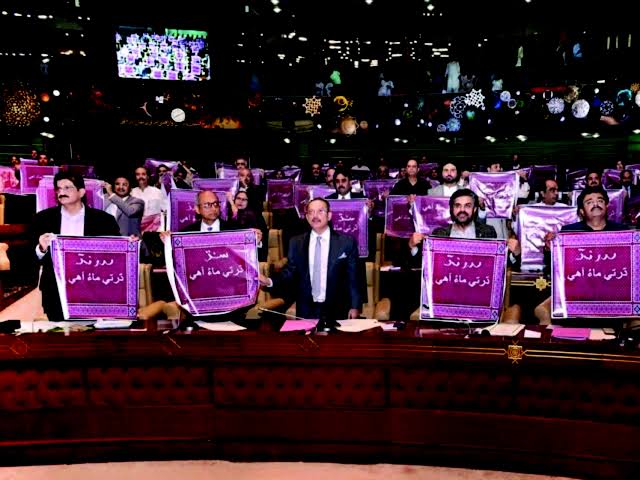
Strip away the pageantry — the banners reading “Sindh is the motherland,” the choreographed walkout, the resolution’s ritual invocation of a 1943 vote nobody in the chamber Thursday was alive to cast — and what’s left is a provincial legislature standing up to an army it cannot name as the thing it’s standing up to.
That is the plain fact Thursday’s vote in the Sindh Assembly was built to avoid saying directly, and it is worth saying directly here: the push to redraw Pakistan’s map did not originate with a political rival, an economist, or a reform commission.
It originated with the country’s military establishment, relayed to the public through Mohsin Naqvi, a federal interior minister who has never won a public election in his life, who was installed as Punjab’s caretaker chief minister in 2023, oversaw that province’s crackdown on supporters of jailed former prime minister Imran Khan, and was elevated to the federal cabinet the following year by a coalition of parties reportedly acting on the army chief’s wishes, and is described, without much dispute among people who watch Pakistani politics closely, as the civilian face of Army Chief Asim Munir.
When Naqvi told an economic summit in Islamabad in late July that Pakistan’s four-province system had “collapsed” and needed structural change, the question in Karachi was never really about governance theory. It was about whether Naqvi was speaking for himself, for the elected government he nominally serves, or for the man who actually runs Pakistan and its most powerful institution.
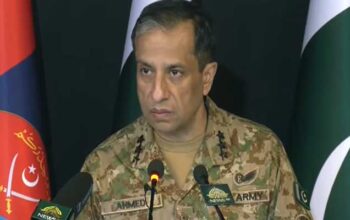
The one entity positioned to answer that question definitively — and asked to, directly — gave an answer carefully engineered not to answer it. The day after Naqvi’s remarks, Lt. Gen. Ahmed Sharif Chaudhry, the director general of the military’s press wing, held a news conference and was asked point-blank about the interior minister’s comments. He said Naqvi’s remarks were “his personal opinion” and that the military would not comment further. Then, without missing a step, he spent several minutes making a nearly identical case: that Pakistan’s population had roughly tripled since the last major administrative overhaul, that “if an administrative reset is needed for better governance, then it should be done,” and that good governance was “essential” to national security. He insisted, twice, that any such change must proceed through constitutional and legal means and reflect the will of the people — language indistinguishable from what any democrat would say, and language that, delivered by the spokesman for an institution that has directly ruled Pakistan for roughly half its history, commits the army to nothing while distancing it from nothing either. That performance — validate the premise, disown the messenger, insist on process while declining to say what happens if the process doesn’t produce the desired result — is not evidence of a threat in the way a leaked memo would be. It is something more familiar to anyone who has watched Pakistani civil-military relations for the past two decades: an institution that gets what it wants without ever being pinned to having asked for it.
Nawaz Sharif, a former prime minister and the most powerful figure in the ruling PML-N — quietly instructed his own party’s leaders to stay silent rather than criticize Naqvi’s proposal, for fear of appearing to break with the military at a moment of regaining a position in Punjab. When the country’s most experienced civilian politician tells his party to hold its tongue rather than risk the army’s displeasure, that is not a policy disagreement playing out in the open. It is what pressure from an unaccountable institution looks like when the institution never has to say the word “or else” out loud.
Sindh’s assembly, in other words, was not really arguing with an idea Thursday. It was building the strongest possible constitutional fence around a province, using the only tool available to an elected body when the actor it fears most has arranged things so that it can plausibly deny even being in the argument. Lawmakers spent four days on a case built from Article 239(4), which requires a two-thirds vote of a province’s own assembly before its borders can be redrawn, and from history reaching back to 1943, when Sindh’s legislature became the first in British India to endorse Pakistan’s creation. It is a serious legal argument. It is also, transparently, the argument of people who remember that the last time Pakistan’s provinces were redrawn without full consent — in 1955, when a civilian government under pressure from the same power centers folded Sindh, Punjab, Balochistan and the old North-West Frontier Province into a single administrative bloc called West Pakistan — the constitution and the courts did not save them. It took fifteen years, and a different general seizing power from the one who had imposed it, to undo that decision. The precedent Sindh’s assembly keeps citing is not really a legal precedent. It is a memory of exactly how little legal process mattered the last time this happened.
Why an administrative reset serves the army’s interests, whether or not it demanded this one
Start with what the ISPR spokesman’s careful non-answer left open: why would good governance, an aim virtually nobody in Pakistani politics disputes, require dismantling the province system rather than reforming what already exists?
The uncomfortable answer has less to do with service delivery than with power. The current military leadership spent recent years steadily expanding its footprint into the machinery of civilian government — a constitutional amendment passed in 2024 that extended service-chief tenures, growing influence over judicial appointments, and the sustained political containment of Imran Khan, the country’s most popular politician, who remains jailed. “What we’re witnessing now,” the historian Ayesha Jalal told the Christian Science Monitor recently, describing that same broader consolidation, “is a military, which has been strong, becoming even stronger.” Breaking Pakistan’s four provinces into a larger number of smaller administrative units would extend that same logic to the country’s party system. Big provinces produce big regional parties — the PPP in Sindh, PML-N in Punjab — with independent bases, patronage networks, and the standing to occasionally say no to Islamabad. A dozen smaller provinces produce a dozen smaller governments, each more fiscally and administratively dependent on the federal centre than any of the current four ever had to be. None of that requires the army to have ordered this specific proposal. It only requires the army, watching the proposal unfold, to recognise that it points in a direction the institution has been moving for years anyway—which is presumably why ISPR’s spokesman, given a direct chance to shut the idea down, chose instead to validate its premise while disclaiming its author.
That is also why Chief Minister Syed Murad Ali Shah’s central rebuttal on Thursday deserves more weight than the chamber gave it. Shah told the assembly that “population alone could not be used as a basis for creating new provinces” — a direct answer to the argument, echoed almost verbatim by both Naqvi and ISPR’s spokesman, that Pakistan’s population has nearly tripled since the current provincial map was last settled and that the system simply hasn’t kept pace. It’s true that Karachi’s demographics have shifted enormously: Sindhi speakers, once the city’s majority, are now a small fraction of its more than 20 million residents, displaced by decades of migration from Urdu-speaking Muhajir communities and, increasingly, Pashtun ones, the latter now estimated above a fifth of the population. A federal quota system dating to the 1970s still reserves most of Sindh’s civil service and university seats for rural applicants over urban ones, a policy PPP-aligned voices defend as protection against what they call the “colonization” of the province’s capital and which Muhajir leaders have called discriminatory for two generations — a grievance real enough that it helped produce the ethnic violence that killed hundreds of Karachi residents a year at its worst, in the 1980s and 1990s. But Shah’s point cuts deeper than a talking point: population growth is precisely the kind of argument that sounds neutral and technocratic while being trivially easy for an institution with its own separate interest in fragmentation to fold into a case that would otherwise stand entirely on its own merits. Whether the census numbers genuinely demand new provinces and whether an army looking to weaken regional parties would want new provinces anyway are two different questions with the same answer, which is exactly what makes the argument so difficult for Sindh’s assembly, or anyone else, to cleanly rebut.
A party that can’t say who it’s really answering
The awkwardness of the PPP’s position is that Thursday’s unanimous vote in Karachi was easy precisely because the fight the party actually needs to win is being fought somewhere else, by someone who cannot be voted down.
In the Sindh Assembly, where the party holds a two-thirds majority and has governed without interruption since 2008, opposing Naqvi’s proposal cost nothing. It let PPP officials — Information Minister Nasir Hussain Shah, Home Minister Zia-ul-Hassan Lanjar, Labour Minister Saeed Ghani, PPP Women’s Wing President Faryal Talpur — reinforce the party’s oldest and most durable political identity, defender of Sindh against a center that has historically been Punjab-dominated, now retooled slightly for an era in which the more immediate threat wears a different uniform. But that identity has always depended on the center being answerable to something — public opinion, parliamentary math, the next election. What makes this round of the debate different, and more dangerous for the PPP, is that the party the center is fighting isn’t really PML-N, or even MQM-P. It’s the military establishment, which does not face voters and cannot be shamed out of a position by a resolution, however unanimous.
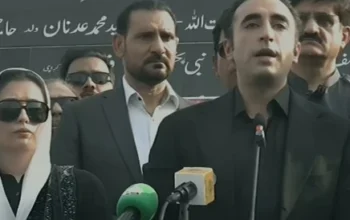
That leaves PPP Chairman Bilawal Bhutto Zardari performing an increasingly difficult balancing act in Islamabad. He has spent recent months insisting his party has never opposed new provinces in principle — citing its long support for a separate South Punjab and a Gilgit-Baltistan province — while making clear that no such consensus exists in Sindh and that none will be manufactured there. “I cannot even imagine conspiring against Punjab,” he recently told reporters, trying to frame the distinction as principled: provinces by consensus, nowhere else. It is a defensible position on its own terms. It is also precisely the kind of nuanced, case-by-case argument that gets flattened the moment the pressure behind it stops answering to any single province’s assembly at all — and Thursday’s own proceedings supplied a reminder of how thin the ruling coalition’s unity on this question really is. PML-N, the PPP’s federal governing partner, has stayed conspicuously silent on Naqvi’s proposal even as two of its own coalition allies openly endorsed it, and the ISPR press conference that followed Naqvi’s remarks did nothing to close that silence off, since it neither endorsed nor foreclosed the idea. Bilawal can distinguish between Sindh and South Punjab all he likes; nothing in the public record suggests anyone with real leverage over the outcome is bound to respect that distinction.
Compounding the problem, Bilawal chose this same month to freeze his party’s routine legislative cooperation with PML-N over an unrelated dispute involving elections in Azad Kashmir — a real, open rupture in a coalition both parties have otherwise preferred to manage quietly. The result is a party simultaneously picking a fight with its coalition partner in Islamabad and trying to hold a united front against the military in Karachi, using the one tool — provincial legislative resolutions — that has no actual power to bind an army chief who was never elected and does not answer to a resolution’s language about “democratic will.”
MQM-P’s argument deserves to be taken on its own terms — and it still doesn’t survive contact with who’s really pushing this
It would be a mistake to treat MQM-P’s position Thursday as simple opportunism, and the party’s own case is stronger than the PPP’s floor speeches gave it credit for. Ali Khurshidi, the opposition leader, argued before walking out that his party has never called for dividing Sindh — only for the kind of administrative decentralisation Pakistan’s 18th constitutional amendment promised in 2010 and never delivered, pushing real budgetary and administrative authority down to the local level rather than concentrating it in a provincial capital more than 150 miles from Karachi. “Everyone living in Sindh knows their performance is zero,” Khurshidi said, and on the specific complaint about governance, he is not simply throwing rhetoric: Karachi’s infrastructure is genuinely inadequate to a city of its size, a fact PPP’s own home minister implicitly conceded Thursday by using part of his floor speech to list new spending on the city’s traffic and safety systems rather than dispute the underlying critique.
But there are two problems with treating decentralisation and division as cleanly separable, and neither is trivial. The first is MQM-P’s own record: party figures floated a “Sindh One” and “Sindh Two” formulation in 2014 and a plan to split Karachi into separate urban and rural administrative zones in 2015 — history Sharjeel Memon, Sindh’s senior information minister, read into Thursday’s record specifically to argue that MQM-P’s current claim to want decentralization, not division, is a distinction that only became convenient once division started being proposed by someone else. The second, more serious problem is that in the current moment, the distinction may not matter as much as either party wants it to. Pakistan’s military has spent the past several years demonstrating a clear preference for a more centralized, less independently powerful set of civilian institutions — extending its own leadership’s tenure by constitutional amendment, expanding its reach into judicial appointments, sustaining the political isolation of Imran Khan — and its own spokesman, asked directly about this proposal, validated the underlying case for an “administrative reset” without ever ruling one out. Decentralization pursued at a province’s expense and outright division end up producing something close to the same practical result: less power concentrated in Karachi and Sindh’s provincial capital, more of it flowing toward Islamabad. MQM-P may be arguing in good faith for local empowerment. Whether that argument can be kept separate from a considerably less benign interest in fragmenting Sindh, once both are pushing in roughly the same direction, is a question Thursday’s debate never got to ask, because the party best positioned to press MQM-P on exactly that point had already walked out of the room.
What the vote actually settles
Very little, and that is the point worth sitting with. Article 239(4) already gave Sindh’s assembly an effective veto over its own division; Thursday’s unanimous vote didn’t create that protection, it just exercised it, for the seventh time since 1948, at intervals that have grown steadily shorter as the pressure behind each iteration of this argument has grown less deniable. A resolution — however forcefully worded, however many banners accompanied it — cannot bind an institution that was never elected and does not require the consent of a provincial legislature to act. What Thursday’s vote actually did was buy time and generate a public record: a formal statement, now headed to Pakistan’s president, prime minister, and both chambers of Parliament, that Sindh’s elected representatives, across party lines that rarely agree on anything else, will not consent to their province’s division.
Copyright © 2021 Independent Pakistan | All rights reserved