By Staff Reporter
ISLAMABAD: Pakistan’s military on Tuesday denied accusations from the Afghan Taliban that its forces had carried out overnight airstrikes in eastern Afghanistan, escalating a bitter dispute over cross-border terrorism that has strained relations between the two neighbors and derailed recent diplomatic efforts.
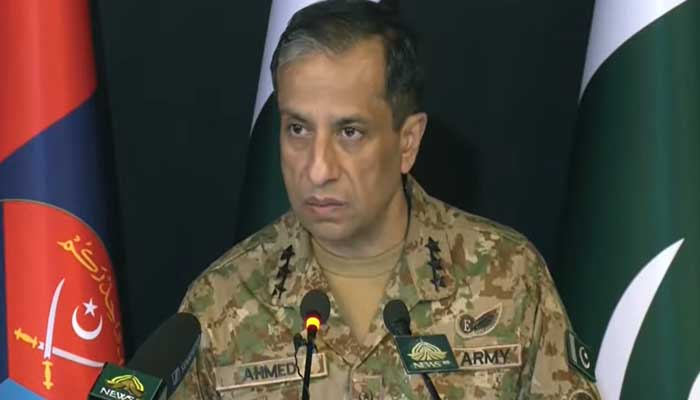
Lieutenant General Ahmed Sharif Chaudhry, the director general of the Inter-Services Public Relations, the military’s media arm, dismissed the claims during a briefing, asserting that Pakistan had not targeted civilians and that its operations were always conducted transparently. “Pakistan Army has not attacked civilians inside Afghanistan,” he said, according to state broadcaster Pakistan TV. “Whenever Pakistan attacks someone, it announces it.”
The denial came hours after Afghan officials accused Pakistan of launching drone and aircraft strikes in the provinces of Khost, Kunar and Paktika. Mustaghfir Gurbuz, a spokesman for the governor of Khost, claimed the attacks were carried out by drones and aircraft. Zabihullah Mujahid, the Taliban’s chief spokesman, condemned the alleged incursions in a statement, saying, “The Islamic Emirate strongly condemns this violation and reiterates that defending its airspace, territory, and people is its legitimate right, and it will respond appropriately at the right time.”
General Chaudhry emphasised Pakistan’s stance against terrorism while urging the Taliban government in Kabul to behave as a sovereign state rather than a militant group. “In our view, there are no good and bad Taliban,” he said, adding that there was “no distinction” between terrorists. “The Taliban government should make decisions as a state, not as non-state actors.”
He also questioned the longevity of the Taliban’s interim administration, asking, “How long will it remain interim?” Pakistan is “against terrorism, not the Afghan people,” the general said, clarifying that the country follows clear principles in its responses. “We are a state and respond only as a state.”
The exchange unfolded against a backdrop of mounting friction along the 2,500-kilometer porous border, where terrorism has emerged as the central flashpoint. Pakistan has repeatedly accused the Taliban of allowing the banned Tehreek-i-Taliban Pakistan (TTP), to use Afghan soil as a base for attacks inside Pakistan. Kabul has denied the allegations, even as a United Nations Security Council report by the Analytical Support and Sanctions Monitoring Team detailed a nexus between the Taliban and the TTP, including logistical, operational and financial support.
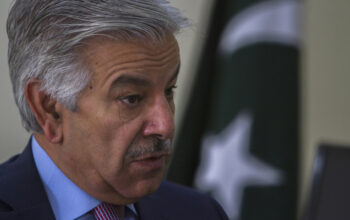
Tensions boiled over in October with border clashes, prompting a series of talks mediated by Turkey and Qatar. The dialogue began in Istanbul on Oct. 25 but quickly faltered. Information Minister Attaullah Tarar announced that the talks “failed to bring about any workable solution.” A joint statement from Ankara on Oct. 31 indicated that “further modalities of the implementation will be discussed and decided” in a subsequent meeting. By Nov. 7, after a third round, Defence Minister Khawaja Asif declared the negotiations “over” and “entered an indefinite phase” due to unbridgeable differences.
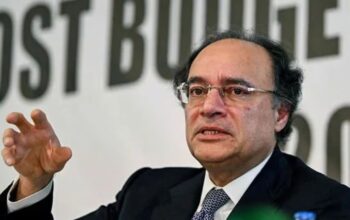
In retaliation, the Afghan Taliban suspended trade ties with Islamabad, which had already closed its border crossings following the clashes. Pakistan’s Foreign Office last week tied the resumption of trade to the Taliban ending cross-border terrorism and linked the future of regional energy projects to Kabul halting support for militant groups. Turkey announced plans for a high-level delegation to visit Pakistan to address the impasse, and Islamabad welcomed the “sincere efforts” of Ankara and Doha on Nov. 14, though the visit has yet to occur amid reported complications.
The denials from General Chaudhry followed a suicide attack on Monday at the headquarters of the Federal Constabulary in Peshawar that killed three officers and wounded 11 others.
In the same briefing, General Chaudhry addressed the ongoing court-martial of Lt. Gen. Faiz Hameed, the retired former chief of the Inter-Services Intelligence agency, urging restraint in public discussion. “The trial is a legal matter; there should be no speculation about it,” he said. “There will be an immediate announcement when the matter reaches its final conclusion.”
General Hameed, who has been in military custody since August 2024, faces charges of violating the Army Act, engaging in political activities, breaching anti-espionage laws and abusing his authority. The proceedings, announced on Aug. 12, 2024, stem from complaints by Moeez Ahmed Khan, the owner of Islamabad’s Top City housing society, who alleged that a May 12, 2017, raid by Pakistan Rangers and ISI officials resulted in the seizure of valuables, including gold, diamonds and cash, under the guise of a counter-terrorism operation.
The case gained traction after a Supreme Court ruling in November 2023 directed Khan to pursue his grievances through the Ministry of Defence. The army indicted General Hameed in December 2024 on three counts, marking one of the most high-profile court-martials in Pakistan’s military history. He is the second three-star general and the first former ISI chief to face such proceedings. Under military law, the indictment followed a court of inquiry and summary of evidence. General Hameed, who also served as Peshawar corps commander and rose to prominence during the 2017 Faizabad sit-in while heading the ISI’s counterintelligence wing, will be permitted legal representation. Three other retired officers were taken into custody in connection with the housing scheme case.
“General Faiz Hamid’s trial is a legal matter, and no conjecture should be made,” General Chaudhry reiterated, stressing that the process must run its course.
Copyright © 2021 Independent Pakistan | All rights reserved