By Staff Reporter
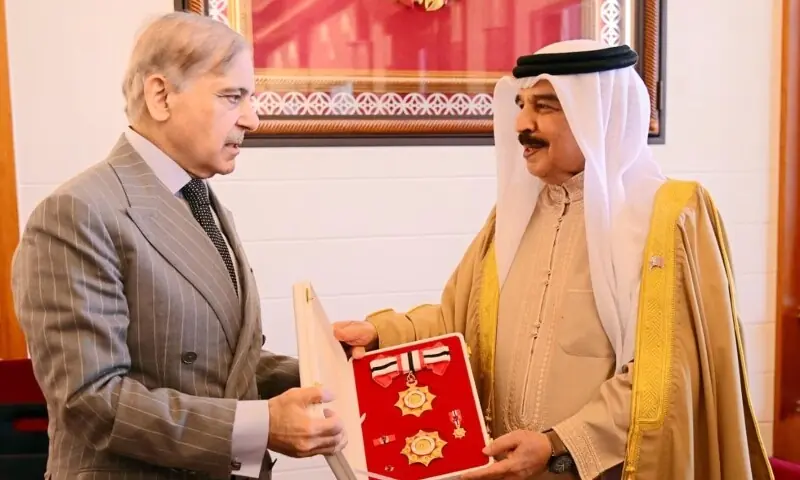
ISLAMABAD: Prime Minister Shehbaz Sharif was awarded Bahrain’s highest civilian honor on Wednesday during a state visit aimed at bolstering economic ties between the two nations, as leaders from both sides pledged to elevate bilateral trade to $1 billion within three years amid discussions on defence cooperation and regional stability.
The visit, which runs from Tuesday to Wednesday, underscores the deepening partnership between Pakistan and Bahrain, longtime allies with shared interests in labour, remittances and security. Sharif, accompanied by a high-level delegation, held talks with Bahrain’s King Hamad bin Isa Al Khalifa and Crown Prince Salman bin Hamad Al Khalifa, focusing on expanding collaboration in fields ranging from food security and information technology to counterterrorism and digital governance.
In a ceremony at the royal palace, King Hamad conferred the Order of Bahrain (First Class) upon Sharif, describing it as the kingdom’s top accolade for heads of state and government. The monarch highlighted the historic bonds between the countries, noting that Bahrain “had the privilege of being represented at a legal forum by none other than Quaid-e-Azam Muhammad Ali Jinnah,” Pakistan’s founder, who served as Bahrain’s lawyer for an extended period.
The Prime Minister’s Office in Islamabad said the two leaders reviewed the “encouraging momentum” in their relations and agreed to enhance cooperation across political, economic, defence and cultural domains. Sharif expressed gratitude for Bahrain’s support, including the establishment of the King Hamad University for Nursing and Allied Medical Sciences in Islamabad and the pardon of Pakistani prisoners.
Earlier in the day, Sharif met separately with Crown Prince Salman, who also serves as Bahrain’s prime minister, at Al Qudaibiya Palace in Manama. There, the Pakistani leader proposed ambitious targets for economic growth, emphasising the potential to raise bilateral trade from over $550 million to $1 billion within three years. That goal, according to a statement from Sharif’s office, would be supported by the Pakistan-Gulf Cooperation Council Free Trade Agreement, now at an advanced stage of finalization, and recently eased visa requirements.
“Economic cooperation was a key focus,” the statement said, adding that Sharif invited Bahraini investors to explore opportunities in food security, IT, construction, mines and minerals, health care, renewable energy and tourism.
He also suggested strengthening port-to-port connectivity between Karachi or Gwadar in Pakistan and Bahrain’s Khalifa Bin Salman Port to facilitate cargo movement and integration with Gulf maritime networks. The discussions extended to education and workforce development, with Sharif welcoming further collaboration in higher education, technical training and digital governance, building on the King Hamad University initiative. He thanked Bahrain for facilitating the release and repatriation of Pakistani nationals and acknowledged the kingdom’s support for the more than 150,000 Pakistanis living there, reaffirming Islamabad’s readiness to provide additional skilled manpower.
Defense and security were prominent on the agenda, with both sides agreeing to expand collaboration in training, cybersecurity, defence production and information sharing. This builds on recent agreements: Last month, during the inaugural meeting of the Pakistan-Bahrain Parliamentary Friendship Group, the countries committed to forming a joint working group on counter-narcotics, counterterrorism, coast guard operations, border security, immigration and police training. They also planned memorandums of understanding on extradition, mutual legal assistance and specialised battalion training.
In September, interior ministers from both nations had similarly pledged enhanced cooperation in counterterrorism, anti-narcotics and immigration. The leaders also addressed the humanitarian crisis in Gaza, agreeing that the establishment of “peace and stability was long overdue for the people of Gaza who have suffered for decades.”
Sharif’s office described the crown prince meeting as concluding “with confidence that the discussions will translate into tangible outcomes and further elevate Pakistan–Bahrain relations across strategic, economic, security and people-to-people domains.” The prime minister also congratulated Bahrain on securing a nonpermanent seat on the United Nations Security Council for the 2026-2027 term and expressed Pakistan’s willingness for close coordination during that period.
Pakistan and Bahrain established diplomatic relations in 1971, and their ties have grown through close economic, labour and defense cooperation. Bahrain hosts over 120,000 Pakistanis, a vital source of remittances for Pakistan. Economic engagement has picked up pace this year, highlighted by the Pakistan-Bahrain Investment Summit, where companies signed contracts worth $13 million. State media in Pakistan described the visit as reflecting “the longstanding cordial relations between the Kingdom of Bahrain and Pakistan, with the aim of promoting a results-oriented and strategic partnership between the two countries.” It added that the engagements would “strengthen traditionally warm and cordial relations, chart new avenues of partnership, and deepen people-to-people connections, which will contribute to mutually beneficial cooperation.”
Copyright © 2021 Independent Pakistan | All rights reserved