By Staff Reporter
ISLAMABAD: Finance minister on Monday defended a long-awaited International Monetary Fund report on governance and corruption as a vital tool for institutional overhaul, dismissing opposition claims of deliberate delays and pledging to implement its recommendations amid broader efforts to digitise the economy and confront climate change.
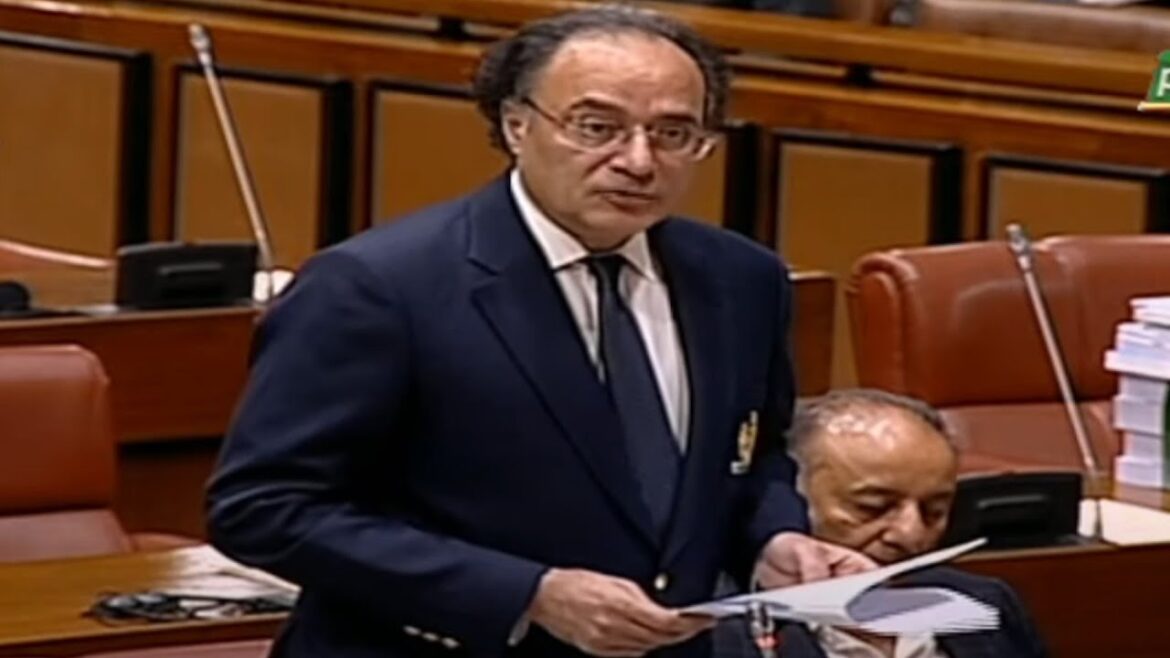
The report, Governance and Corruption Diagnostic Assessment, was initiated by the government itself, Finance Minister Muhammad Aurangzeb told the Senate, framing it as a proactive step rather than an imposition. Winding up a debate on a motion introduced by Kamran Murtaza of the Jamiat Ulema-e-Islam-Fazl party, Aurangzeb described the document as covering seven key areas, including judicial oversight and corruption, while pinpointing structural deficiencies that he called a “positive development.”
“It provided 15 recommendations for institutional reforms,” he said, assuring lawmakers that progress was already underway. He cited a recent law passed by Parliament that requires public servants to declare their assets as an early example of the government’s response.
Aurangzeb emphasised transparency in the process, vowing to make the government’s action plan public. “We will share our action plan on institutional reforms with the public and parliament,” he said, noting that similar diagnostic reports have been issued for numerous other countries and serve as benchmarks for best practices in governance assessment.
Opposition members had raised alarms over the report’s delayed release, attributing it to potentially embarrassing findings on corruption. But the finance minister pushed back, explaining that the timeline reflected the need for thorough input from various institutions. He rejected outright the notion that the government had stalled or suppressed the document. “The process took time because input had to be gathered from relevant institutions,” Aurangzeb said. “I come from the private sector. When a report is issued, it is circulated among departments, feedback is taken, some points are incorporated, others are rejected.”
He detailed the exhaustive preparation, revealing that around 100 meetings were convened and more than 30 institutions participated in compiling the report. Aurangzeb also sought to clarify its scope, insisting it bore no relation to a recent audit by the Auditor General of Pakistan or a separate report from the State Bank of Pakistan. Echoing concerns voiced in the debate about bolstering governance, enhancing professional expertise in technical ministries and reforming civil servant pay, the minister said these issues were under review by the Civil Service Reforms Committee, chaired by Planning and Development Minister Ahsan Iqbal. Aurangzeb, a committee member himself, endorsed the points as critical for improvement.
He further spotlighted the government’s push toward economic digitisation as a cornerstone for greater transparency and efficiency. “It was faster, cheaper and more transparent,” he said of the shift, urging the chairman of the Federal Board of Revenue to brief lawmakers on the measures being taken.
Murtaza, who had moved the motion, described the IMF report as an “important document” that spotlighted worries about Pakistan’s judicial system and governance framework. He proposed referring the matter to a Senate committee for deeper scrutiny.
In a separate engagement on Monday, Aurangzeb addressed an international delegation led by Jean Bouquot, president of the International Federation of Accountants, underscoring climate change as an “urgent economic reality” for Pakistan. He reaffirmed the government’s dedication to sustainable finance, including the rollout of a green taxonomy and frameworks for climate-aligned disclosures.
The minister stressed the importance of aiding small and medium enterprises in standardising their financial reporting. He also highlighted Pakistan’s forward-looking stance on digital assets and emerging technologies, with new institutional structures in the works to weave innovation into a “formal, transparent, and compliant economy. “The discussions come at a time when Pakistan grapples with economic pressures, including reliance on IMF support, while navigating environmental vulnerabilities exacerbated by floods and other climate impacts in recent years.
Copyright © 2021 Independent Pakistan | All rights reserved