By Staff Reporter
ISLAMABAD: The authorities are weighing a transfer of imprisoned former prime minister Imran Khan from Rawalpindi’s Adiala jail, possibly to an isolated facility in Balochistan, though not confirmed, as politicians traded sharp barbs on Wednesday over the fate of Khan and his Pakistan Tehreek-e-Insaf party, with a top government official declaring that confrontations had reached a “point of no return”.
The exchanges showed deepening rifts in the country’s fractious political landscape, where Khan’s PTI has clashed repeatedly with the ruling coalition and military establishment. Tensions spiked after a Dec. 6 press conference by the armed forces’ spokesperson, who lambasted Khan’s recent criticisms of military leaders. Lawmakers from various parties have since rallied in support of the military, including a resolution passed Tuesday by the Punjab Assembly that branded PTI “anti-state” and called for a ban on Khan and his party.
Coordinator to the Prime Minister on Information for Khyber Pakhtunkhwa Affairs Ikhtiar Wali Khan, addressing a press conference, assailed PTI for its actions and signaled an end to any leniency. “We have tolerated you with much grace and for the sake of democracy. However, things have now reached a point of no return, no mercy and no tolerance,” Wali said. “All doors to talks are now closed.” Wali confirmed the deliberations of Khan’s moving to other prison. “They want the prisoner shifted from Adiala, and the government is genuinely considering it.”
He accused supporters of the jailed Khan of undermining Pakistan’s sovereignty. “Anyone supporting the incarcerated PTI founder stood for the desecration of Pakistan’s sovereignty, honour, and development,” Wali added. While insisting the government did not want to brand anyone a traitor or outlaw a party, he posed a rhetorical question to the public: “Given the current state of affairs, I ask the people what [else] can be done.”
Wali also attacked Khyber Pakhtunkhwa Chief Minister Sohail Afridi, claiming a “nexus with drug smugglers” and alleging family members were involved in narcotics under his patronage. “His performance is not zero — it is minus.”
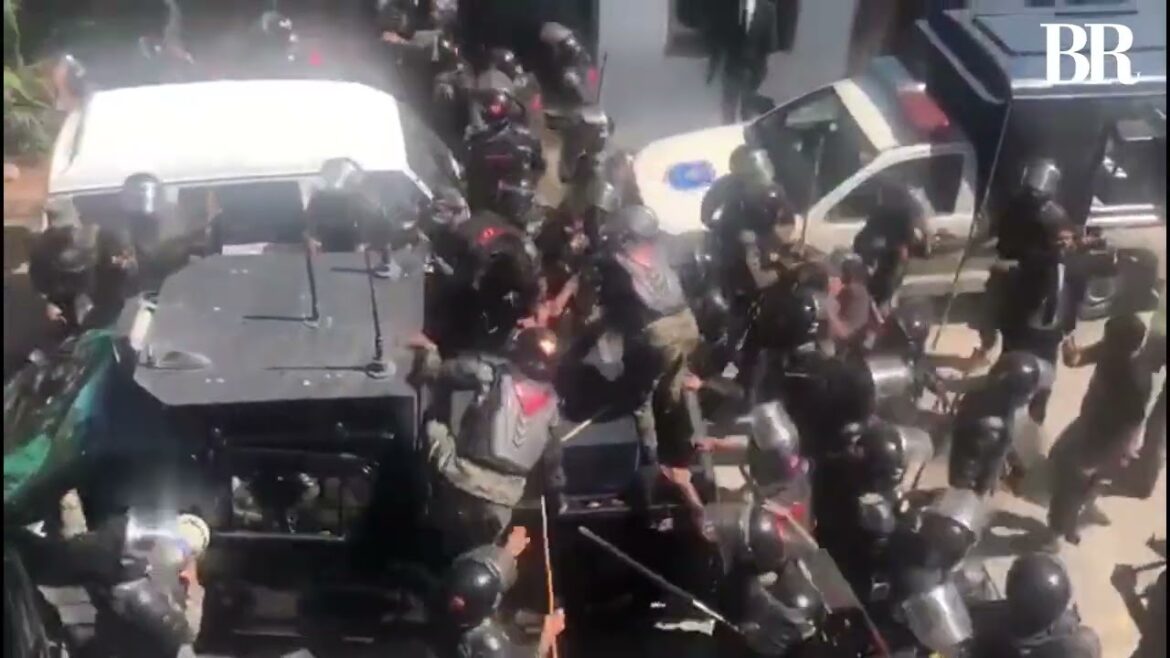
The remarks followed a Tuesday night sit-in outside Adiala jail by Khan’s sisters — Aleema Khan, Uzma Khan and Noreen Khan — demanding visitation rights. Police dispersed the protesters with water cannons after some hurled stones, leading to arrests of several PTI workers. The demonstration echoed earlier protests, including a 16-hour sit-in last month by Chief Minister Afridi and brief detentions of Khan’s sisters in a prior action.
Meetings with Khan have become a flashpoint, with the government imposing a blanket ban. The restriction followed a statement from Inter-Services Public Relations Director General Lt. Gen. Ahmed Sharif Chaudhry, who called Khan a “mentally ill person” and a national security threat. The last permitted visit was last week, when Uzma Khan met her brother.
Opposition figures from the Tehreek-i-Tahafuz Ayeen-i-Pakistan alliance, including PTI, pushed back in a press conference outside Parliament. “If you keep parents in jail, […] how can the children sit together with you? And if you don’t understand this, then probably the public will make you understand.” He stressed that force would backfire and claimed Khan enjoyed support from “at least 70 percent people in the country.” “Don’t enrage the people of Pakistan,” he said. “We haven’t done anything in violation of the Constitution.”
Gohar highlighted a high court order directing meetings with Khan be allowed, questioning the government’s motives. “If you create hurdles [in this regard], then we don’t know what your intentions are. But if you get a response from the other side, the country and democracy would suffer a loss.”
Earlier, he condemned the Punjab Assembly resolution for pitting “federating units against each other” and asked: “You are isolating a major political party. Does removing them from due process save democracy?”
Gohar condemned police tactics at the sit-in and issued a veiled threat. “This is not the corporate world where one can remove one or two people and let the other remain. If attempts are made to minus us, none of them will remain either.” He added that PTI entered Parliament to bolster democracy, “but some people do not want to see the situation improve.”
Pakhtunkhwa Milli Awami Party Chairman Mehmood Khan Achakzai echoed the call for access to Khan as a prerequisite for talks. “If anyone wants to hold a dialogue, permission must be given to meet PTI founder Imran Khan. How can we negotiate without his permission?” Referencing the Tuesday sit-in, he noted PTI parliamentary leader Shahid Khattak’s leg “had been broken” in the dispersal. “If the public rises, everything will burn down,” Achakzai warned. “Before destruction strikes, we should move towards dialogue.”
National Assembly Speaker Ayaz Sadiq lamented the impasse, saying he and Prime Minister Shehbaz Sharif had offered dialogue repeatedly. “If the opposition wants to advance talks, it is a welcome development,” he said. But he revealed opposition demands for direct talks with Chief of Army Staff Air Marshal Asim Munir. “The very forces that defeated India were targeted with offensive language.” Sadiq warned politics had reached a point “from where return may no longer be possible,” citing anti-judiciary and anti-army rhetoric in Parliament. “I moved four steps forward for dialogue, but now I have had to retreat 40 steps,” he said. “If Pakistan exists, politics exists, and everything else exists.”
Copyright © 2021 Independent Pakistan | All rights reserved