By Staff Reporter
ISLAMABAD: Pakistan has sealed a weapons deal worth more than $4 billion with the Libyan National Army, one of the largest arms sales in the country’s history, thrusting Islamabad into a select group of nations exporting conventional military hardware despite a longstanding United Nations embargo on Libya, Reuters reported.
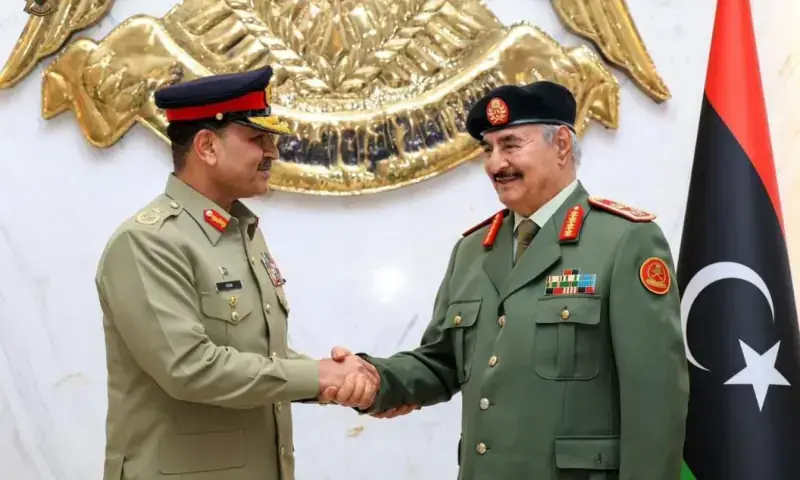
The agreement, finalised last week during a meeting in this eastern Libyan city between Pakistan’s chief of defence forces, Field Marshal Asim Munir, and Saddam Khalifa Haftar, the deputy commander-in-chief of the Libyan National Army, includes the sale of fighter jets, trainer aircraft and other equipment for land, sea and air forces, according to officials and documents reviewed by Reuters.
Military officials in Pakistan described the pact as “historic in terms of size and financial impact,” though the foreign ministry, defense ministry and military did not respond to requests for comment. A draft of the deal seen by Reuters outlined the purchase of several JF-17 fighter jets, a model jointly developed by Pakistan and China, along with a number of Super Mushak trainer aircraft used for basic pilot training.
A Pakistani official, speaking on condition of anonymity, confirmed that the transaction, valued at over $4 billion, would span two and a half years and encompass a broad array of military gear. The sale comes amid Libya’s persistent fragmentation, a legacy of the 2011 NATO-backed uprising that ousted Col. Muammar el-Qaddafi and plunged the oil-rich North African nation into chaos. The United Nations imposed an arms embargo that year, requiring Security Council approval for any transfers of weapons or related materiel.
Yet senior Pakistani military officials justified the move, pointing to widespread violations by major Western and Middle Eastern powers that have supplied arms to Libyan factions for years. They dismissed the restrictions as a “paper embargo” that is “non-existent due to multiple reasons,” arguing that the deal aligns with the prime minister and army chief’s push for “an export driven self sustained economy.”
The Libyan National Army, led by the powerful warlord Khalifa Haftar, controls vast swaths of eastern and southern Libya, including key oil fields, and rejects the authority of the internationally recognized Government of National Unity in Tripoli, headed by Prime Minister Abdulhamid Dbeibah, which holds sway over much of the west. Any arms agreement with the LNA is certain to draw international scrutiny, given the country’s enduring instability and the risk of escalating rivalries between the dueling administrations.
On Sunday, the LNA’s official media channel announced a defence cooperation pact with Pakistan, encompassing weapons sales, joint training and military manufacturing, though it offered no specifics. “We announce the launch of a new phase of strategic military cooperation with Pakistan,” Haftar said in remarks broadcast on Al-Hadath television. Authorities in Benghazi did not immediately respond to requests for comment.
For Pakistan, the deal represents a significant step in its efforts to broaden defence exports, leveraging decades of experience in counterinsurgency operations and a robust domestic industry that produces aircraft, armored vehicles, munitions and naval vessels. “Our recent war with India demonstrated our advanced capabilities to the world,” Field Marshal Munir said in remarks also broadcast by Al-Hadath on Sunday.
The transaction places Pakistan alongside other nations that have navigated or skirted the UN embargo, including Russia, the United Arab Emirates and Turkey, which have backed various sides in Libya’s conflicts.
Copyright © 2021 Independent Pakistan | All rights reserved