By Staff Reporter
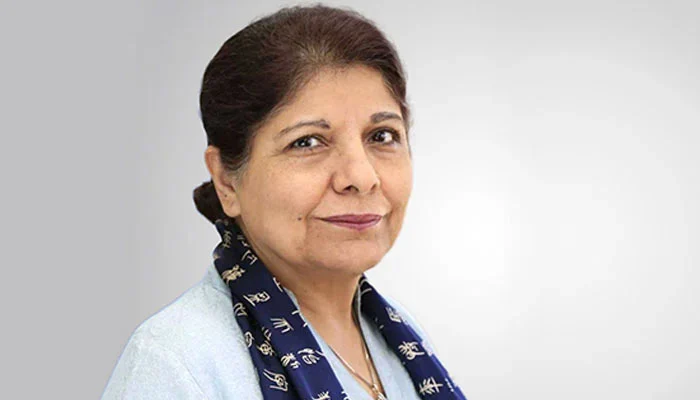
KARACHI: Dr. Shamshad Akhtar, a pioneering figure in global finance who shattered barriers as the first woman to lead Pakistan’s central bank and held top posts at the World Bank and the United Nations, died on Saturday of cardiac arrest. She was 71.
Her death was confirmed by the family, who said it came suddenly, as she had not been suffering from any serious illness. At the time, Dr. Akhtar was serving as chairperson of the Pakistan Stock Exchange, a role that capped a career spanning monetary policy, fiscal management and capital markets in her home country, alongside influential positions on the international stage.
Muhammad Azfar Ahsan, founder of the Corporate Pakistan Group and a former minister, shared news of her death after hearing from her sister abroad. “With deep sorrow, we share the sad news that our very own CPGian Dr. Shamshad Akhtar (Pakistan’s former Minister for Finance & Governor, State Bank of Pakistan) has passed away. Inna Lillahey Wa Inna Illaihey Rajeyoon. May Allah (SWT) grant her the highest place in Jannah and give strength and patience to her family, friends, and colleagues. Aameen,” Ahsan wrote in a post
Born in Hyderabad, Dr. Akhtar received her early education in Karachi and Islamabad. She graduated from the University of Punjab with a bachelor’s degree in economics in 1974, followed by a master’s in economics from Quaid-i-Azam University in Islamabad. She earned an MA in development economics from the University of Sussex in 1977 and a PhD in economics from Paisley College of Technology in Britain in 1980.
A Fulbright scholar, she was also a visiting fellow at Harvard University’s economics department in 1987. Her career began in the planning offices of Pakistan’s federal and Sindh provincial governments, but she soon moved to the World Bank, where she spent a decade as an economist at its resident mission in Pakistan. There, she analyszed monetary policy, the banking sector and financial market diversification, while advising on reforms to regulatory institutions like the Securities and Exchange Commission of Pakistan and the Insurance Commission. She worked closely with the private sector, including the country’s stock exchanges, and helped develop long-term funding mechanisms through bond markets.
In 1990, Dr. Akhtar joined the Asian Development Bank, rising steadily through the ranks. She became manager in 1998 after roles as senior and principal financial sector specialist, and from 1998 to 2001, she coordinated the APEC Finance Ministers Group while serving on internal committees overseeing reorganisation and oversight. By January 2004, she was director general of the bank’s Southeast Asia department, having earlier led its governance, finance and trade division for East and Central Asia. In these positions, she represented the institution at global forums like the Bank for International Settlements and the International Organization of Securities Commissions, building expertise in the financial affairs of Southeast Asia, Central Asian republics and China.
Dr. Akhtar’s tenure as governor of the State Bank of Pakistan, starting on Jan. 2, 2006, marked a historic milestone. She was the 14th governor since the bank’s founding in 1948 and the first woman in the role. Over three years, she drove financial sector reforms, bolstered economic governance and enhanced Pakistan’s international engagement. She chaired the central bank’s board and served as the country’s governor at the International Monetary Fund.
Her international stature grew further at the World Bank, where she became vice president for the Middle East and North Africa, leading the response to the Arab Spring uprisings. Later, as a United Nations under-secretary-general, she served as executive secretary of the Economic and Social Commission for Asia and the Pacific. She also acted as special senior advisor on economics and finance to the secretary-general, assistant secretary-general for economic development and the UN sherpa for the G20, coordinating the post-2015 development agenda.
Back in Pakistan, Dr. Akhtar twice stepped in as finance minister in caretaker governments — first ahead of the 2018 elections and again from 2023 to 2024 — managing key economic portfolios during political transitions. She conducted analytical work on subjects like insurance reform, capital markets and special economic zones. Her accolades reflected a lifetime of achievement. On March 23, 2024, she received the Nishan-e-Imtiaz, Pakistan’s highest civilian award, for her services in economics and public finance. She was named Asia’s best central bank governor by Emerging Markets and The Banker, and in 2008, The Wall Street Journal Asia listed her among the region’s top 10 professional women.
Presidents of Kazakhstan and Turkmenistan awarded her medals, and since 2019, she advised China’s Ministry of Foreign Affairs on the Belt and Road Initiative as one of 12 global advisors. She was a policy sherpa at the Boao Forum for Asia, later becoming a council advisor, and served on G20 task forces on infrastructure under Japanese, Saudi and Italian presidencies. She also advised UN secretary-general groups on food security and development financing, and was part of the UN Global Women Leaders Group and the Advisory Council of the Sustainable Finance Center at SOAS, University of London.
President Asif Ali Zardari expressed deep sorrow in a statement, paying tribute to her contributions to economic management and financial governance. He acknowledged her role in strengthening key state institutions and prayed for the elevation of her ranks, extending condolences to the bereaved family.
Finance Minister Muhammad Aurangzeb called her a “dignified, principled and thoughtful voice in the economic history of Pakistan.” In remarks issued by his ministry, he described Dr. Akhtar as “a high-level economist and a wonderful person” who served with utmost integrity and dedication in multiple high positions. “Shamshad Akhtar’s national services will always be remembered with respect,” he said.
Umar Saif, a former caretaker minister for information technology and telecommunications who worked alongside her in the cabinet, shared his grief on the social media platform X. “In the few months we served together in the cabinet, we formed a special bond,” he wrote. “She was loving, thoughtful, and deeply competent. We would jokingly call each other ‘my favourite minister’ whenever we met.” He termed her death a national loss, adding, “Pakistan is a poorer place today.”
Dr. Akhtar’s burial was scheduled for Sunday after Asr prayers at Sultan Mosque in the Defense Housing Authority neighborhood of Karachi. Her passing closes a chapter in Pakistan’s economic policymaking, defined by institutional reforms, global diplomacy and scholarly rigor.
Copyright © 2021 Independent Pakistan | All rights reserved