By Staff Reporter
ISLAMABAD: Pakistan and China called on Afghanistan on Monday to take more “visible and verifiable” actions to dismantle terrorist organisations operating from its soil, amid persistent tensions over cross-border militancy that has strained relations in the region.
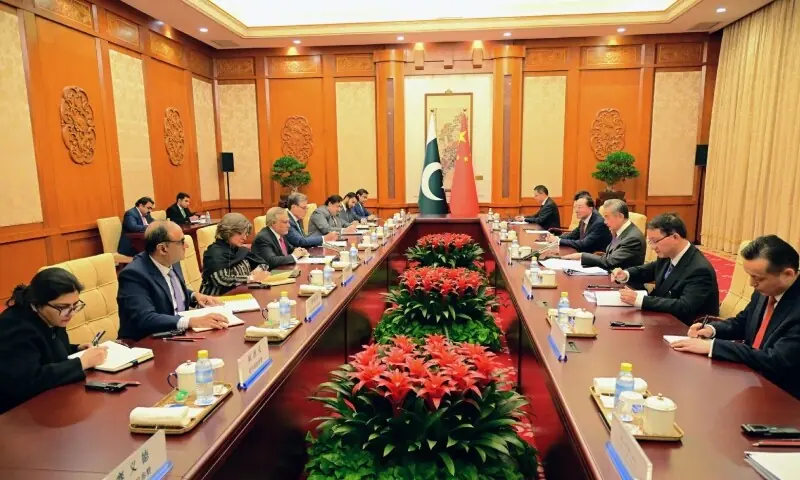
The appeal came in a joint communique issued after a high-level strategic dialogue in Beijing between Pakistan’s deputy prime minister, Ishaq Dar, and China’s foreign minister, Wang Yi. The meeting, the seventh round of such talks between the two allies, underscored their shared concerns about security threats emanating from Afghanistan, where Pakistani officials have long accused militant groups of finding safe haven.
“The two sides called for more visible and verifiable actions to dismantle and eliminate all terrorist organisations based in Afghanistan which continue to pose serious threats to regional and global security, and prevent terrorist organisations from using the Afghan territory for terrorism against any other country and to endanger any other country,” the statement said.
Ties between Pakistan and Afghanistan have been fraught since the Taliban returned to power in Kabul in 2021. Islamabad has repeatedly charged that groups like the Tehreek-e-Taliban Pakistan use Afghan territory to stage attacks inside Pakistan, allegations that Afghan authorities have denied. In the communique, the two countries agreed to maintain close coordination on Afghanistan and to work with the international community to press the Afghan government to establish an inclusive political framework, adopt moderate policies, prioritise development and foster good-neighborly relations.
They also committed to advancing the China-Afghanistan-Pakistan trilateral foreign ministers’ dialogue and the China-Bangladesh-Pakistan cooperation mechanism. China praised Pakistan’s efforts to combat terrorism and safeguard Chinese personnel, projects and institutions in the country, acknowledging “the significant contributions and huge sacrifices that Pakistan made in combating terrorism over the years.” “The two sides reiterated their commitment to combating terrorism in all its forms and manifestations with zero tolerance, and agreed to further deepen all-round cooperation on counter-terrorism and security, and make concerted efforts to ensure that the China-Pakistan Belt and Road cooperation advances in a secure and smooth manner,” the statement said, while calling on the international community to bolster counterterrorism efforts and rejecting “double standards” on the issue.
The dialogue, held on Jan. 4, covered a broad spectrum of bilateral ties, including strategic and political coordination, defence and security, economic collaboration, trade, investment, and cultural exchanges. The two nations, describing themselves as “all-weather strategic cooperative partners bound by ironclad friendship,” pledged to enhance strategic communication, deepen mutual trust and jointly protect their common interests to promote economic and social development.
Marking the 75th anniversary of diplomatic relations in 2026, they launched commemorative activities, viewing the milestone as an opportunity to consolidate friendship and explore new areas of cooperation. Pakistan congratulated China on the successful completion of its 14th Five-Year Plan and the forthcoming 15th under President Xi Jinping, praising its “people-centred development philosophy” and noting that the “Chinese path to modernisation provided a new option and practical solution for other developing countries to achieve independent development.” In return, China commended Pakistan’s leadership for achieving macroeconomic stability through its National Economic Transformation Plan (2024-2029), known as URAAN Pakistan, laying a foundation for growth and shared prosperity.
Pakistan reaffirmed its adherence to the one-China principle, declaring that Taiwan is an “inalienable part of China’s territory” and opposing any form of “Taiwan independence” or attempts to create “two Chinas” or “one China, one Taiwan.” It also expressed firm support for China on matters concerning Xinjiang, Xizang, Hong Kong and the South China Sea. China, for its part, reiterated its backing for Pakistan in safeguarding its sovereignty, independence and territorial integrity, and pledged support for Islamabad’s pursuit of a development path suited to its conditions, its fight against terrorism and its expanded role in international affairs.
A key focus was upgrading the China-Pakistan Economic Corridor, a flagship Belt and Road Initiative project, to “version 2.0.” The two sides agreed to align development strategies and prioritize sectors like industry, agriculture and mining. They committed to advancing the Gwadar Port in southwestern Pakistan, ensuring smooth operations along the Karakoram Highway and enhancing Pakistan’s sustainable development capacity. “The two sides will deepen cooperation in areas such as trade and investment, information technology, science and technology, cybersecurity, technical and vocational training and education, and people-to-people and cultural exchanges,” the communique said. They also agreed to leverage the year-round opening of the Khunjerab Pass to boost two-way trade and exchanges, and welcomed third-party participation in CPEC under agreed terms. Financial and banking ties were highlighted, with mutual support at multilateral forums and Pakistan expressing appreciation for China’s assistance to its fiscal sectors.
In space cooperation, the two expressed satisfaction with expanding collaboration, including the anticipated entry of Pakistani astronauts into the China Space Station for short-term missions. On regional matters, they emphasized upholding the United Nations Charter, international law and norms governing relations, opposing unilateral actions and the resurgence of fascism or militarism. They supported a postwar international order based on documents like the Cairo Declaration and Potsdam Proclamation.
Pakistan briefed China on developments in Indian-occupied Kashmir, with Beijing reiterating that the dispute should be resolved “properly and peacefully in accordance with the UN Charter, relevant UN Security Council resolutions and bilateral agreements.” The two also expressed readiness for trans-boundary water resources cooperation on principles of equality and mutual benefit, stressing fulfillment of international legal obligations—a nod to Pakistan’s longstanding grievances over water-sharing with India, which Islamabad has warned could escalate to conflict if violated.
Globally, they pledged to advance China’s Global Development Initiative, Global Security Initiative, Global Civilization Initiative and Global Governance Initiative, aiming for a more just and equitable world order. Pakistan commended China’s efforts to protect developing countries’ rights to sustainable development. Within forums like the United Nations and the Shanghai Cooperation Organization, they vowed to deepen coordination to defend shared interests and oppose hegemonism, bullying, “small circles” and bloc confrontations. China praised Pakistan’s performance during its U.N. Security Council presidency and offered full support for its role as rotating president of the SCO from 2026 to 2027.
On the Middle East, the communique demanded an “unconditional, comprehensive and permanent ceasefire in Gaza” and affirmed the Palestinian people’s right to self-determination through a two-state solution, including an independent Palestinian state. They voiced concern over the occupied West Bank and urged urgent action, while pledging to collaborate with the international community for regional peace.
During his visit, Mr. Dar met with a delegation from China Minmetals Corporation, led by Vice President Xu Jiqing, to discuss ongoing and future mining projects in Pakistan, reaffirming Islamabad’s support for investment and industrial development. He also conferred with Luo Zhaohui, chairman of the China International Development Cooperation Agency, reviewing socioeconomic partnerships and praising the agency’s contributions to Pakistan’s development. They committed to expanding ties in education, space, livelihoods, information technology and disaster relief, including initiatives for the diplomatic anniversary.Dar thanked his hosts for their hospitality, and the two sides agreed to convene the next strategic dialogue in Islamabad next year on mutually convenient dates.
Copyright © 2021 Independent Pakistan | All rights reserved