By Staff Reporter
KARACHI: A resolution by the Sindh provincial assembly affirming Karachi’s unbreakable ties to the province has triggered a sharp political confrontation, with leaders of the Muttahida Qaumi Movement-Pakistan denouncing it as an attack on the country’s foundational laws and a sign of hidden separatist ambitions.
The assembly, dominated by the Pakistan Peoples Party, passed the measure on Saturday, tabled by Chief Minister Syed Murad Ali Shah. It condemned any effort to divide Sindh or form a new province out of Karachi, declaring the city “an integral and inseparable part” of the province forever. The text called on all political actors to steer clear of rhetoric or actions that could erode harmony within the province or the nation at large, framing Sindh’s unity and historic identity as inviolable legacies to be protected through legal and democratic channels.
This step followed persistent appeals from MQM-P figures for the federal government to step in and manage Karachi, proposing it be designated the nation’s economic hub and brought under central authority. Mustafa Kamal, the party’s health minister, had contended that the city endured undue burdens from political deals struck in other regions, citing Articles 148 and 149 of the Constitution to support making it a federal territory without overhauling the framework.
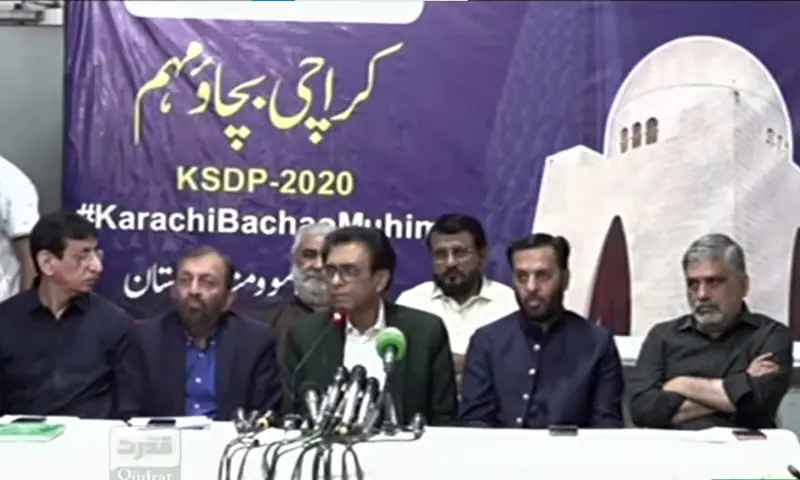
Responding on Sunday, MQM-P convener Khalid Maqbool Siddiqui, who holds the federal education portfolio, held a news conference in Karachi with colleagues including Farooq Sattar, Mustafa Kamal and Senator Faisal Subzwari. He cast the resolution as a brazen defiance of Pakistan’s Constitution, equating the assembly’s conduct to that of an independent entity. “Yesterday, a resolution against the Constitution of Pakistan was passed by one assembly of Pakistan,” Siddiqui said. He posed the question to Sindh’s residents and thinkers: Could any province enact something that clashed with the national document? With the PPP in charge for 17 years, he argued, this was no mere pushback against his party’s ideas but a broader assault on the Constitution, the state and even the PPP’s own legacy under Zulfikar Ali Bhutto.
Drawing on Article 239, which lays out steps for new provinces, Siddiqui also mentioned Articles 246 and 248 for presidential authority in crises. He harked back to the party’s advocacy for stronger local governance amid the 26th Amendment discussions, when he said the nation’s institutions leaned heavily on MQM-P. Dialogue was the answer, he insisted, not intimidation, and his group had never strayed from constitutional bounds. “What fear made you table this resolution?” he demanded. Siddiqui evoked the scars of 1970, when Pakistan splintered, leading to unity gestures like Punjab adopting Urdu as its language, with Khyber Pakhtunkhwa and Balochistan following suit. Sindh alone held back, he said, revealing the ruling party’s ulterior motives now laid bare. “As long as we are here, every dream of establishing Sindhudesh will be shattered,” he vowed. “As long as we are here, we cannot let this happen.”
He traced the PPP’s roots to linguistic lines, pointing out its absence of candidates in West Pakistan during the 1970 elections—covering more than half the country—and its foothold in just 1.5 provinces. Now, he charged, it clung to power via an artificial majority dating to 1972. Siddiqui challenged the prime minister, president, judiciary and public: Was linguistic division like this seen elsewhere? The quota system from that era, he added, was linguistically driven, not just bureaucratic. He lamented the unique hardships faced by Sindh’s urban centers, where demands for fairness branded people as disloyal. Siddiqui underscored MQM-P’s patriotism, recalling the expulsion of its founder after anti-Pakistan comments. “For the party leaders, it is Pakistan first, then MQM,” he said, affirming no demands ever harmed national interests.
Siddiqui alleged a 37 percent undercount in Karachi’s census figures, urging a redo overseen by the army to alter the province’s dynamics. He faulted the provincial handling of federal allocations, saying half of the Rs30 trillion from the capital should have reached Karachi. Though Sindh ranked as the richest province, poverty there had surged most, he noted. Referencing Articles 239(4) and 140-A, he criticized the PPP for ignoring rules on new provinces and local devolution, including to the mayor. “Any attempt to divide the country on linguistic, ethnic or provincial lines will be firmly opposed,” he warned.
Sharjeel Inam Memon, a senior PPP official, fired back, labeling the MQM-P event a showcase of constitutional illiteracy. He chided Siddiqui and Kamal, as cabinet members, for skimping on their homework, deeming their comments reckless and wondering if they spoke for the federal government. Memon pressed for clarification from Islamabad on why its ministers and partners targeted Sindh. He viewed the Governor’s residence as a neutral body, not a battleground against the province. “It is unwise to create tensions between the federation and the provinces at such a critical time,” he said, seeking swift federal input. The episode highlights enduring frictions in Sindh, where divides between city and countryside, along with ethnic undercurrents, have long festered. Karachi’s economic weight often sparks arguments over control and funds.
Copyright © 2021 Independent Pakistan | All rights reserved