By Staff Reporter
ISLAMABAD: The Foreign Office on Thursday defended the recent cross-border airstrikes into Afghanistan as carefully planned operations to protect Pakistani citizens from imminent terrorist threats, insisting the action was carried out with “utmost caution” to avoid civilian harm.
The strikes, conducted overnight over the weekend in Afghanistan’s Nangarhar and Paktika provinces, marked the most extensive military engagement between the two neighbors since border clashes erupted last October. Pakistani officials had previously said more than 80 terrorists were killed in the raids on seven identified camps and hideouts.
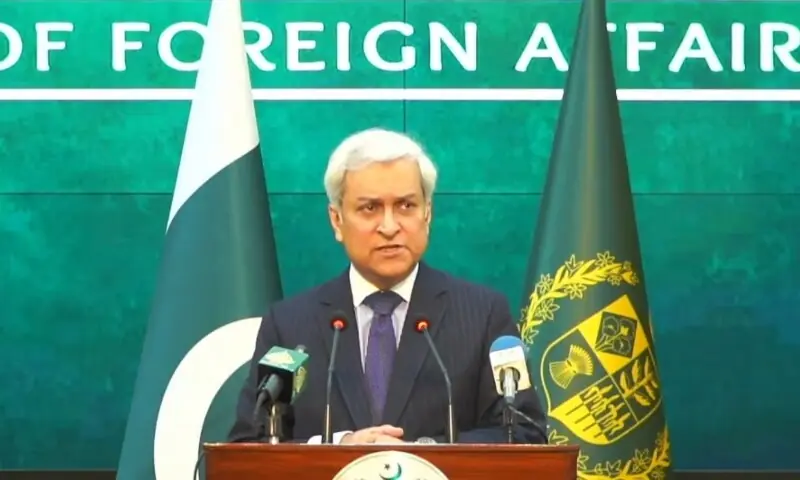
Foreign Office spokesperson Tahir Andrabi, speaking at the ministry’s regular weekly briefing, directly addressed questions about civilian casualties, the exact death toll and the locations targeted. He described the operation as “intelligence-based selective targeting” driven by the need “to ensure the safety and security of Pakistani citizens and to prevent imminent terrorist attacks against Pakistan, particularly against our law enforcement officials and our civilians living near the border regions.”
Andrabi stressed that the strikes were “proportional, based on careful planning with necessary due diligence and were directed solely against identified terrorist camps and hideouts.” “We exercised utmost caution to prevent any harm to civilians,” he added. The spokesperson placed the action firmly in the context of repeated United Nations Security Council statements condemning terrorist attacks on Pakistan, including one issued after the Feb. 6 assault on an imambargah in Islamabad. Those statements, he noted, have “repeatedly underlined the need to hold perpetrators, organisers, abettors, sponsors of these reprehensible acts of terrorism accountable and bring them to justice” while urging states to cooperate with Pakistan.
Pakistan, Andrabi said, “remained committed to peace in the region” but called on the Afghan Taliban government to “comply with these obligations.” At the same time, he made clear that Islamabad would take “all necessary measures in the exercise of the right to self-defence against terrorist attacks emanating from Afghanistan.” On the safety of Pakistani nationals still in Afghanistan, he said Islamabad had raised the issue with Afghan authorities and expected “foolproof security” for its diplomats and civilians.
Responding to India’s condemnation of the strikes, Andrabi rejected the statement issued by New Delhi’s Ministry of External Affairs outright. He said it only reinforced Pakistan’s longstanding position that “India continues to aid and abet terrorism” in Pakistan, particularly through its alleged support for the Balochistan Liberation Army and other groups. “Pakistan holds concrete evidence of India’s involvement in sponsoring and abetting terrorism,” he said, adding that recent Indian statements — including those following a spate of attacks in Balochistan last month — provide “additional evidence, circumstantial evidence, of India’s complicity in promoting terrorism in Pakistan.”
Those Balochistan attacks, claimed by the Baloch Liberation Army, left 22 security personnel and 36 civilians dead. Pakistani forces responded by killing 92 India-backed terrorists, according to the military. Andrabi said Pakistan had conveyed its determination to respond “swiftly, strongly in exercise of our right to self-defence” to all international stakeholders and renewed its demand for action against “terrorist outfits operating with impunity and with freedom from Afghan soil.”
He said he was not aware of any “structured dialogue” between Pakistan and Afghanistan. Asked about a possible diplomatic role for Qatar following Prime Minister Shehbaz Sharif’s recent visit to Doha, Andrabi noted that the issue may have arisen in broader discussions between Sharif and Qatar’s Emir Sheikh Tamim bin Hamad Al Thani, which focused on “dialogue, diplomacy and peaceful resolution of disputes.” “To that extent, of course, we would welcome Qatar’s role in settling all these issues, including Afghanistan.”
The spokesperson also used the briefing to mark the 19th anniversary of the Samjhota Express bombing, expressing “severe disappointment” at India’s handling of the case. On Feb. 18, 2007, two crude incendiary bombs exploded aboard the security-sealed train traveling from Delhi to Lahore, killing 68 people, including 44 Pakistanis. “We express our severe disappointment at the Indian government’s callousness towards the plight of families of Pakistani nationals and others, including Indian nationals, I believe, who await justice even after the passage of so many years,” Andrabi said.
He accused the Indian government of acting as an “official and political accomplice” in the attack and condemned the “shameless acquittal and exoneration” of the four perpetrators. Citing public confessions by figures such as Swami Aseemanand and Indian Colonel Shrikant Purohit — both of whom he said had admitted involvement — Andrabi linked the bombing to “Hindutva extremism and saffron terror,” which he said “has intensified manifold under the current regime in India.”
Pakistan, he said, demands a “fair trial” for the perpetrators so that “the families of innocent Pakistani nationals mercilessly killed at the hands of the Hindutva-motivated extremists deserve justice.” He described India’s position as “yet another example of Indian duplicity and state sponsorship of terrorism against Pakistan.”
Andrabi also addressed growing defense cooperation between India and Israel, saying Pakistan “remained seized of the defence ties between Israel and India, including systems and platforms used by New Delhi against Islamabad.” “We are alive to the threat that they pose to our security and our sovereignty and territorial integrity, as well as to the regional peace and stability,” he said. Pakistan, he added, maintains “robust military preparedness to defend and deter any Indian aggression.”
His remarks followed Indian Prime Minister Narendra Modi’s recent two-day visit to Israel, during which the two countries pledged to expand joint defence development, production and technology transfer, and to work toward a free trade agreement. The spokesperson condemned Israeli Prime Minister Benjamin Netanyahu’s recent description of a proposed “hexagon of alliances” that could include Israel, India, Greece, Cyprus and other states to counter what Netanyahu called “radical” adversaries.
Pakistan’s Senate unanimously passed a resolution rejecting the idea earlier this week. “I would also like to draw your attention to the recent resolution adopted by the Senate of Pakistan that strongly condemned such remarks and attempts to undermine Muslim unity,” Andrabi told reporters. “We continue to condemn these provocative steps and statements by the leadership of the occupying power that threaten regional peace and stability.” He described Netanyahu’s comments about dividing the Muslim world along sectarian lines as a “nefarious design.” Throughout the briefing, Andrabi repeatedly framed Pakistan’s positions as rooted in self-defense, international law and a commitment to regional stability — while leaving little doubt that Islamabad remains ready to act when it perceives threats to its security.
Copyright © 2021 Independent Pakistan | All rights reserved