By Staff Reporter
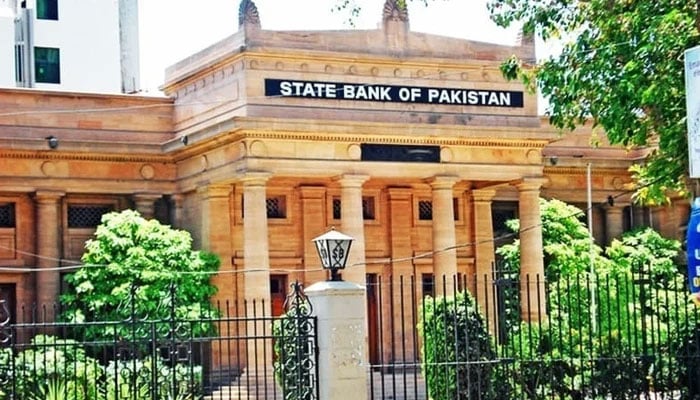
KARACHI: The State Bank of Pakistan kept its benchmark policy rate unchanged at 10.5% on Monday, its second Monetary Policy Committee meeting of 2026, as the outbreak of war in the Middle East sent global energy prices surging and clouded the inflation outlook for the import-dependent economy.
The decision, first flagged on the central bank’s X account and followed by a detailed monetary policy statement, was in line with unanimous expectations from analysts and a Reuters poll of 10 economists. Markets had priced in a hold after Brent crude posted what was on track to be its biggest one-day gain on record, driven by escalating conflict between the US-Israel alliance and Iran that has closed the Strait of Hormuz and disrupted global supply routes.
“While the incoming data was largely consistent with the macroeconomic projections shared after the January meeting, the Committee observed that the macroeconomic outlook has become quite uncertain following outbreak of the war in the Middle East,” the MPC said. The conflict has triggered “a sharp increase in global fuel prices as well as freight and insurance costs, while also affecting cross-border trade and travel.”
The committee stressed that the intensity and duration of the fighting would determine the ultimate hit to Pakistan’s economy. Still, it noted that prudent monetary and fiscal policies had strengthened the country’s resilience compared with the start of the Russia-Ukraine war in early 2022, when inflation and external buffers were far weaker. “The MPC’s initial assessment of the evolving geopolitical situation indicates that the outlook for key macroeconomic variables for FY26 is within the earlier projected ranges,” the statement said. “However, risks for the macroeconomic outlook have increased significantly.”
Pakistan, which imports the bulk of its energy needs, is already absorbing the first direct blows. Last week the government raised petrol and high-speed diesel prices by Rs55 a liter — the largest single increase on record — to pass through higher international costs. The move came as Brent’s rally intensified pressure on the current account and domestic prices.
Headline inflation climbed to 5.8% in January and 7% in February, largely from the fading of a low base in food and energy as well as higher fixed electricity charges for households. Core inflation rose to around 7.6%. The MPC said the impact of elevated domestic fuel prices would be partly offset by softer food costs and better agricultural prospects, but warned that inflation is likely to stay above 7% through the rest of FY26 and into FY27. “Given these developments and risks, the Committee assessed that inflation may remain above 7 percent in the remaining months of FY26 and into FY27,” it said, while reaffirming its commitment to “hard-earned price stability.”
The bank has already cut rates by a cumulative 1,150 basis points since mid-2024, when the policy rate stood at a record 22%, as inflation eased from multi-decade highs. Monday’s pause reflects the abrupt reversal in that disinflation trend.
Beyond geopolitics, the MPC highlighted several domestic developments since its Jan. 26 meeting: – A current-account surplus of $121 million in January narrowed the July-January deficit to $1.1 billion. Imports fell while exports and remittances stabilized. Foreign-exchange reserves climbed to $16.3 billion as of Feb. 27, helped by State Bank purchases in the interbank market. – Large-scale manufacturing grew 0.4% year-on-year in December, lifting the July-December cumulative expansion to 4.8%. High-frequency indicators — auto sales, cement dispatches, electricity generation and POL sales excluding furnace oil — pointed to stronger activity in July-January. – Consumer inflation expectations and confidence improved in February; business sentiment was stable. Federal Board of Revenue tax collections rose just 10.6% in July-February, widening the shortfall against the annual target. – The US administration’s announcement of uniform global tariffs added another layer of uncertainty for trade.
The committee noted “the high degree of uncertainty in the outlook for international commodity prices and supply-chain disruptions” and called for faster structural reforms to support sustainable growth.
Real Economy
Economic activity continued to gain traction. Recent policy steps — including a lower cash reserve requirement, reduced mark-up rates on exporter loans and cheaper industrial power tariffs — have bolstered manufacturing prospects. Wheat sowing met targets with favorable input conditions. The MPC kept its FY26 real GDP growth forecast at 3.75%-4.75%, though it flagged risks from the unfolding Middle East situation.
External Sector
The current-account deficit is still projected at 0%-1% of GDP for the full year. The bank emphasized the need for timely official inflows to reach its $18 billion reserve target by June 2026, warning that the external environment has become “more challenging” because of the conflict.
Fiscal and Monetary
The overall fiscal balance remained in surplus, supported by lower interest payments, while the primary surplus held near last year’s level. However, moderate tax receipts underscored the need for base-broadening measures. Broad money (M2) growth slowed to 16% as of Feb. 20 after reduced government borrowing from banks, freeing space for private-sector credit, which rose Rs790 billion. Credit flowed especially to textiles, wholesale-retail trade and chemicals; consumer financing also expanded.
The central bank is operating under a $7 billion International Monetary Fund program that urges data-dependent, tight monetary policy to anchor expectations and rebuild external buffers. Analysts had anticipated the pause. Topline Securities said the outcome matched its forecast, while Arif Habib Limited highlighted “caution amid a rapidly evolving global backdrop. A recent brokerage survey showed 96% of respondents expecting no cut, citing the 25% surge in Brent prices over the past two to three weeks.
Analysts said the MPC’s message was clear: any further easing will remain hostage to how the Middle East conflict evolves, how quickly global commodity prices stabilize, and whether Pakistan can secure planned external financing while keeping fiscal consolidation on track.
Copyright © 2021 Independent Pakistan | All rights reserved