By Staff Reporter
ISLAMABAD: Pakistan will press the International Monetary Fund for greater leeway in its bailout program to manage the fallout from the US-Israeli war on Iran, including measures to shield consumers from soaring petroleum prices, the Ministry of Finance said on Thursday.
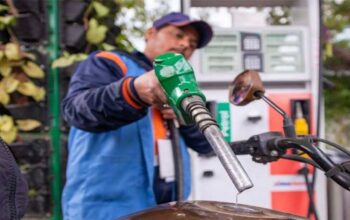
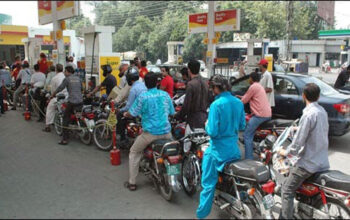
The move comes as Islamabad has frozen retail prices of petrol and diesel for three weeks, absorbing an estimated Rs129 billion in costs after an initial increase in the first week of the conflict. Global diesel prices have risen more than 220% and petrol more than 80% since the war began, with diesel jumping more than $46 a barrel — over 15% on Thursday alone — the biggest one-day gain on record.
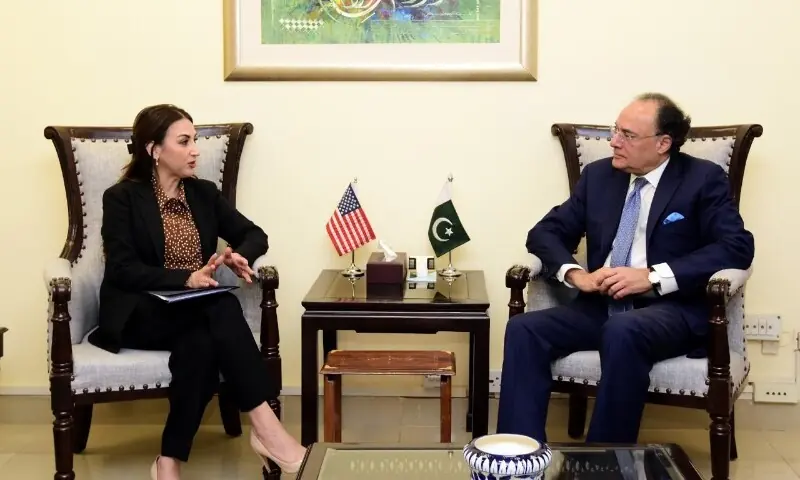
The announcement followed a meeting between Finance Minister Muhammad Aurangzeb and US Charge d’Affaires Natalie Baker, held ahead of the IMF and World Bank spring meetings later this month. In an official statement, the ministry said the two sides reviewed Pakistan’s engagement with international financial institutions and development partners, as well as efforts to sustain reform momentum under the IMF program. “The finance minister reiterated Pakistan’s commitment to fiscal discipline while seeking flexibility in light of evolving global and regional challenges,” the statement said.
Aurangzeb briefed Baker on the government’s handling of energy-sector pressures, including procurement, pricing mechanisms and targeted subsidies. “While supply arrangements were being maintained, the government was working on improving price transmission and ensuring that subsidies are better targeted towards vulnerable segments such as small farmers and public transport users,” he was quoted as saying.
The federal government has begun persuading provinces to assume responsibility for subsidizing bikers, farmers and public transport, while passing the full imported cost of fuel through to retail prices. Discussions also covered the broader economic outlook, with an emphasis on preserving stability and protecting the most vulnerable, the ministry said.
Aurangzeb highlighted the impact of higher global oil prices on Pakistan’s import bill, inflation outlook and macroeconomic stability. Baker, for her part, reaffirmed US support for Islamabad’s economic reform agenda and welcomed the government’s efforts to stabilize the economy under difficult conditions. She expressed continued American interest in promoting investment in energy, mining, technology and logistics, and the two sides explored opportunities to boost investment flows, including through upcoming international forums.
The statement said they also discussed infrastructure development, digital connectivity and regional trade, as well as broader Pakistan-US bilateral relations, economic developments and cooperation in trade, investment and energy. Baker highlighted a recent symposium in Washington hosted by the Pakistan Caucus in the US Congress that brought together policymakers, diaspora representatives and business leaders to assess bilateral ties. Aurangzeb acknowledged the constructive role of US partners and stressed Pakistan’s commitment to improving the business environment, structural reforms, export-led growth and stronger institutional frameworks.
Prime Minister Shehbaz Sharif has directed the finance ministry to seek the removal of petroleum levies from the IMF program to cushion households from rising fuel costs, a senior cabinet member said. The levies — currently around Rs100 per liter on petrol and Rs55 per liter on diesel — are a significant revenue source under the IMF-supported framework. Removing them would deliver relief of up to those amounts per liter.
Pakistan has already spent billions to stabilize fuel prices, but further increases may be unavoidable as consumption rises. Sharif wants any required price adjustments offset through the existing levies.
A finance ministry official said it was unlikely the IMF would agree to changes in the levy structure. The lender has already pressed Pakistan to cap fuel-related subsidies at under Rs150 billion. Pakistan and the IMF reached a staff-level agreement last week on the third review of the country’s 37-month Extended Fund Facility, approved in September 2024. The $7 billion program requires fiscal discipline and limits subsidies.
Copyright © 2021 Independent Pakistan | All rights reserved