By Staff Reporter
ISLAMABAD: Pakistan’s most powerful military officer wrapped up a three-day visit to Iran on Saturday while Prime Minister Shehbaz Sharif returned from a whirlwind tour of Saudi Arabia, Qatar and Türkiye, in a coordinated diplomatic offensive aimed at transforming a precarious two-week-old ceasefire between Tehran and Washington into a lasting regional settlement.
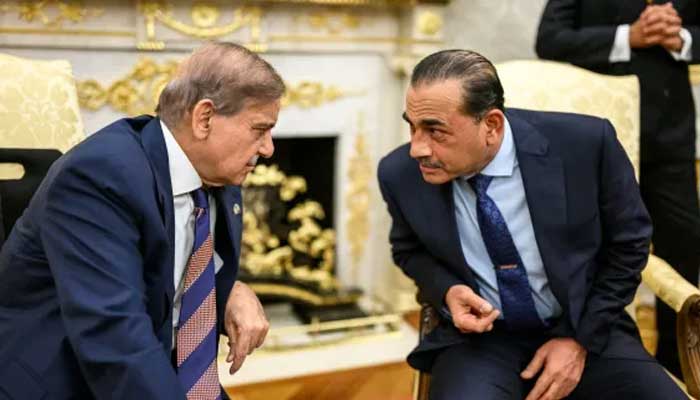
Field Marshal Asim Munir, who holds the dual roles of chief of army staff and chief of defence forces, traveled to Tehran with Interior Minister Mohsin Naqvi and a senior delegation at the invitation of Iranian leaders. The trip, the Pakistani military’s media wing said in a statement, centered on “bringing sustainable peace to the region, with particular emphasis on the evolving regional security environment, ongoing diplomatic engagements, and collaborative measures aimed at promoting enduring peace and stability.”
Munir met Iranian President Masoud Pezeshkian and held separate discussions with Parliament Speaker Mohammad Bagher Ghalibaf, Foreign Minister Abbas Araghchi and Maj. Gen. Ali Abdollahi, commander of Iran’s Khatam-ul-Anbiya Headquarters. According to the Inter-Services Public Relations, Munir “underscored the need for dialogue, de-escalation, and peaceful resolution of outstanding issues through sustained diplomatic engagements.”
Munir expressed appreciation for the warm hospitality extended by his Iranian hosts and conveyed “sincere regards and best wishes” from Pakistan’s president, prime minister and people. He also reaffirmed Islamabad’s commitment to deepening the “historic and brotherly ties” between the two countries. The military statement said the visit was a clear demonstration of “Pakistan’s unwavering resolve to facilitate a negotiated settlement to the Middle East conflict and to promote peace, stability, and prosperity in the region.”
Sharif’s parallel three-nation tour, which concluded Saturday with his arrival in Lahore, formed the civilian counterpart to the military outreach. The prime minister held talks in Riyadh with Saudi Crown Prince Mohammed bin Salman, in Doha with Qatar’s Emir Sheikh Tamim bin Hamad Al Thani, and in Antalya, Türkiye, with President Recep Tayyip Erdogan and other world leaders attending the Antalya Diplomacy Forum.
In each capital he pressed the case for de-escalation and regional stability following the inconclusive direct talks between US and Iranian negotiators that Pakistan hosted in Islamabad on April 11. The dual-track diplomacy reflects the unusual centrality Pakistan has assumed in one of the Middle East’s most dangerous flash points. The ceasefire between the United States and Iran, which Islamabad helped broker on April 8 after weeks of open conflict, is due to expire on April 22. While technically intact, the truce is widely viewed as fragile.
Iranian forces struck Israeli, American and Gulf infrastructure targets during the earlier fighting, and the Strait of Hormuz — a critical global energy artery — remains effectively blocked by Tehran. The April 11 negotiations in Islamabad, the highest-level engagement between Washington and Tehran since the 1979 Islamic Revolution, ran nearly 21 hours without producing an agreement on the core disputes: Iran’s nuclear program, sanctions relief and the future status of the Strait of Hormuz.
Munir’s presence in Tehran this week was explicitly framed by the military as part of “ongoing mediation efforts” for de-escalation. The field marshal had played a visible role in the Islamabad talks, personally greeting both delegations on arrival. Pakistani air force aircraft had earlier escorted the Iranian negotiators home after the first round ended without a breakthrough. On Friday, Iranian Interior Minister Eskander Momini telephoned Naqvi to praise Pakistan’s role in securing the initial ceasefire and advancing reconciliation, according to a statement issued by the interior ministry.
Sharif’s tour, which began April 15, was similarly focused on leveraging Pakistan’s relationships across the Muslim world. In Saudi Arabia he held a two-hour meeting with Crown Prince Mohammed bin Salman, updating him on the ceasefire and Islamabad talks while expressing “full solidarity and support” for Riyadh amid the recent escalation. In Qatar he met one-on-one with the emir and, with Deputy Prime Minister and Foreign Minister Ishaq Dar, reviewed cooperation in security, defense and energy while underscoring the need to maintain stable energy supply chains.
In Türkiye, Sharif participated in the Antalya Diplomacy Forum, held a bilateral meeting with Erdogan, and joined a trilateral session with the Turkish president and the Qatari emir. He also held informal talks with the presidents of Azerbaijan, Kazakhstan and Syria. Dar, who accompanied the prime minister throughout, described the visits as “productive and fruitful” and praised the Antalya forum as “a global space for dialogue, bringing together diverse perspectives in support of peace, stability, and cooperation.”
Pakistan’s unusually prominent role stems from its longstanding ties to both Tehran and Washington, as well as its close relationships with the Gulf monarchies and Türkiye. Trump has repeatedly referred to Munir as his “favourite field marshal,” a rapport forged during US efforts to defuse a short but intense conflict between Pakistan and India last year.
Copyright © 2021 Independent Pakistan | All rights reserved