By Staff Reporter
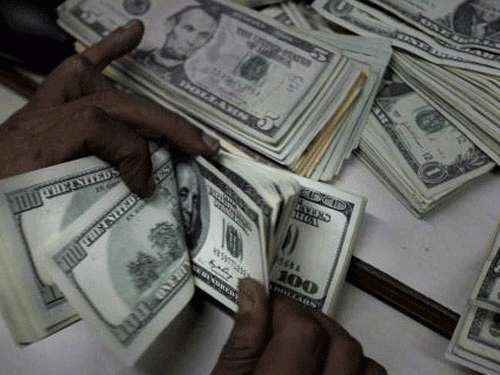
ISLAMABAD: The State Bank of Pakistan confirmed on Saturday that the government has repaid $2 billion to the United Arab Emirates, part of maturing bilateral deposits that are testing the country’s external financing position even as fresh inflows from Saudi Arabia provide a buffer.
The repayment forms part of a scheduled $3.5 billion return to the UAE by the end of April under arrangements dating back to 2019 support for Pakistan’s balance of payments. A senior Pakistani official had said earlier this month that Abu Dhabi requested the immediate return of the full amount. The government had already paid $500 million, with the remainder expected on April 23.
“I can confirm that we have made the $2 billion repayment to the UAE,” Noor Ahmed, chief spokesperson at the SBP, said. “For now, I can confirm this much [$2 billion repayment] only,” he added when asked about the balance due.
The central bank had previously described the UAE funds as held with it as a safe deposit under the original terms. The $2 billion outflow, together with a 6% interest payment, is expected to widen Pakistan’s external financing gap, officials have indicated. The development came a day after Pakistan and Saudi Arabia signed an agreement to extend the maturity of a $3 billion deposit placed by the Saudi Fund for Development with the SBP. Earlier this week, the central bank said it had received $2 billion from the kingdom with a value date of April 15, 2026. On Thursday, Saudi Arabia pledged an additional $3 billion in deposits for Pakistan and extended its existing $5 billion facility for a further three years.
Pakistan has relied heavily in recent years on such rollovers and support from allies including Saudi Arabia and China to maintain the foreign-exchange reserve levels required under its $7 billion International Monetary Fund program. The country also repaid $1.43 billion in external debt this month, including a $1.3 billion Eurobond.
On Friday, however, the government announced it had raised $500 million in the international capital markets through a Eurobond — the first such issuance in four years. As of April 10, the central bank’s foreign-exchange reserves stood at $20.52 billion.
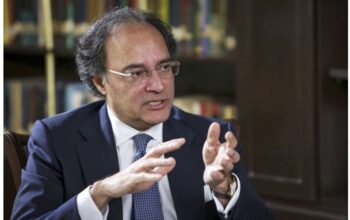
Finance Minister Muhammad Aurangzeb said Tuesday that Pakistan is weighing Eurobonds, loans from other countries and commercial debt to replace the UAE facility and manage its reserves. Speaking on the sidelines of the IMF and World Bank spring meetings in Washington, he told Reuters that the shock from the ongoing war in the Middle East required the country to consider building a strategic petroleum reserve and accelerating a switch to renewable energy. “All options are on the table,” Aurangzeb said when asked if the government was in talks with Saudi Arabia for a loan that could replace the UAE facility.
The minister added that Pakistan can manage all its debt repayments and that reserves remain at roughly 2.8 months of import cover. “Maintaining at least that level would be an important aspect of our overall macro stability as we go forward,” he said. “We are looking at Eurobond, we are looking at Islamic sukuk, we are looking at dollar-settled rupee-linked bonds.”
He said Pakistan has not yet requested any additions or changes to its $7 billion IMF program because of the economic shocks from the Middle East conflict, but that remains a potential option. “Depending upon how things pan out over the next few weeks, that’s something which can be discussed,” he said. The IMF board is likely to approve the latest lending tranche by the end of this month or early next, unlocking just under $1.3 billion via the Extended Fund Facility and the Resilience and Sustainability Facility.
Copyright © 2021 Independent Pakistan | All rights reserved