By Staff Reporter
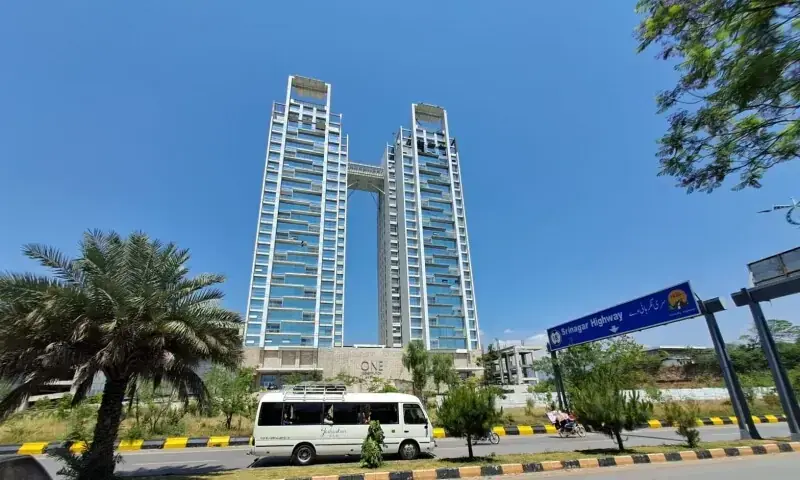
ISLAMABAD: The Islamabad High Court on Monday released a detailed judgment upholding the Capital Development Authority’s cancellation of the lease for One Constitution Avenue, a high-end residential and commercial complex in one of the most valuable districts of Pakistan’s capital.
In a ruling, Chief Justice Sardar Muhammad Sarfraz Dogar dismissed a batch of petitions filed by the project’s developer, BNP (Pvt) Limited, as well as apartment buyers and other stakeholders who had challenged the authority’s decision to terminate the lease. The court ruled that the authority’s action was lawful, consistent with binding directives from the Supreme Court and fully within the bounds of administrative discretion over public land.
The decision leaves purchasers of the luxury apartments without any independent ownership rights in the property itself. The court held that their claims were entirely contingent on the developer’s now-canceled lease and that buyers must instead pursue legal action against BNP to recover their investments.
The dispute traces back to a 2005 lease agreement between the Capital Development Authority and BNP for the construction of a five-star hotel on prime federal land. The developer later reoriented the project into One Constitution Avenue, a mixed-use development marketed as a prestigious address for affluent residents and commercial tenants. The lease was first terminated in 2016. In January 2019 the Supreme Court restored it, but only on strict conditions: BNP was required to pay 17.5 billion rupees over eight years in structured installments, backed by bank guarantees acceptable to the authority. The Supreme Court stipulated that any future termination could occur only after a documented default and the issuance of a 30-day notice.
The Islamabad High Court described the Supreme Court’s 2019 order as creating a comprehensive and binding framework for the parties’ rights and obligations. Strict compliance, the judgment emphasized, was not optional. After examining the record, Chief Justice Dogar found that BNP had repeatedly failed to meet its financial commitments. The developer missed scheduled installment payments and did not furnish bank guarantees in the form required by the authority.
The court rejected BNP’s argument that delays by the Capital Development Authority had frustrated its performance. Even if some administrative hurdles had arisen, the judgment stated, they did not relieve the developer of its primary duty to adhere to the payment schedule and provide acceptable guarantees. The pattern of prolonged non-compliance, the court concluded, amounted to a material default.
On the question of due process, the judges determined that the authority had issued proper notices and given BNP sufficient opportunity to cure the defaults before proceeding with termination. The action was therefore neither arbitrary nor unlawful, the ruling said. The court also dismissed claims of bad faith, or mala fide, on the part of the authority, noting that its decisions were grounded in statute and the Supreme Court’s explicit instructions.
A separate but central element of the case involved the rights of individual apartment buyers. The court ruled that their interests could not survive the lawful cancellation of the underlying lease. Purchasers, the judgment observed, had entered into transactions with the developer at their own risk and could not assert title against the state authority once the lease was extinguished. At the same time, the court made clear that the buyers were not without legal recourse; they remain free to file suits against BNP for the return of their money.
The judgment showed the broader public-law dimensions of the dispute. Because the project sits on land controlled by a statutory body exercising governmental powers, the court said, the authority’s actions must be judged by standards of legality, fairness and fidelity to higher judicial directives. In this instance, the Capital Development Authority had met those standards.
The Monday ruling follows reports last week of heightened tensions at the site. Videos and posts that circulated widely on social media showed police officers at the building, with some accounts describing eviction notices being served to residents and late-night operations in which officers allegedly broke doors and locks. Among the reported apartment owners are several prominent Pakistani figures, including PTI founder and former prime minister Imran Khan, senior lawyer and opposition politician Chaudhry Aitzaz Ahsan, lawmaker Shandana Gulzar Aurangzeb, former minister Burjees Tahir and former caretaker prime minister Nasirul Mulk.
On Friday, after the court had upheld the lease cancellation in principle, Prime Minister Shehbaz Sharif stepped in, forming a high-level committee to examine the matter and directing authorities to take no further enforcement steps until the review was complete. The Monday judgment now provides the detailed legal reasoning behind the court’s earlier stance. The case has drawn attention not only for its financial scale but also for the political and social prominence of some of the stakeholders involved. It illustrates the continuing tension in Pakistan between large-scale private real estate development on public land and the state’s obligation to enforce contractual and regulatory compliance.
Copyright © 2021 Independent Pakistan | All rights reserved