By Staff Reporter
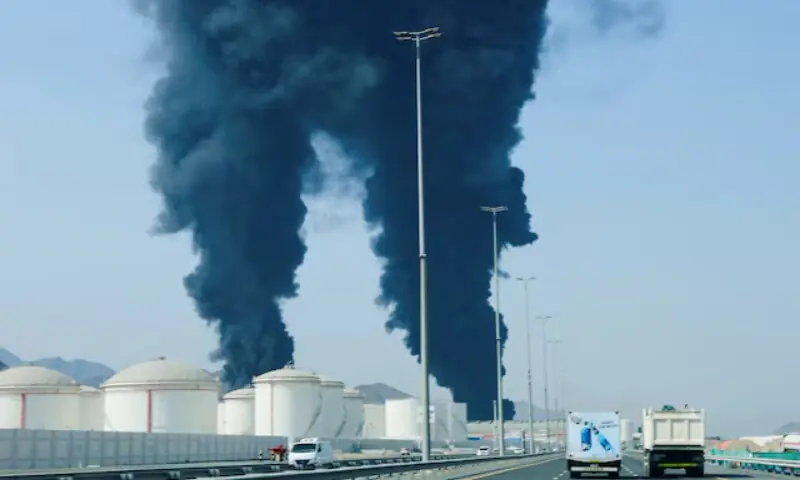
ISLAMABAD: A drone launched from Iran struck the Fujairah Oil Industry Zone on Monday, igniting a fire at the critical UAE oil export terminal and injuring three Indian nationals, authorities said, even as the country’s air defences intercepted multiple incoming missiles and drones in what officials described as a dangerous escalation.
The attack shattered a period of relative calm that had held since a Pakistan-mediated ceasefire between the United States and Iran took effect on April 8. Civil defence teams moved quickly to contain the blaze, the Fujairah Media Office said in a statement. The three injured workers were treated for moderate injuries and hospitalised.
The UAE Defence Ministry said its forces intercepted three Iranian missiles over its territorial waters, with a fourth crashing into the sea. In a later accounting, officials said air defences had engaged 12 ballistic missiles, three cruise missiles and four drones. Mobile-phone alerts issued in Dubai and Abu Dhabi warned residents of possible further missile threats and instructed them to seek shelter in the nearest secure building.
Fujairah, on the UAE’s eastern coast along the Gulf of Oman, lies beyond the Strait of Hormuz and has served as a vital alternative export route during the conflict. Crude from Abu Dhabi’s inland fields reaches the terminal via the Abu Dhabi Crude Oil Pipeline, allowing the UAE to continue shipping oil to global markets even when the strait itself has been under threat. A similar drone attack struck the Port of Fujairah on March 14, briefly suspending some oil-loading operations.
The UAE’s Foreign Ministry condemned the attacks in the strongest terms as “renewed terrorist, unprovoked Iranian attacks targeting civilian sites and facilities.” Abu Dhabi said it reserved the right to respond. Late Monday, the UAE announced it would close its airspace for a full week.
The strikes came as the United States pressed forward with “Project Freedom,” an operation to escort hundreds of commercial vessels and their crews out of the Gulf after Iran’s de facto blockade of the Strait of Hormuz left more than 800 ships and roughly 20,000 seafarers stranded.
President Donald Trump, in a Fox News interview on Monday, said the naval effort is “one of the greatest military manoeuvres ever done” and said Iran had become “much more malleable” in recent peace negotiations. He warned that any attack on U.S. vessels would be met with overwhelming force. “We have more weapons and ammunition at a much higher grade than we had before,” Trump told Fox News correspondent Trey Yingst. “We have the best equipment. We have stuff all over the world. We have these bases all over the world. They’re all stocked up with equipment. We can use all of that stuff, and we will, if we need it.”
US Central Command reported that American forces destroyed six Iranian small boats — described by Trump as “fast boats” — attempting to interfere with commercial shipping. Helicopters were used in the operation, the military said. Iran denied that any of its vessels had been sunk or that it had struck any US warship, as its state media had initially claimed. Tehran instead said it had fired warning shots at a US vessel.
Shipping giant Maersk confirmed that one of its US-flagged vessels, the Alliance Fairfax, had successfully exited the Strait of Hormuz under US military protection. “The vessel subsequently exited the Persian Gulf accompanied by US military assets,” the company said in a statement. “The transit was completed without incident, and all crew members are safe and unharmed.” The United States said two US-flagged merchant vessels had transited the waterway; Iran called the claim “entirely false.”
The UAE also reported that a tanker affiliated with its state-owned oil company Adnoc had been hit in the strait, and South Korea said one of its ships anchored off the UAE coast had suffered an explosion. In Oman, two people were injured when a residential building in the coastal town of Bukha was struck, Omani state media reported.
Iran’s Revolutionary Guard Corps Navy released a map, carried by Iranian news agencies, asserting an expansion of areas under Iranian control near the Strait of Hormuz. The map included the UAE ports of Fujairah and Khorfakkan, as well as the coastline of the emirate of Umm Al Quwain. A social media account linked to the Revolutionary Guard later posted images and video purporting to show drone and missile strikes on the Port of Fujairah and a ship ablaze.
Iranian Foreign Minister Abbas Araghchi, writing on social media, said the day’s events demonstrated that “there’s no military solution to a political crisis.” He called the American operation “Project Deadlock” and cautioned both Washington and Abu Dhabi against being drawn back into conflict “by ill-wishers” while Pakistan-mediated talks continued.
The ceasefire, announced by Trump on April 7 and put into effect the following day, had paused more than two months of intense fighting during which the UAE said it had intercepted and destroyed thousands of Iranian drones and missiles. The waterway, through which roughly one-fifth of the world’s oil and liquefied natural gas normally passes, has remained largely closed since US and Israeli strikes on Iran began in February.
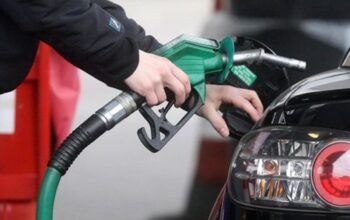
Oil markets reacted sharply. The benchmark Brent crude price surged past $115 a barrel, up more than 5 percent on the day.
Copyright © 2021 Independent Pakistan | All rights reserved