By Staff Reporter
ISLAMABAD: Pakistan said on Thursday it expected the United States and Iran to reach an agreement ending their conflict “sooner rather than later,” offering a measured note of optimism as the two sides appeared to edge closer to a deal that could ease tensions in the Persian Gulf and stabilise global energy markets.
The comments from Foreign Office spokesman Tahir Andrabi came a day after President Donald Trump said that his conversations with Iranian officials was “very good” and Tehran signaled it was reviewing a fresh US proposal. Iranian officials said they would relay their response through Pakistani channels, underscoring Islamabad’s unusual position as both host of direct talks and informal go-between.
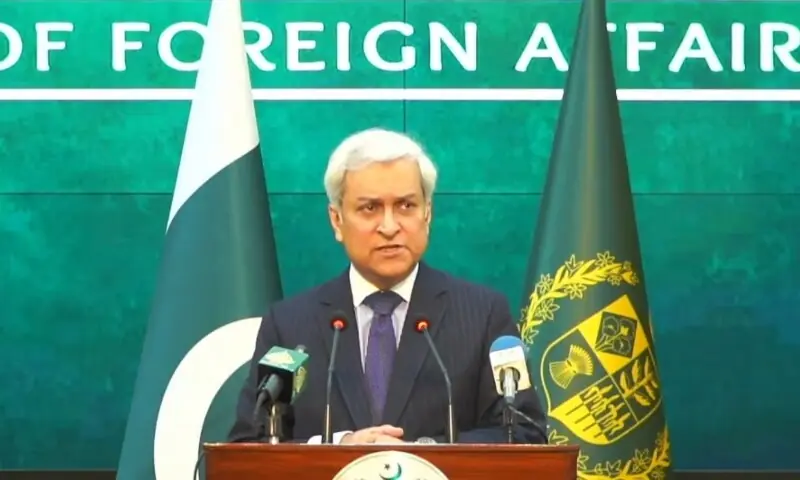
“We remain optimistic,” Andrabi told reporters at the weekly Foreign Office briefing. “A simple answer would be that we expect an agreement sooner rather than later. We hope that the parties will come to a peaceful, sustainable solution and bring peace, not just to our region but internationally as well.” Pakistan, which has cast itself as a facilitator rather than a formal mediator, has hosted one round of direct US-Iran negotiations in Islamabad last month. Those April 11-12 talks produced no final agreement but prevented a collapse of the fragile ceasefire that Pakistan helped broker on April 8. Since then, Islamabad has reverted to shuttling messages between Washington and Tehran while publicly urging restraint.
Andrabi declined to speculate on the format of any emerging document, saying he could not say “whether the draft of the agreement would be one page or longer.” He also brushed aside questions about possible US domestic political pressures, including midterm elections, telling reporters to focus on outcomes rather than motives. “We want a peaceful settlement, a peaceful solution, irrespective of what the causes are or how the countries are compelled to reach a diplomatic solution,” he said. “So let’s not focus on the causes but focus on the effect. And the effect should be that there is peace.”
The latest round of hostilities began Feb. 28 with US and Israeli strikes on Iran and has disrupted shipping through the Strait of Hormuz, the chokepoint for roughly one-fifth of the world’s oil. A US operation “Project Freedom,” aimed at keeping the strait open, was suspended earlier this week, a move Prime Minister Shehbaz Sharif welcomed as “timely.” Sharif has expressed hope that the current momentum would produce a “lasting agreement” securing “durable peace and stability for the region and beyond.”
Deputy Prime Minister and Foreign Minister Ishaq Dar has maintained contact with his US and Iranian counterparts over the past week “with the same spirit of optimism and positive engagement,” Andrabi said. Pakistan would welcome any venue for a final settlement, he added, even on its own soil. “If an agreement is reached in Pakistan, it would be an honour for us.”
In the same briefing, Andrabi used the first anniversary of last year’s military confrontation with India to reaffirm Pakistan’s defense posture and call for dialogue while criticizing the persistent “belligerence” from New Delhi. The conflict, which Pakistan has formally named “Marka-i-Haq” or Battle of Truth, began with an attack in Indian-occupied Kashmir on April 22, 2025, escalated through Indian strikes and Pakistan’s Operation Bunyanum Marsoos, and ended in a ceasefire on May 10.
Andrabi said Pakistan’s response as “measured, lawful, and in line with the UN Charter.” Marking the anniversary, he said, was “not only about remembering the past; it is about shaping the future because the spirit of Marka-i-Haq lives not just in our history, but in each of us.” Pakistan, he added, would defend its “sovereignty, territorial integrity, and political independence … with all means possible and with full resolve.”
Andrabi noted that Pakistan has repeatedly expressed readiness for dialogue with India but said New Delhi has not reciprocated. “It takes two to have a dialogue,” he said. “Even a dialogue has to be meaningful; it has to be a dialogue and not a monologue.” He said responsibility for the lack of talks “is for everybody to judge.” Pakistan is closely monitoring India’s arms buildup and force modernization, Andrabi said, and will maintain its “credible minimum deterrence.” He assured that defense acquisitions and preparedness “would be sufficient to maintain our robust defence” and strategic stability in South Asia.
On the Indus Waters Treaty, which India has suspended unilaterally, Andrabi said Pakistan “reserves the right of exploring all legal political mechanisms enshrined in the treaty and under international law.” He said officials were documenting river flows and variations and that “all options are on the table,” including proceedings before the Indus Waters commissioners. “I can assure you that all efforts will be made … that not a drop of water is stolen from Pakistan from what is our right,” he said.
Andrabi also updated reporters on consular cases involving Pakistani nationals abroad. In Cambodia, 54 Pakistanis detained in a raid on a suspected scamming compound have been issued emergency travel documents. Forty-nine have already returned home, with the remaining three in the final stages of processing, he said. In Uganda, 85 Pakistanis detained April 27 for working without authorization on visit visas were repatriated after their sentences were waived. Each was fined $400 for visa violations following intervention by the Pakistani embassy.
Andrabi said that the deportation of hundreds of its citizens from the United Arab Emirates this year stemmed overwhelmingly from immigration infractions and other legal matters, rather than any political targeting, even as anxiety grows in Pakistan over reports of mass expulsions and stricter visa policies in one of its most important economic lifelines.
The UAE is home to as many as 1.8 million Pakistani expatriates, one of the largest such communities in the world. Their earnings represent a critical flow of remittances to Pakistan’s fragile economy. But in recent years, Pakistani workers and travelers have described a noticeable tightening of entry rules, increased scrutiny at airports and a rise in deportations tied to overstays, unauthorized employment and other violations of Emirati law.
Andrabi said Pakistani diplomatic missions in the UAE had issued nearly 1,500 emergency travel documents between January and April to help affected citizens return home. The Consulate General in Dubai issued about 714 of those documents, while the mission in Abu Dhabi issued roughly 780, he said. Andrabi described the deportation numbers as broadly stable and linked in part to a royal pardon process in the UAE that had led to the release of some prisoners. “This situation was largely prompted by a Royal Court pardon in the UAE that enabled the release and repatriation of jailed individuals,” he said.
He was emphatic that Islamabad saw no political dimension to the expulsions. “I do not see any political reason behind the deportations,” Andrabi said. “These are primarily legal cases, which are being handled both by our diplomatic missions in the UAE as well as by the UAE authorities.”
Pakistani officials have remained in regular contact with their Emirati counterparts, he added, and have repeatedly urged members of the large Pakistani community to observe local laws and regulations strictly. That message has taken on added urgency in the wake of heightened security concerns across the Gulf following a series of attacks by Yemen’s Iran-aligned Houthi militants on the UAE, which Pakistan has publicly condemned. “Our embassy and authorities remain in touch with the UAE authorities,” Andrabi said. “They have also ensured that, in the wake of hostilities in the Gulf region and the very serious Houthi attacks against the UAE … our community fully complies with local laws and instructions.” By and large, he said, the expatriates had cooperated, “except for one or two sporadic cases.”
Copyright © 2021 Independent Pakistan | All rights reserved