By Staff Reporter
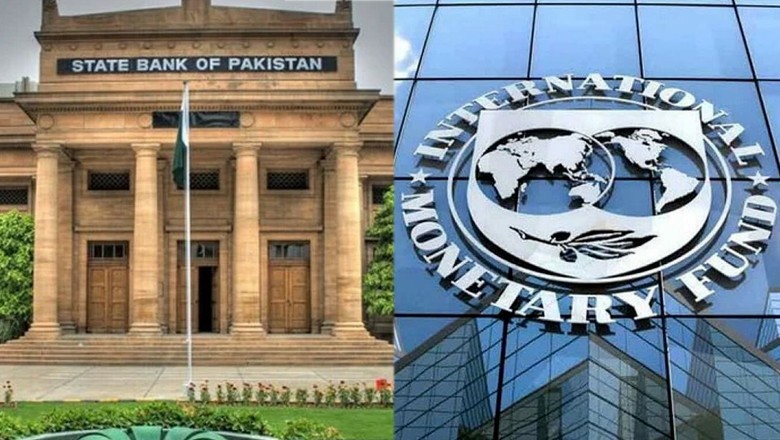
KARACHI: The central bank received about $1.3 billion from the International Monetary Fund after the lender’s executive board completed a review of the country’s bailout program, providing fresh support for foreign-exchange reserves even as the conflict in the Middle East clouds the outlook.
The State Bank of Pakistan said on Wednesday that it received the equivalent of 914 million special drawing rights — about $1.3 billion — on May 12 under the Extended Fund Facility and the Resilience and Sustainability Facility. The funds will be reflected in the country’s foreign-exchange reserves for the week ending May 15.
The disbursement follows the IMF executive board’s decision on May 8 to complete the third review under the 37-month EFF and approve the second tranche under the RSF. That cleared the way for roughly $1.1 billion from the EFF and $220 million from the RSF, bringing total payouts under the two arrangements to about $4.8 billion.
“The IMF Executive Board completed the third review under the Extended Fund Facility in its meeting held on May 8 and approved the disbursement of SDR 760 million for Pakistan,” the central bank said in a statement posted on X. “Furthermore, the IMF Executive Board has also approved the disbursement of the second tranche of SDR 154 million under the Resilience and Sustainability Facility. Accordingly, SBP has received SDR 914 million under the EFF and RSF on May 12 from the IMF.”
The money arrives as Pakistan works to rebuild reserves, keep inflation in check and meet the fund’s demands to raise revenue and advance the privatization of state-owned companies. The EFF, approved on Sept. 25, 2024, is designed to entrench macroeconomic stability through sound policy implementation, rebuild foreign-exchange reserves and broaden the tax base. It also targets stronger competition and productivity, reform of state-owned enterprises, improved public services, expanded spending on health, education and social protection, restored viability in the energy sector, and intensified anti-corruption efforts.
The 28-month RSF, approved on May 9, 2025, focuses on reducing vulnerability to climate and natural-disaster risks. Its reforms emphasise disaster preparedness, more efficient public investment processes, better water use, stronger federal-provincial coordination, improved disclosure of climate-related risks, and support for mitigation commitments.
In its statement accompanying the review, the IMF noted that Pakistan’s authorities had delivered strong implementation despite the Middle East war, helping maintain economic stability and improve financing and external conditions. Yet the fund cautioned that recent gains remain exposed to heightened global volatility and spillovers from the conflict. “The authorities’ strong implementation, despite the Middle East war, has maintained economic stability and improved financing and external conditions,” the IMF said. It added that “the shocks emanating from the Middle East war underlined the continued importance of maintaining strong policies to continue building resilience and of moving ahead with structural reforms to achieve sustainable long-term growth.”
IMF Deputy Managing Director Nigel Clarke, acting as chair, struck a similar note. “Amid a more challenging and highly uncertain external environment since the onset of the war in the Middle East, Pakistan needs to maintain strong macroeconomic policies while accelerating reform efforts, which are critical to managing further shocks and fostering higher sustainable medium-term growth,” he said.
The central bank itself struck a cautious tone in its half-year report released Tuesday. While macroeconomic stability had improved in the first half of fiscal 2026, the SBP warned that the Middle East conflict posed risks to the economic outlook amid heightened uncertainty. Supply-chain disruptions were likely to affect the inflation trajectory, external trade, remittance flows and overall economic activity, it said.
The latest approval came after a staff-level agreement reached on March 27 between IMF staff, led by Iva Petrova, and Pakistani authorities. Discussions were held in Karachi and Islamabad from Feb. 25 to March 2, followed by virtual engagements.
Copyright © 2021 Independent Pakistan | All rights reserved