By Staff Reporter
ISLAMABAD: The commander of US Central Command told senators this week that Pakistan is a critical counterterrorism partner and lies at the heart of efforts to contain the Islamic State-Khorasan group across South Asia.
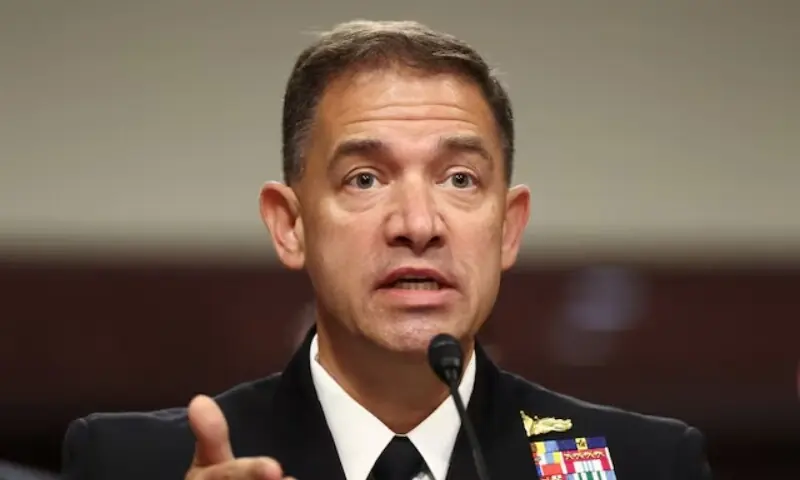
Navy Adm. Bradford Cooper made the comments during testimony before the Senate Armed Services Committee on the status of Operation Epic Fury, the US military campaign against Iran that opened on Feb. 28 and has since been suspended. A statement issued after the May 14 closed briefing also included Cooper’s assessment of American military engagement across South and Central Asia.
“The shared threat of external operations emanating from Afghanistan continued to be an animating force among our partners,” Cooper said. “Pakistan, especially, is a critical CT partner that is central to the fight against ISIS-K in the region.”
The admiral said the military-to-military relationship between Washington and Islamabad has delivered concrete results, including action against “high-value individuals with American blood on their hands.” He added that the same partnership had enabled Centcom to provide meaningful assistance to Pakistan after catastrophic floods swept the country in September 2025. “These tangible, mutual wins are direct reflections of our enduring friendship and shared resolve,” Cooper told the committee.
Cooper also noted that governments across Central Asia continue to watch Afghanistan-based terrorist threats with unease. The testimony underscores the durability of a counterterrorism relationship that has produced several high-profile successes in the past 15 months. In March 2025, shortly after he began his second term, President Donald Trump announced that Pakistani authorities had helped capture the man responsible for the Abbey Gate bombing at Kabul airport in August 2021. The Islamic State group claimed responsibility for the attack, which killed 13 American service members and roughly 170 Afghan civilians.
Trump publicly credited Pakistan at the time. “I want to thank especially the government of Pakistan for helping arrest this monster,” he said. In June 2025, Cooper’s predecessor, Army Gen. Michael Kurilla, offered his own strong endorsement. He called Pakistan “a phenomenal partner in the world of counter-terrorism” and said Islamabad had carried out aggressive operations against ISIS-K, especially in Balochistan province. “Pakistan has gone after ISIS Khorasan, killing dozens of them,” Kurilla said.
Last August, the two governments held a formal US-Pakistan Counterterrorism Dialogue in which the United States reiterated its commitment to fighting terrorism in all its forms. That same month, the State Department designated the Balochistan Liberation Army a foreign terrorist organization, a step Pakistan had long requested.
On Friday in Islamabad, Interior Minister Mohsin Naqvi met with Paul Kapur, the assistant secretary of state for South and Central Asian affairs. Naqvi told Kapur that bilateral ties had grown stronger during Trump’s current term, according to a Pakistani government statement. The relationship has not been without complications. US and Pakistani officials have differed at times over strategy in Afghanistan and other regional issues. Yet counterterrorism cooperation has remained a consistent point of alignment, driven by the persistent danger posed by groups such as ISIS-K that have shown both the intent and the reach to strike beyond Afghan borders.
Copyright © 2021 Independent Pakistan | All rights reserved