By Staff Reporter
ISLAMABAD: Pakistan will not normalise relations with Israel unless an independent Palestinian state is established, Deputy Prime Minister and Foreign Minister Ishaq Dar said on Friday, rebuffing pressure from U.S. President Donald Trump to expand the Abraham Accords as part of a broader Middle East peace settlement.
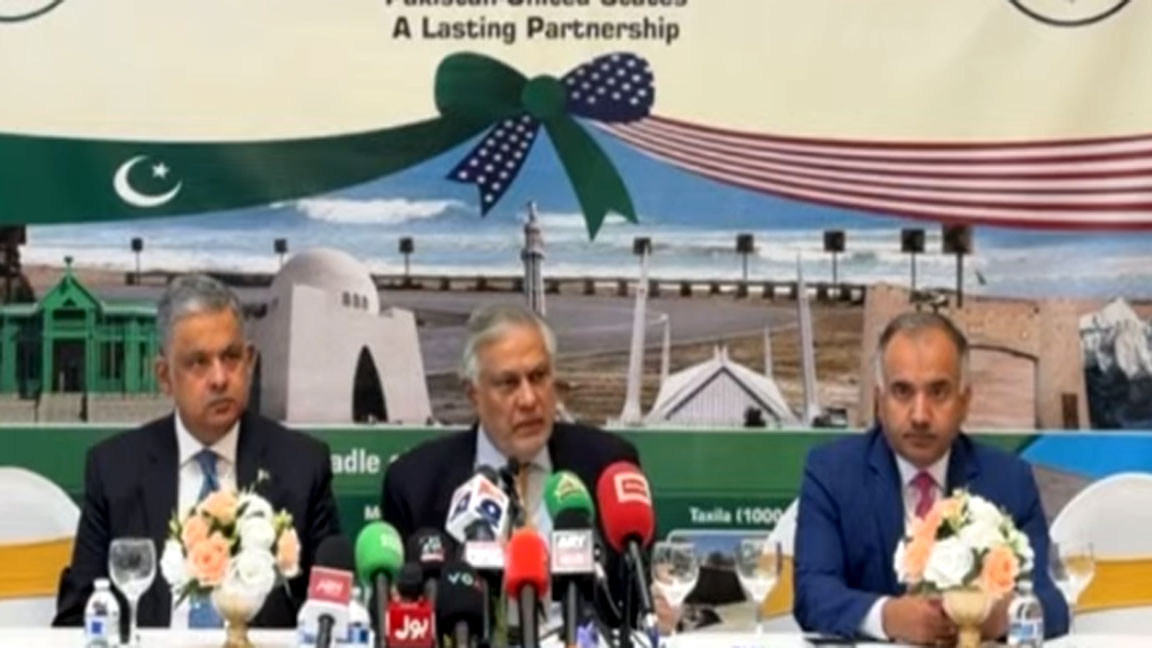
Dar’s remarks, delivered at a press conference at Pakistan’s embassy in Washington following talks with Secretary of State Marco Rubio, drew a firm line around one of Islamabad’s oldest and most politically entrenched foreign policy positions — even as Pakistan simultaneously sought to deepen its ties with Washington through its role as a mediator between the United States and Iran.
“Pakistan remains steadfast in its position on Palestine and Gaza,” Dar said. “Israel must move towards the establishment of a Palestinian state before there could be any change in Pakistan’s stance towards Israel.”
He went further in addressing what he called widespread speculation about Islamabad’s intentions. “There are a lot of rumours going on related to the Abraham Accords. Let me be clear — Pakistan’s stance is very consistent. Until Palestine is recognised on the basis of pre-1967 borders with Quds Al Sharif, occupied East Jerusalem, as its capital, there will be no flexibility.”
The statement came days after Trump, in a post on Truth Social last Monday, declared it should be “mandatory” for a list of Muslim-majority nations — including Pakistan, Saudi Arabia, Qatar, Turkey, Egypt and Jordan — to join the Abraham Accords simultaneously as part of any agreement to end the ongoing US-Israeli conflict with Iran. “It should start with the immediate signing by Saudi Arabia and Qatar, and everybody else should follow suit,” Trump wrote.
Pakistan’s Defence Minister Khawaja Muhammad Asif had already rejected the notion earlier in the week, saying Islamabad could not join any arrangement that conflicted with its “fundamental ideologies.”
Dar did not directly address whether the accords had been raised in his meeting with Rubio, saying instead that he had reiterated Pakistan’s Palestine position during engagements at the United Nations earlier this week, where he attended a China-sponsored Security Council discussion on the role of the UN in resolving global disputes.
Rubio praises Pakistan’s mediation
The Pakistani foreign minister’s visit to Washington carried a separate and more constructive diplomatic strand: U.S. recognition of Islamabad’s role in brokering ceasefires between Washington and Tehran.
The State Department, in a statement attributed to spokesperson Tommy Pigott, said Rubio had thanked Dar “for the constructive role Pakistan continues to play in realising President Trump’s vision for peace in the Middle East and its mediation efforts with Iran.” Rubio later posted a version of the same message on X.
Dar said both ceasefires between the U.S. and Iran had been made possible through Pakistani efforts and that Washington had conveyed its appreciation clearly during Friday’s meeting, which he described as held in a “cordial” atmosphere and attended by Pakistan’s Ambassador to the United States, Rizwan Saeed Sheikh, and senior Foreign Office officials.
The Foreign Office in Islamabad echoed that characterisation in a separate statement, saying the two sides “expressed satisfaction over the positive momentum in Pakistan-U.S. bilateral relations” and agreed to advance cooperation across trade, investment, security and counter-terrorism.
Dar declined to elaborate on the substance of Pakistan’s back-channel discussions with American and Iranian officials, saying Islamabad’s mediating role depended on discretion.
“Pakistan cannot compromise its role as a mediator by divulging details of the talks, because we are deeply invested in the peace process,” he said. “We are the mediators and, as such, we are required to maintain secrecy. Both the Americans and the Iranians appreciate our approach.”
He said Qatar, Oman and several other countries had expressed interest in hosting the negotiations, but Pakistan had been selected because of its relationships with all parties.
When asked whether Pakistan’s mediating role could translate into a more strategic partnership with Washington — historically a transactional relationship — Dar said he had proposed substantive discussions on building such a partnership during Friday’s meeting and that the proposal had been accepted. He added that Rubio had agreed to visit Pakistan later this year.
“The mediation has brought global recognition for us,” Dar said, “as did our victory against India in May 2025.”
Rubio also expressed condolences during the meeting for victims of a suicide bombing in Quetta last Sunday that targeted a shuttle train, killing more than ten people.
Trump’s Iran deal in the balance
The Dar-Rubio meeting took place against a backdrop of delicate and fast-moving diplomacy. American media reported on Friday that US and Iranian negotiators had edged toward a memorandum of understanding to extend their fragile ceasefire by 60 days and open talks on Iran’s nuclear programme, but the deal remained contingent on Trump’s personal approval.
Trump said during the day that he was making a “final determination” and convened a meeting in the White House Situation Room. Hours later, a White House official confirmed the meeting had concluded without providing details, and Trump had not announced a decision.
In a Truth Social post, Trump said any deal would require Iran to commit never to acquiring a nuclear weapon and to immediately reopen the Strait of Hormuz to unrestricted shipping in both directions. “Nuclear material will be unearthed by the US,” he added. “Say HELLO to your wives, husbands, parents, and families from me, your favourite President!”
Iranian officials pushed back sharply. A senior Iranian source, speaking on condition of anonymity, said the prospective agreement contained no nuclear-related provisions. Foreign Ministry spokesperson Esmaeil Baghaei said the management of the Strait of Hormuz was a matter to be decided by Iran and Oman. Iran’s semi-official Fars news agency, citing sources, called Trump’s characterisation an “attempt to portray a fabricated victory” and said the strait would be reopened under Tehran’s conditions once the U.S. lifted its blockade on Iranian ships. Fars also reported that $12 billion in frozen Iranian assets would be released under any deal.
Trump said no money would be exchanged “until further notice.”
The conflict, launched by the United States and Israel on February 28, has killed thousands of people, the majority in Iran and Lebanon, and disrupted global energy markets through Iran’s effective closure of the strait. A first ceasefire brokered through Pakistani mediation took effect on April 8, but follow-on talks in Islamabad failed to produce a lasting settlement. Trump later extended the truce indefinitely.
Pakistan’s Israel red line
Pakistan’s refusal to recognise Israel predates the country’s founding documents and has remained a rare constant across successive civilian and military governments. Pakistani passports carry an inscription noting they are valid for all countries except Israel.
Successive administrations have tied any potential change in that position to the establishment of an independent Palestinian state based on pre-1967 borders, with East Jerusalem as its capital — a threshold that has never been met.
Analysts say the policy is reinforced not only by diplomatic calculation but by powerful domestic constraints. Public opinion polls consistently show overwhelming sympathy for Palestinians, and any government perceived as abandoning the Palestinian cause would face immediate and severe pushback from religious parties, mainstream political opposition and large sections of civil society.
The war in Gaza since October 2023 has, if anything, hardened those attitudes further. A Gallup Pakistan survey from 2023 found 91 percent of respondents sympathised with Palestinians, while only two percent expressed sympathy for Israel.
Senator Lindsey Graham, one of Trump’s closest congressional allies, has publicly warned that refusal to join the Abraham Accords “will have severe repercussions for our future relationships,” calling expansion of the accords “beyond transformative for the region and the world.” Pakistani policymakers and analysts have largely dismissed the pressure as politically unworkable.
Many analysts also note that Pakistan’s approach to Israel is closely tied to Saudi Arabia’s. Riyadh, which controls Islam’s holiest sites and maintains extensive financial, defence and employment ties with Islamabad, continues to insist that any normalisation with Israel must be linked to a credible two-state solution — a position that closely mirrors Pakistan’s own.
“Any future shift on Israel in Pakistan would be closely linked to Saudi Arabia’s position,” said one Islamabad-based security official. “President Trump is aware of those limitations. That may explain why he has acknowledged that one or two countries could ultimately decide not to join the Abraham Accords. Pakistan is widely viewed as one of the most likely candidates.”
Copyright © 2021 Independent Pakistan | All rights reserved