By Staff Reporter
ISLAMABAD: The government has brokered a sweeping fiscal compact with its two most populous provinces, freezing their shares of national tax revenues and redirecting a portion back to the Centre in a financial restructuring that officials say is essential to fund defence priorities and honour commitments to the International Monetary Fund.
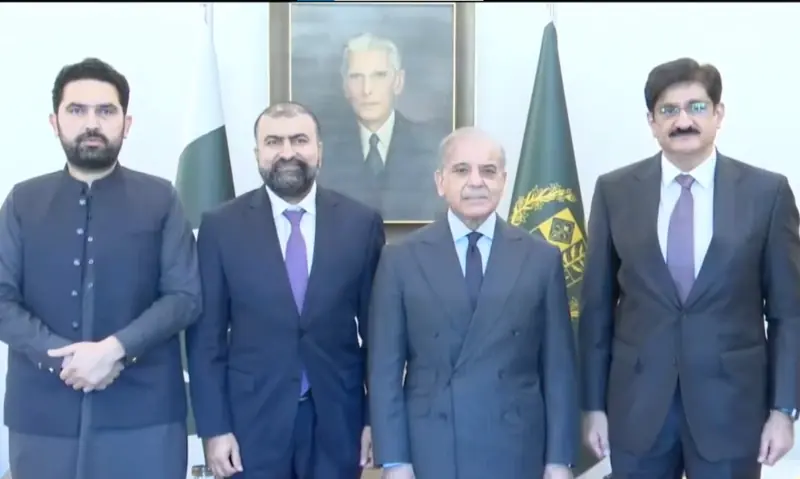
The arrangement, negotiated between Prime Minister Shehbaz Sharif’s Pakistan Muslim League-Nawaz and the Pakistan Peoples Party — which governs Sindh and anchors the ruling coalition — could channel between Rs1.3 trillion and Rs1.7 trillion in additional resources to Islamabad during fiscal year 2026-27. The price is a visible contraction in public investment across the federation, with development budgets at both the federal and provincial level facing significant compression.
The National Economic Council, Pakistan’s highest constitutional forum for economic planning, convened Wednesday after four successive postponements to formally ratify the arrangement, which had been in negotiation for weeks. Prime Minister Shehbaz chaired the meeting, attended by three of the country’s four chief ministers and senior federal ministers.
“Without federal and provincial integration and support, we would not have reached this point,” Shehbaz said in televised remarks. “Now we have to move forward quickly.”
A Dynamic Number, Not a Fixed Transfer
What distinguishes the deal from earlier reporting is its deliberately fluid design. Rather than a fixed sum, the additional revenues flowing to the Centre are explicitly linked to Federal Board of Revenue collection performance. The current-year FBR baseline stands at Rs13,005 billion; any collection above that level would be retained by Islamabad rather than distributed to provinces under the existing National Finance Commission formula.
Saleem Mandviwalla, the PPP’s former finance minister and a senior member of the negotiating team, confirmed the arrangement while stressing its flexibility. “Whatever the requirement may be, it would be jointly covered by the Centre and the provinces,” he said. “It will be done within existing resources and without additional taxes.” He put the likely additional fiscal requirement at between Rs1.2 trillion and Rs1.5 trillion.
The accounting mechanism is designed with some care. Rather than formally amending or suspending the NFC award — which would require constitutional processes and risk setting an unwelcome precedent — the Centre will continue to transfer full provincial shares as normal. Provincial governments will then credit the incremental surplus back to federal accounts. The circular flow preserves the appearance of NFC compliance while achieving the fiscal outcome Islamabad requires.
A more aggressive option was on the table: removing customs duties from the federal divisible pool entirely via a presidential order under Article 160(3) of the Constitution, a move that could have generated nearly Rs1 trillion in additional federal headroom. Officials concluded the legal and political complications were prohibitive. Mandviwalla was unequivocal: “The idea of excluding customs duty from the divisible pool is nonsense and stands nowhere now.”
PPP’s Concessions Had a Price
The PPP’s cooperation came with concrete quid pro quos. In exchange for Sindh’s agreement, the federal government committed to more than tripling funding for the Sukkur-Hyderabad Motorway — the M-6 — from Rs20 billion approved by the Annual Plan Coordination Committee to approximately Rs70 billion, along with firm commitments for actual disbursement and accelerated construction during the coming fiscal year, not merely a paper allocation, sources familiar with the discussions said.
Development Budgets Under the Knife
The fiscal reordering has left unmistakable marks on Pakistan’s public investment plans. The NEC has significantly revise downward both federal and provincial development outlays, which had been collectively submitted to the APCC at Rs4.715 trillion for 2026-27 — a figure now widely understood to be aspirational.
Planning Minister Ahsan Iqbal confirmed this week that the proposed Public Sector Development Programme of Rs1.126 trillion has already been trimmed by Rs126 billion, or roughly 11%, bringing the federal development allocation to Rs1 trillion. Iqbal said the Finance Ministry had communicated the revised ceiling to his ministry. He added that no new development scheme would be admitted to the coming year’s programme, aside from projects proposed by the Ministries of Defence and Interior.
The Centre had already carved out approximately Rs175 billion in PSDP reductions through addenda, corrigenda, and prime ministerial directives. Provincial development plans face equivalent pressure. Punjab had submitted an Annual Development Plan of Rs1.45 trillion — a 17% year-on-year increase and roughly half of total provincial investment — while Sindh’s allocation of Rs816 billion was already below the current year’s Rs887 billion. Khyber Pakhtunkhwa had pitched Rs564 billion and Balochistan Rs308 billion, already Rs53 billion below current-year levels. All four are expected to compress further. Three provinces — Punjab, Sindh and Balochistan — are understood to have agreed to freeze their development budgets at this year’s actual spending levels, freeing up an estimated Rs350 billion or more in combined provincial headroom.
Defence and Debt Drive the Math
The fiscal urgency is in part a product of scale. The IMF has pencilled in Rs2.665 trillion for defence spending in 2026-27, but Islamabad is pushing for closer to Rs3 trillion, citing elevated hostilities along both its eastern and western frontiers. The Rs335 billion allocation planned for critical water infrastructure — including the Diamer Basha, Mohmand, and Dasu dams — represents an additional claim on strained public finances.
A revenue shortfall at the Federal Board of Revenue has compounded the pressure. Petroleum levies have been raised partly to offset the FBR gap, a burden that has fallen disproportionately on salaried workers, whose direct tax contributions have climbed to more than Rs600 billion in recent years. The government is now finalising Rs50 billion in income tax relief for the salaried class, targeted at earners above Rs183,400 per month, with a revised rate structure that would lower rates for incomes up to Rs267,000 and introduce new brackets further up the income scale.
IMF Watching Closely
The global lender has set explicit conditions requiring that parliament approve only the IMF-endorsed budget, designed to prevent fiscal slippage. Shehbaz told the NEC that he had spoken with IMF Managing Director Kristalina Georgieva a day earlier. “She was extremely appreciative of Pakistan’s sincere efforts,” he said.
The premier acknowledged the geopolitical backdrop that has complicated the budget process — specifically the surge in global oil prices triggered by conflict in the Middle East, which forced increases in domestic petroleum product prices. He said the federal government had spent Rs128 billion from its “extremely limited resources” before drawing on provincial assistance, and credited federal-provincial coordination for preventing fuel shortages or queues at filling stations.
“Today, despite having to face big challenges, our economy is stable at the macroeconomic level,” Shehbaz said. “But injecting growth into this is an extremely important process.”
One Province Still Out
The most visible gap in the compact remains Khyber Pakhtunkhwa. The province, governed by Imran Khan’s Pakistan Tehreek-e-Insaf, had not joined the arrangement as of Wednesday. KP’s finance adviser said publicly earlier this week that the province would not transfer additional NFC revenues to the Centre without a meeting involving the PTI founder — a condition that keeps Islamabad’s consolidation effort incomplete. Punjab Chief Minister Maryam Nawaz, a key figure in the negotiations, was absent from Wednesday’s NEC session, recovering from a recent medical procedure.
Copyright © 2021 Independent Pakistan | All rights reserved