By Staff Reporter
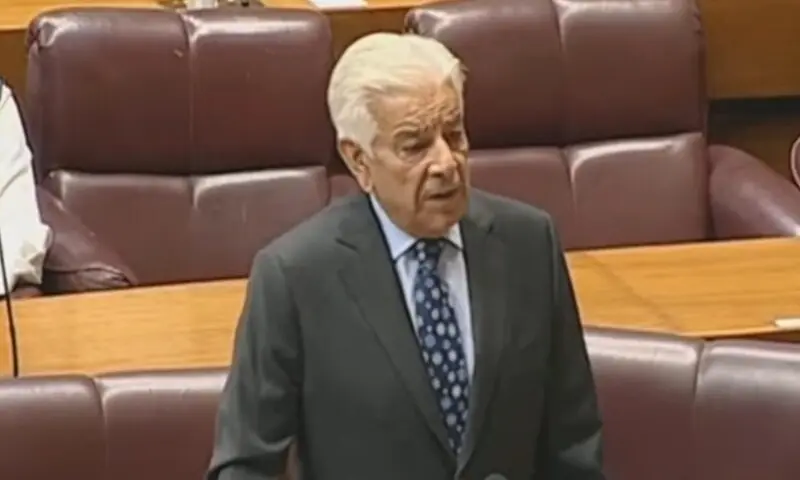
ISLAMABAD: Defence minister took to the floor of the National Assembly on Thursday to rebuke a banned Kashmiri protest movement, urging it to settle its grievances at the ballot box rather than through marches and confrontation — as that very movement’s supporters massed on the outskirts of a regional capital and a fragile standoff showed no sign of resolution.
Khawaja Asif, addressing parliament with a firmness that at times shaded into warning, directed his remarks at the Joint Awami Action Committee — the JAAC — a group that the Azad Jammu and Kashmir government declared a proscribed organization only days earlier. The committee has been at the center of widening unrest in the disputed region, fueled in large part by its demand to abolish 12 seats in the AJK Legislative Assembly that are reserved for refugees who fled Indian-occupied Jammu and Kashmir after the 1947 partition and subsequently settled in mainland Pakistan.
“How could you exclude them from the electoral process?” Asif said, his voice rising. The matter, he maintained, belonged not to street committees or protest convoys, but to the voters of the region themselves. With regional elections scheduled for July 27, he called on the JAAC to raise the issue publicly and “take it to the people” — rather than attempting to shape the legislative body “as per their will.”
The defence minister’s comments landed against a backdrop of deepening crisis. Hundreds of JAAC supporters, having spent the night camped at scattered points across Hajira tehsil, resumed their westward march on Wednesday toward Rawalakot, the main city of Poonch district. By evening, according to witnesses and official sources, protesters had reached Chehr Bazar and taken up positions in the industrial area near the city’s Eidgah mosque, on its eastern flank. A second contingent from the Mang and Thorar areas had settled near the bus terminal to the south. A third, smaller group from Bagh district was stationed at a school in Kotehri village to the north.
The city, residents said, had shuttered entirely. Public transport vanished from the roads. Announcements broadcast over mosque loudspeakers warned citizens to remain indoors and cautioned that anyone entering from outside would bear responsibility for whatever followed. Law enforcement personnel had blockaded key roads and taken up positions at multiple points across the city.
The initial convergence had begun Tuesday night, when large groups from Mirpur, Kotli, Bhimber and Dadyal pushed into Poonch district through Tatta Pani, reportedly clashing with security forces along the way. Unconfirmed accounts described casualties, though officials offered no formal acknowledgment of the figures.
Behind the scenes, there appeared to be at least some effort to defuse the situation. A senior government official told Dawn that Umar Nazir Kashmiri, regarded as one of the JAAC’s more hardline figures, had submitted what was described as a six-point petition to unspecified “decision-making authorities.” Among the demands: that the government rescind its order proscribing the group, address the deaths that occurred during protests and drop the criminal cases that followed, and lift movement restrictions. The petition also proposed a kind of freeze — that both security forces and protesters remain in place while the demands were being considered. The official said Kashmiri had given assurances that the marchers would not advance further.
No JAAC leader could be reached to confirm or deny the account.
The government’s posture has hardened considerably since last Friday, when AJK authorities declared the JAAC a proscribed organization, saying the group had engaged in terrorism and acted in a manner “prejudicial to peace and security.” The crackdown that followed swept up scores of leaders and activists across the region. Sedition proceedings have been initiated against two JAAC figures, and a reward of 10 million rupees has been announced for information leading to the capture of four others.
The immediate trigger for the crackdown was a violent protest in Rawalakot, in which at least four law enforcement personnel and seven civilians were killed. Islamabad subsequently dispatched federal paramilitary forces to reinforce a regional police force stretched well past capacity. Authorities have advised intending visitors to postpone their trips to the area through at least June 20.
In parliament, Asif did not soften his language when addressing the question of who has a stake in Azad Kashmir — or who has the right to speak for it.
The Kashmiri refugees who hold those 12 contested assembly seats had paid a “heavy price” to migrate, he said, and the JAAC had no standing to strip them of their voting rights. He noted, pointedly, that he had once ensured the formal settlement of such refugees in his own constituency, people who had lived for decades in a limbo that left them without reliable access to electricity or gas.
His language turned sharper when he addressed the JAAC’s broader legitimacy. “What have they sacrificed for Kashmir?” he asked. “They do not have any stake, nor have they invested anything in the liberation of Kashmir.” The soldiers on the mountain passes protecting the region, he said — Punjabis, Baloch, Pashtuns, Sindhis — were Pakistanis. “The word Azad would not have been there if it were not for Pakistan,” he said.
Then came what sounded very much like a warning. If the group chose to take the law into its own hands, he said, the government could not be expected to “stay silent.”
He closed with a remark whose implications were left deliberately open. “I wonder if this hatred has been imported from across the line,” Asif said — a reference, his listeners understood, to the Line of Control that divides the disputed territory between Pakistan and India.
The JAAC, which has organized a series of protests in AJK in recent years over issues ranging from electricity prices to tax policy, was formally banned after announcing a general strike for June 9. The group has rejected the proscription order and continued to organize. Its future, and that of the refugee seats it seeks to abolish, now appears to hinge on whether the petitions being quietly passed to authorities can produce a negotiated pause — or whether the standoff outside Rawalakot tips in a different direction.
Copyright © 2021 Independent Pakistan | All rights reserved