By Staff Reporter
SIALKOT: The 23rd FIFA World Cup began on Thursday, launching nearly six weeks of football across the stadiums of the United States, Canada and Mexico. The players are from 48 nations. The coaches speak dozens of languages. But the ball they will all chase — the one that will determine who lifts the trophy in New Jersey on July 19 — was made in Pakistan.
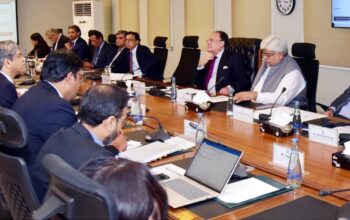
Prime Minister Shehbaz Sharif marked the occasion with a message on X that was equal parts congratulations and quiet national pride. “Pakistan is proud to be part of this global celebration through its renowned sporting goods industry,” he wrote. “The official match balls, ‘Trionda,’ being used at this World Cup have been manufactured in Pakistan, reflecting the skill and craftsmanship of our people.”
Pakistan has never qualified for a World Cup. Its national team has not come close. And yet, the country has spent decades at the very center of the sport’s global machinery, stitching and molding the balls that professionals from São Paulo to Seoul train with, compete with, and celebrate with.
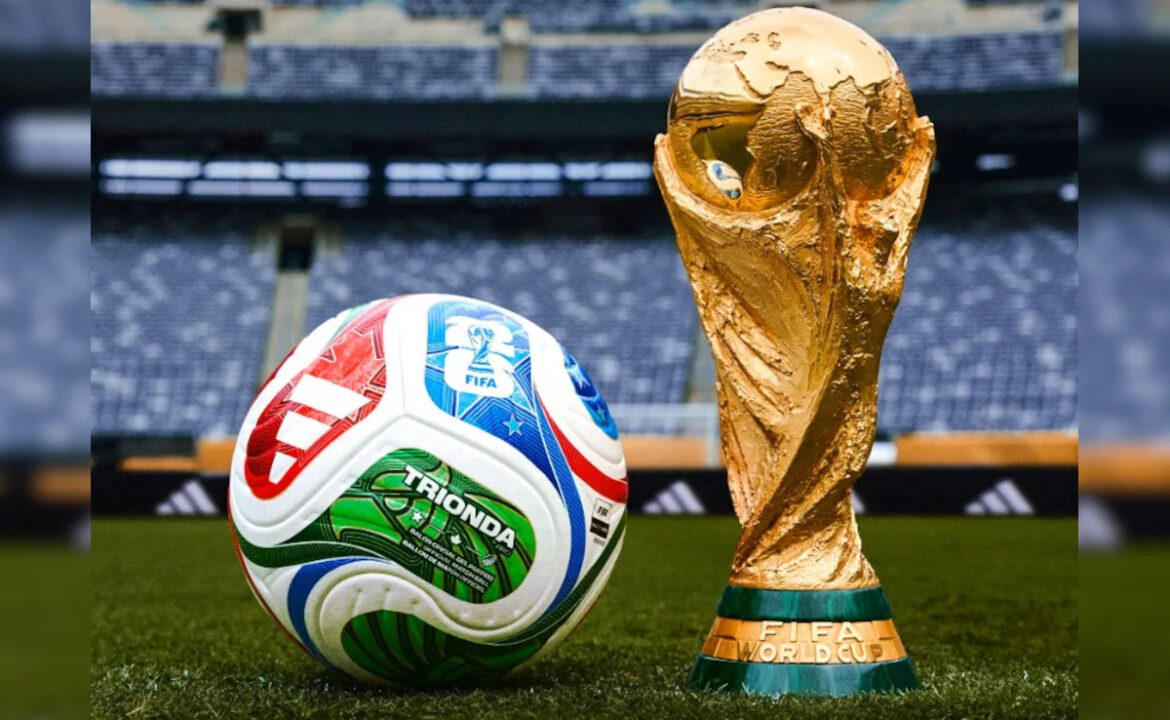
The Trionda — designed by Adidas, the German sporting goods giant — was manufactured by Forward Sports in Sialkot, a city in Punjab province that has long been the world’s dominant producer of footballs. The ball’s name, a fusion of “trio” and “onda” — the Spanish word for wave — nods to the three host nations, and its design carries their symbols: maple leaves for Canada, an eagle for Mexico, stars for the United States. A triangular motif running through the panels is meant to represent the three countries’ unity.
But the Trionda is more than decorative. Its four-panel design incorporates deep seams engineered to provide what Adidas describes as optimal in-flight stability. Embossed icons across its surface are intended to improve grip in wet or humid conditions — a meaningful consideration in the summer heat and humidity of American stadiums. And embedded within the ball is a motion sensor chip that will transmit real-time data on the ball’s movement directly to the video assistant referee system, sharpening the precision of officiating decisions across all 104 matches of the tournament.
“A very special day for football fans around the world as the 23rd FIFA World Cup kicks off today,” Sharif wrote on X. “This global event is a celebration of sport’s unique ability to bring people together across borders, cultures, and nationalities.”
The tournament itself got underway Thursday evening with co-hosts Mexico facing South Africa at the Estadio Azteca in Mexico City, a cathedral of football that hosted the 1970 and 1986 World Cup finals. The stadium’s 85,000 seats were expected to generate a wall of noise that South Africa coach Hugo Broos, a Belgian, acknowledged his players would have to simply endure. “They will have 85,000 Mexicans shouting and singing,” Broos said. “But we have to focus on our game. And if we can do that… then we can have a good game.”
Mexico coach Javier Aguirre, meanwhile, pointed to an uncomfortable bit of history: his country has not won any of its seven appearances in a World Cup opening match. “We have to break the statistic,” Aguirre said. “It will be another source of motivation.”
The second game of the opening day sends South Korea against the Czech Republic in Guadalajara.
The favorites heading into the tournament are Spain, France and England, with reigning champions Argentina looking to Lionel Messi, 38 years old and playing in what is almost certainly his final World Cup, to carry them toward a third title. England arrived in fine form, closing out their preparations on Wednesday with a 3-0 dismantling of Costa Rica — a match in Orlando that was delayed an hour by thunderstorms — with goals from Declan Rice, Anthony Gordon and Ollie Watkins. Coach Thomas Tuchel sounded almost relieved. “Until now, it was more a feeling of a pre-season, like an overseas pre-season,” Tuchel said. “I think we set the tone today.”
The tournament that FIFA is billing as the largest and most lucrative in history — projected to generate $13 billion in total revenue — has not arrived without turbulence. FIFA president Gianni Infantino spent much of Wednesday in Mexico City on the defensive, fielding criticism over ticket prices that in some cases exceeded $30,000. He pushed back, pointing to a tranche of $60 tickets made available in response to public pressure. “Our average price, which is below $500, is again the lowest of the American sports on average,” Infantino said.
More unsettling was the case of Omar Artan, a Somali referee who was denied entry to the United States after arriving in Miami. The US State Department said Artan had “associated with suspected members of terrorist organisations.” FIFA confirmed he will play no part in the tournament. Infantino sought to minimize the episode. “We don’t control everything,” he said. “Sometimes it’s good to chill, relax, we work on everything, we try to solve everything.”
Iran’s participation — fielding a team in a country whose government is engaged in a military conflict with Tehran — drew pointed questions as well. Infantino framed it as a diplomatic achievement. “People were saying Iran couldn’t come to the World Cup,” he said. “There are challenges, it’s not easy, but I don’t know who else would have been able to ensure in these circumstances — which we could not influence — Iran could come and play.”
President Trump, whose immigration policies have created friction around the tournament, confirmed on Wednesday that he plans to attend matches, without specifying which ones. His relationship with Infantino has drawn scrutiny; the FIFA chief was effusive in his praise. “Without his engagement and involvement, I think it would have been, simple as that, impossible to organise a World Cup in the United States,” Infantino said of the president.
Back in Sialkot, the workers who cut, stitched and pressure-tested the Trionda will watch the tournament the same way most of the world does — on screens, from a distance, in a country that has no team in the draw. But the ball that swerves into the top corner, or skips off a goalkeeper’s fingers in the final, will have passed through their hands first.
Sharif closed his message with a wish that carried a particular weight in a city that has spent generations shaping the sport it cannot play in. “May this tournament inspire friendship, unity, and sporting excellence across the world.”
Copyright © 2021 Independent Pakistan | All rights reserved