By Staff Reporter
ISLAMABAD: US President Donald Trump abruptly canceled a planned military assault on Iran on Thursday evening, announcing in a post on Truth Social that negotiations with Tehran had advanced to the point where the Islamic Republic’s leadership had effectively approved the terms of a deal — a claim Iran had not confirmed as of late Thursday.
The reversal came roughly five hours after Trump had warned in a separate post that the United States would be “hitting Iran VERY HARD TONIGHT,” and followed days of escalating strikes that had driven the two countries to the edge of full-scale war. Markets responded immediately to the news of a potential deal: stock indexes surged and oil prices fell sharply.
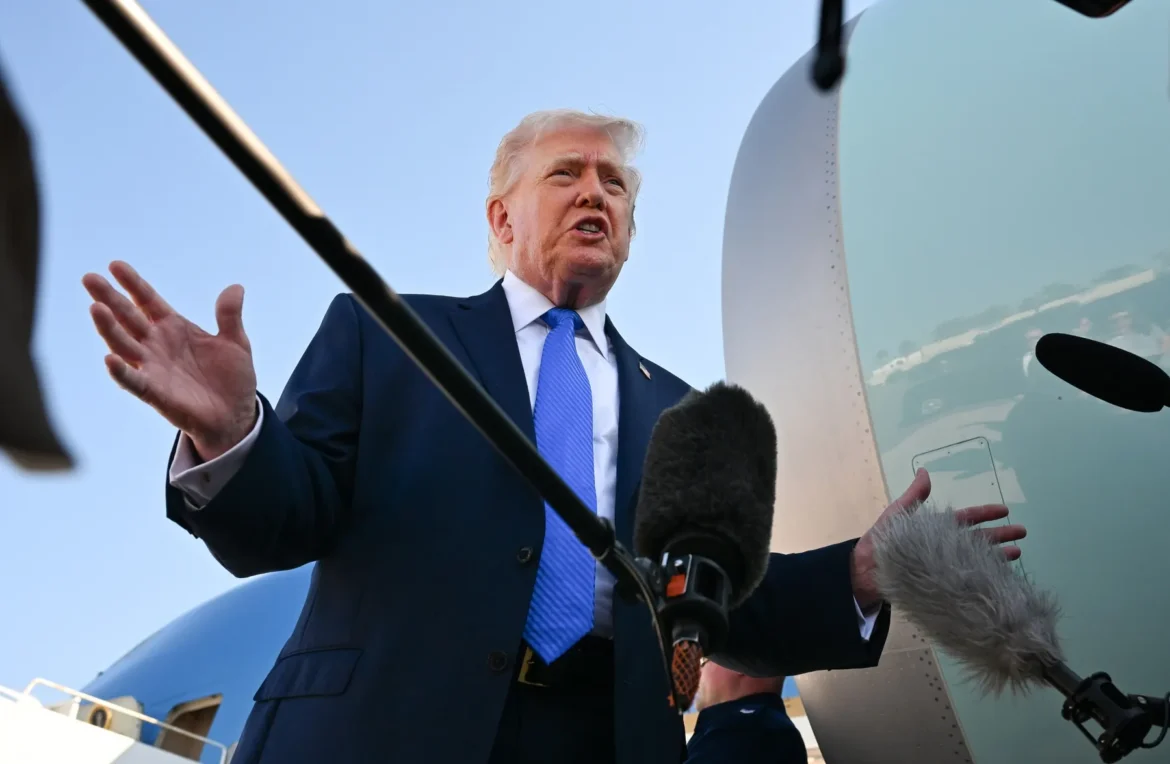
“Based on the fact that discussions with the Islamic Republic of Iran have been brought to the highest level of Iranian leadership and approved, I have, as President of the United States of America, cancelled the scheduled strikes and bombings against Iran this evening,” Trump wrote.
He listed more than a dozen nations — including Israel, Saudi Arabia, the United Arab Emirates, Qatar, Turkey, Pakistan, Bahrain, Kuwait, Jordan and Egypt — as parties who had signed off on the agreement “in both concept and great detail.”
But the president also made clear the deal remained unsigned. The US naval blockade of Iranian ports in the Gulf of Oman, Trump said, “will remain in full force and effect until this Transaction is finalized — Time and place of the signing to be announced shortly.”
An agreement in principle — with the hardest questions still unresolved
The announcement was the latest in a series of proclamations from the White House that a settlement with Iran was within reach, only for talks to stall or collapse. What distinguished Thursday’s claim, according to three sources briefed on the negotiations and cited by Axios, was that Qatari and Iranian officials believed late Wednesday that they had produced an agreed-upon text the United States would accept.
Qatari envoy Ali Al-Thawadi and Iranian Foreign Minister Abbas Araghchi negotiated late into Wednesday night in Tehran, the sources said, narrowing gaps on three central disputes: the mechanism for releasing Iran’s roughly $100 billion in frozen assets — the issue Iranian officials have pressed most forcefully — arrangements for reopening the Strait of Hormuz during a proposed 60-day ceasefire period, and the structure of negotiations over Iran’s nuclear program during that window.
Iranian officials told several countries on Thursday that Tehran had reached an agreement in principle, the sources said, but that Supreme Leader Mojtaba Khamenei had not yet given his final approval. And, according to the sources, both the Iranians and the Qataris stressed that American airstrikes carried out overnight had significantly deepened Iranian suspicions about Trump’s actual intentions.
Hours of escalation, then reversal
The about-face unfolded with the whiplash speed that has come to define Trump’s approach to the conflict. Earlier Thursday, the president had announced that the United States would soon seize Kharg Island, the heavily guarded installation off Iran’s southern coast that processes roughly 90 percent of the country’s crude oil exports — a target so strategically significant that it has long been considered one of the most consequential pressure points available to any adversary of the Islamic Republic.
“At some point in the not too distant future, we will be taking Kharg Island, and other oil infrastructure points, and assume total control of their Oil and Gas Markets,” Trump wrote, invoking as a parallel the U.S. intervention in Venezuela, which included the removal of President Nicolás Maduro. Maduro’s replacement, Delcy Rodríguez, has since opened Venezuela’s state oil industry to foreign investors under heavy American pressure.
In an interview with Fox News shortly after, Trump said taking Kharg Island had always been his “preference,” though he acknowledged doubts about public support for such an operation. “I don’t know that America has the stomach for it, to be honest,” he said, adding that he remained opposed to deploying ground troops in Iran.
A fragile ceasefire under siege
The declarations came at a particularly fraught moment. Iran’s Foreign Ministry said Thursday that the latest round of American strikes had rendered the existing pause in fighting “practically meaningless.” Mohammad Bagher Ghalibaf, Iran’s top nuclear negotiator, warned on X that “wrong strategies and impulsive decisions will reset the entire board for the worse, explode energy infrastructure and markets and create an endless quagmire that you will be stuck in for years.”
Iran’s joint military command, the Khatam al-Anbiya Central Headquarters, issued a warning through state media that Iran would respond more severely than before if the United States launched additional attacks.
Recent American strikes have hit the port city of Bandar Abbas, Qeshm Island, and the southern towns of Sirik, Minab and Karaj, west of Tehran. Iran, in turn, has struck U.S. military facilities in Bahrain, Kuwait and Jordan. Trump accused Iran on Thursday of shooting down a U.S. Army helicopter over the Strait of Hormuz on Monday — an incident that triggered a new round of American missile strikes on Tuesday. The United States fired again on Wednesday.
Iran also announced Thursday the full closure of the strait, the narrow waterway through which roughly a fifth of the world’s oil supply passes and which has emerged as Tehran’s most powerful lever in the conflict. U.S. Central Command separately announced Thursday that American forces had disabled three oil tankers in the Gulf of Oman as part of the naval blockade.
The strikes carried human costs beyond the military. India formally called on the United States to halt its attacks after confirming that three Indian crew members were killed when an American strike hit a vessel.
Iranian state media reported Thursday that Elon Musk’s commercial operations in the Middle East — including SpaceX’s Starlink satellite internet service — would henceforth be regarded as military targets.
The politics of a deal
Analysts have long argued that Trump faces a particular political constraint in these negotiations: any agreement must, in his telling, surpass the terms of the 2015 Joint Comprehensive Plan of Action, the nuclear accord from which he withdrew in 2018 and which he has consistently derided as a giveaway. The administration has twice conducted strikes against Iran since Trump returned to office, even as talks on its nuclear program continued.
Analysts who have tracked the negotiations closely say both sides are attempting to use escalation as a form of coercion. Reporting from Washington for Al Jazeera, correspondent Kimberly Halkett described Trump’s combination of military threats and Truth Social posts as “diplomacy at the barrel of a gun.” Abas Aslani, a senior research fellow at the Centre for Middle East Strategic Studies, said the Trump administration’s strategy was to manufacture leverage — to push Iran into concessions it had resisted in prior rounds of negotiations.
Iran, Aslani said, has its own logic for escalation: the need to restore a sense of deterrence. “The previous response to the U.S. attack was not enough to ensure that they will not attack Iran again,” he said. “That is why they might be escalating to de-escalate.”
Iran had not commented publicly on Trump’s claims by Thursday evening.
Copyright © 2021 Independent Pakistan | All rights reserved