By Staff Reporter
Pakistan’s budget today will be framed as the dividend of two years’ hard stabilisation work. A day earlier, the economic survey supported that framing: GDP grew 3.7 percent, the economy reached a record Rs126.87tn ($452.1bn), inflation fell from 23.4 percent to single digits, and the fiscal deficit narrowed to levels the finance ministry calls the best in decades. By the standard measures of macroeconomic management, Pakistan has had a good year, and the finance ministry is not wrong to say so.
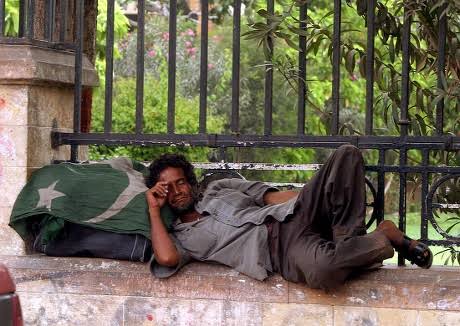
Buried deeper in the same survey is a number that ought to have led every front page: the poverty rate has risen to 28.9 percent, up from 21.9 percent in 2018-19 — a reversal of fifteen years of progress, during which poverty had fallen from over 50 percent. The Gini coefficient, Pakistan’s measure of how unequally income is distributed, rose from 28.4 to 32.7 over the same stretch. Rural poverty, at 36.2 percent, is now more than double the urban rate. And in the labour market, unemployment rose to 7.1 percent from 6.3 percent in a year when the economy grew — the workforce expanded by close to ten million people, but joblessness grew faster than employment did.
The most telling number in the entire survey, though, is a quiet one about food. Average monthly consumption of wheat, rice, pulses, milk and meat — the staples that anchor a basic diet — has fallen for every one of those items since 2018-19. In their place, consumption of vegetable ghee, cheap and nutritionally thin, has risen 81 percent. The survey’s own explanation is unambiguous: when food prices outrun household incomes, families substitute down. That is not a forecast or a model. It is what has already happened over the same years the government now describes as a stabilisation success.
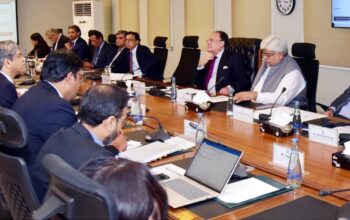
None of this is happening by domestic choice alone. The targets, the timing and the trade-offs all sit inside Pakistan’s $7bn IMF programme, which has asked for at least Rs430bn in additional fiscal measures this year, with a roughly matching contribution expected from the provinces. The IMF’s own growth forecast for next year, at 3.5 percent, is more cautious than the government’s 4.1 percent target — a gap that matters, because a shortfall in growth makes the FBR’s revenue increase even harder to hit without leaning further on the same taxpayers. The Fund is not dictating which sectors get squeezed; that discretion remains Islamabad’s. But the overall scale of the adjustment, and the deadline for delivering it, are not.
This is the context in which today’s budget asks the FBR to raise Rs15.267tn — 37 percent more than a target the agency is already on track to miss this year. And it is the context in which the question of who pays for that becomes not a technical detail but the central fact of the budget. The answer, as it has been for years, is the formal economy: registered companies and salaried employees, because the alternative — agriculture, retail, real estate, where most of the country’s income genuinely sits — remains untaxed, with just 1.3 percent of Pakistanis filing returns showing taxable income.
For companies, that means the super tax: an additional three percent levy on large firms’ income, introduced in 2022 as a two-year emergency measure and now in its fourth year with no end specified. Foreign companies, which together contribute about a third of Pakistan’s total tax take, have asked for it to be phased out by one percentage point a year over three years — alongside a similarly gradual cut in the headline corporate rate from 29 to 25 percent. They point to Türkiye, which halved its corporate tax rate for manufacturers last month specifically because of the regional war’s economic fallout — the same war Pakistan cites as a reason it cannot afford to do anything similar.
For salaried workers, the top income tax rate now stands at 35 percent, after two increases in two years, on an economy where per capita income is $1,901. Companies have proposed cutting that to 25 percent and doubling the tax-free threshold to Rs1.2m. The finance minister, asked directly what salaried workers could expect from this budget, said only that the prime minister had told him to focus on the sector — without saying what that focus would produce.
The other side of the ledger is development spending, and here the numbers move in the opposite direction. In the days before this budget, the federal government and the provinces agreed to cut national development spending by close to a quarter, from Rs4.264tn to Rs3.218tn. Provincial development budgets were reduced by nearly 30 percent — Punjab’s by almost half — and the money freed, estimated at Rs800bn-900bn, has been redirected toward what the planning minister called strategic needs: water and national security. Pakistan’s security challenges are real and not in dispute. But this is also money that will not go toward the things the survey itself says Pakistan needs most: investment, currently stuck at 14.4 percent of GDP, savings, which actually fell this year from 14.87 percent to 14.13 percent of GDP, and health spending of just 0.8 percent of GDP — a level that has barely moved in years and that most health economists would call inadequate for a population this size.
The finance minister said this week that the country needs a paradigm shift in the age of AI, because traditional indicators are not delivering job growth. He is right about the diagnosis. The budget presented today is not the shift he is describing. It is a careful, IMF-compliant continuation of an approach whose results are now visible in the same survey that announces it as a success — a rising poverty rate, shrinking diets, and a labour market that cannot keep pace with the people entering it. Pakistan has stabilised its accounts. Whether it has stabilised anything that its own citizens can feel is a separate question, and on the evidence of this week’s own government data, the answer is no.
Copyright © 2021 Independent Pakistan | All rights reserved