By Staff Reporter
RAWALAKOT: They came by the thousands, converging on the eastern edges of this mountain city from across the rugged districts of Azad Jammu and Kashmir. By midnight Thursday, they were gone.
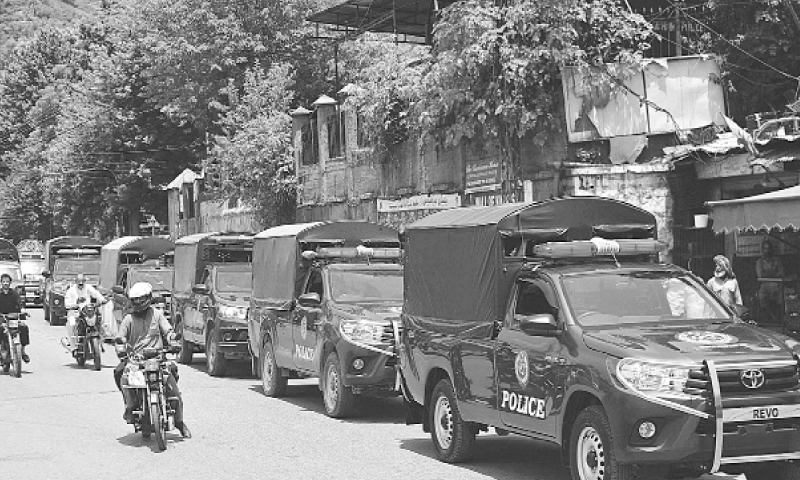
The swift and total dispersal of activists aligned with the Joint Awami Action Committee — a protest movement that authorities proscribed under anti-terrorism laws last week — came hours after the region’s top civilian administrator dispatched nearly a thousand paramilitary troops, police officers and armored vehicles in a conspicuous show of force intended, officials acknowledged, to signal that any further defiance would carry severe consequences.
The standoff’s end did little to diminish the scale of what had already transpired. A tally compiled by AFP on Friday, drawing on official figures from multiple district authorities, placed the death toll from days of clashes between security forces and protesters at 20 — a sharp and sudden rise from the seven fatalities officials had reported at the start of the week. Among the dead were four police officers. The rest were civilians.
“There is not a single participant at any of the three sit-in sites on the outskirts of Rawalakot,” Poonch Divisional Commissioner Sardar Waheed Khan said in the early hours of Friday. “All have unconditionally surrendered before the state and have returned — rather fled — back to their respective areas.”
The collapse of the protests caps a volatile week in a territory that authorities regard as acutely sensitive, given its proximity to the Line of Control dividing Kashmir between Pakistan and India, and its fraught history of armed conflict with its neighbor. Mobile internet access has been largely cut off across the region. Shops in the capital, Muzaffarabad, shuttered for days in solidarity with the movement. Federal paramilitary reinforcements were rushed in to bolster a thinly stretched local police force, and the government advised prospective visitors to postpone travel until at least June 20.
The Committee and Its Demands
The JAAC, which has mounted protest campaigns in Azad Kashmir for several years, draws support from a broad coalition of civic activists, traders and residents who say the region is systematically shortchanged by Islamabad. Among its most contentious demands: the abolition of 12 seats in the territory’s Legislative Assembly reserved for descendants of Muslim refugees who fled Indian-occupied Jammu and Kashmir after the 1947 partition and settled in mainland Pakistan. Critics of those seats argue they dilute the political voice of permanent Azad Kashmir residents.
The government’s decision last Friday to designate the JAAC a proscribed organization — accusing it of engaging in terrorism and acting against the peace and security of the state — ignited fresh fury. Within a day, security forces launched a sweeping crackdown, arresting scores of the group’s leaders and rank-and-file members across multiple districts. Authorities ordered sedition proceedings against two senior figures and announced a reward of 10 million rupees for information leading to the arrest of four others.
The group’s members dismissed the terrorism designation as political persecution. “This is oppression,” JAAC supporters said, insisting they were exercising legitimate rights to protest economic mismanagement and demand political accountability.
Days of escalating confrontations followed, with particularly intense clashes erupting on the outskirts of Rawalakot. The higher education minister of the local government, Malik Zafar, told AFP that seven people had been killed this week in his own constituency of Kotli alone. Khurram Iqbal, a senior police officer in Mirpur, confirmed that a protester had died in clashes on Wednesday. Commissioner Waheed, the top civilian official in Rawalakot, said 12 people had been killed within his jurisdiction, including the four officers. Rawalakot observed a complete commercial strike for the third consecutive day Thursday.
The JAAC’s protests are not without precedent. In September, days of violent clashes between security forces and the movement left nine people dead, drawing condemnation from rights groups and opposition politicians.
The Night the Protesters Left
Thursday’s operation began taking shape in the afternoon, when the administration assembled a dedicated contingent of roughly 1,000 personnel drawn from the Rangers, Federal Constabulary, and both Islamabad and Azad Kashmir police. Between 70 and 80 armored and other vehicles staged a flag march — a deliberate display of force meant to communicate the administration’s resolve before a single order was issued.
Behind the scenes, Khan said, the administration was engaged in parallel backchannel negotiations with Umar Nazir Kashmiri, a hardline core member of the JAAC whom authorities had sought to arrest earlier that day. The message was delivered through two local intermediaries — District Bar Association President Sardar Javed Nisar and Poonch District Council Chairman Sardar Javed Sharif — who conveyed to Kashmiri that his personal safety, and that of the protesters around him, depended on an unconditional standdown.
Kashmiri’s initial response, according to Khan, was a conditional offer: if the proscription order against the JAAC were lifted, he would call off the sit-ins and turn himself in to the local police. Khan said he relayed the demand up the chain of command and told the JAAC leadership to hold their position while he sought guidance. The committee’s tone, he said, shifted noticeably during that interval — leaders began speaking more guardedly about continuing only a “peaceful sit-in.”
Then the armored convoy rolled through Rawalakot.
“When the message of a huge flag march reached the JAAC camp, they became apprehensive that the administration was contemplating launching a decisive action — perhaps a blitz,” Khan said.
By midnight, the administration was receiving reports of panic spreading through the JAAC’s ranks at the main gathering site in the Eidgah area. Within an hour, Khan said, the entire field was empty. Word spread quickly to the two other encampments on the city’s outskirts, and they dissolved as well.
Khan said the administration, which had earlier blocked the national identity cards and passports of all 31 core members of the JAAC, had directed deputy commissioners across the territory to begin raiding the homes of activists facing outstanding arrest warrants.
“God willing, Umar Nazir will also soon surrender himself,” Khan said. “This time,” he added, “there will be no compromise on the writ of the state.”
A Region on Edge
Speaking in the National Assembly on Thursday, Defense Minister Khawaja Asif struck a more measured tone, urging the JAAC to allow the people of Azad Kashmir to decide democratically whether the disputed refugee seats should be abolished — an apparent acknowledgment that the underlying grievances animating the protest movement retain some political legitimacy.
The territory of Azad Jammu and Kashmir occupies a particular place in the competing national narratives of Pakistan and India, both of which claim sovereignty over the entirety of the former princely state of Jammu and Kashmir. The region is administered by Pakistan but is not constitutionally a province of the country, a status that has long fed resentment among its roughly four million residents over the limits of their autonomy and representation. The neighboring Indian-occupied portion is similarly disputed.
Copyright © 2021 Independent Pakistan | All rights reserved