By Staff Reporter
ISLAMABAD: Pakistan said on Friday that the United States and Iran had reached agreement on a final text for a peace deal to end more than three months of armed conflict — even as the two sides offered sharply conflicting accounts of what that deal actually contained, casting uncertainty over one of the most consequential diplomatic developments of the year.
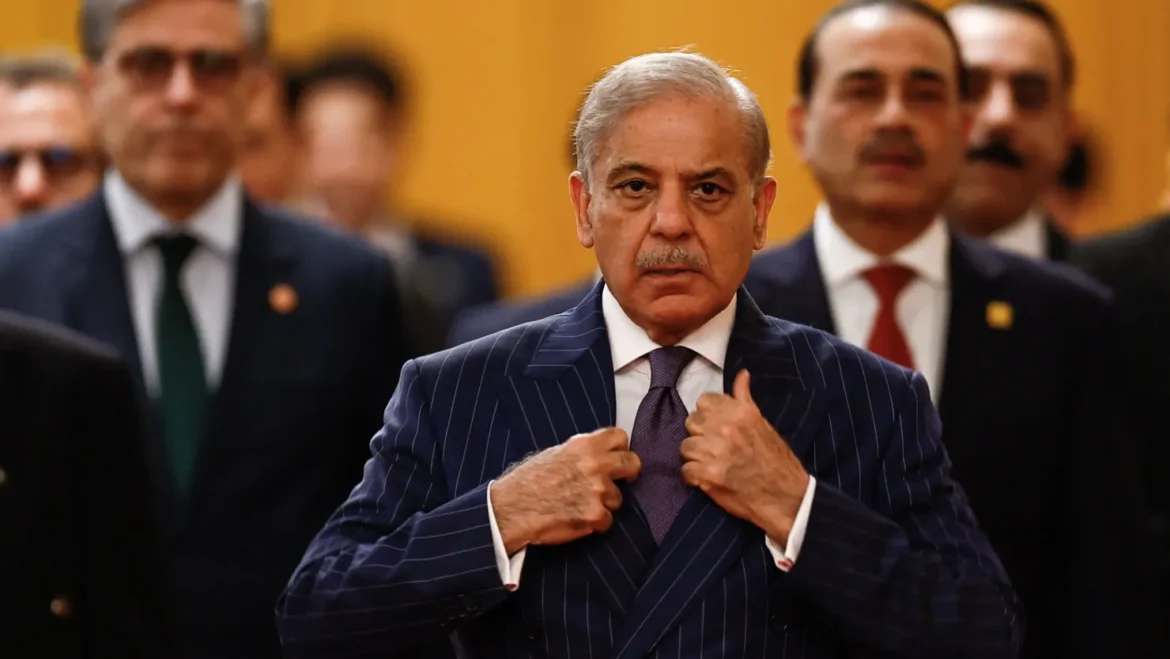
Prime Minister Shehbaz Sharif, whose government has played an increasingly central role as mediator between Washington and Tehran, said in a post on X that Pakistan was now “working closely with both sides to finalize the next steps” following the conclusion of what he described as a “final, agreed-upon text” of the proposed accord.
“Peace has never been this close as it is now,” Sharif wrote, in his most unambiguous statement yet that negotiations between the two longtime adversaries were nearing a conclusion.
But even as Islamabad projected confidence, the two parties at the heart of the negotiations appeared to be talking past each other — in public, at least — about what had been agreed to, and on what terms.
President Trump, writing on Truth Social on Friday morning, accused Iran of distorting the substance of the proposed agreement and flatly rejected public accounts of its terms. “Very dishonorable people to deal with,” Trump wrote. “With them, there is no such thing as dealing in good faith.”
His post was a sharp departure from his own triumphant announcement the previous day, when Trump told reporters at the White House that the United States had made “a great settlement of the war with Iran” — language that briefly sent global financial markets higher and pushed oil prices down, as investors parsed what a deal might mean for energy supplies disrupted since the outbreak of the conflict.
Iranian Foreign Minister Seyed Abbas Araghchi, for his part, said the proposed “Islamabad Memorandum of Understanding” had “never been closer,” but urged media outlets not to speculate about its provisions. “In line with our responsible and transparent approach, all details will be shared with the public in due course,” he said.
The dueling signals from the principals — and the confident declarations from Islamabad — amounted to an unusual diplomatic tableau: a potential end to a conflict that has rattled global energy markets, disrupted shipping through the Strait of Hormuz and drawn in countries across the Middle East, announced and disputed simultaneously by the very parties who would have to sign it.
What the Leaked Draft Reportedly Contains
Iranian state media and a senior Iranian source who spoke to Reuters on Friday described a draft agreement that would include the lifting of US sanctions on Iranian oil exports, the release of billions of dollars in frozen Iranian assets and a cessation of hostilities across multiple fronts, including in Lebanon.
Tasnim News Agency reported that Tehran would retain control over the Strait of Hormuz under the proposed arrangement — a point likely to draw scrutiny in Washington, where officials have repeatedly cited the waterway’s reopening as a core objective of the negotiations. Iran also reportedly would make no commitment to restore the conditions that existed before the conflict erupted in February.
The leaked provisions made no mention of what concessions Iran would make in return, leaving unanswered the central question that has defined months of on-again, off-again negotiations: the future of Tehran’s nuclear program.
Washington has maintained throughout the talks that any durable agreement must include firm guarantees that Iran will never develop a nuclear weapon. Iranian officials have rejected the characterization of their nuclear activities as a weapons program, insisting the program is devoted entirely to civilian purposes.
Trump, who has used the prospective deal as a recurring political touchstone — Iran’s semi-official Tasnim agency noted acerbically that he had announced a deal was imminent 38 times in the previous two months — on Thursday told reporters that a signing ceremony could take place “maybe in Europe, over the weekend,” and that Vice President JD Vance would attend in his place. “Most importantly, we have a deal that Iran will never have a nuclear weapon,” Trump said. “So, it was a very big thing.”
Pakistan’s Improbable Emergence as a Diplomatic Linchpin
Few observers anticipated, when the conflict began in late February with joint U.S.-Israeli strikes on Iran, that Pakistan would emerge as the indispensable diplomatic conduit between Washington and Tehran. The two countries do not share a formal alliance; Pakistan has no treaty obligations to either party; and Islamabad has historically walked a careful line between its relationships with the United States and its geographic and cultural ties to the Muslim world.
Yet in the months since, Pakistan has hosted direct talks between American and Iranian officials in Islamabad — the April sessions that gave the proposed accord its working name — and has served as a backchannel for messages between the two governments even during periods of active military exchange.
Trump has spoken of Islamabad’s role with unusual warmth, crediting both Sharif and Field Marshal Asim Munir, Pakistan’s chief of defense staff, whom the president has taken to calling affectionately “the General” — or, given Munir’s rank, “the Field Marshal, a step above.”‘
“Pakistan was fantastic,” Trump said on Thursday, grouping Islamabad alongside Qatar, the United Arab Emirates, Saudi Arabia, Bahrain, Kuwait and other states he credited with supporting the diplomatic effort. “The Prime Minister and — I call him the General. He’s a General. He’s a great General. He’s so great that he’s actually a field marshal, a step above. And they’re all very happy.”
Saudi Arabia on Thursday added its own endorsement of Pakistan’s mediating role, urging parties to return to “constructive negotiations sponsored by the brotherly Islamic Republic of Pakistan” alongside Qatar’s complementary efforts, and calling for diplomacy to spare the region from renewed hostilities.
A Week of Brinkmanship Before the Breakthrough
The apparent breakthrough came after days of particularly dangerous escalation. Earlier this week, Trump threatened to strike Iran “VERY HARD TONIGHT” and raised the prospect of seizing Kharg Island, Tehran’s primary oil export facility in the Persian Gulf — a move that would have represented a dramatic and potentially irreversible expansion of the conflict.
Iran, for its part, warned Washington that further military strikes risked creating an “endless quagmire” and destabilizing the broader region. As the rhetoric sharpened, Kuwait reported that Iranian forces targeted its territory and damaged radar equipment at an airport, forcing a temporary airspace closure — a reminder of how quickly the confrontation has drawn in neighboring states.
On Thursday, Trump announced he had canceled the planned strikes after negotiations advanced to “the highest level of Iranian leadership” — a description suggesting direct engagement with Supreme Leader Ali Khamenei or his immediate circle, though Washington has not confirmed the specifics of those contacts.
“Based on the fact that discussions with the Islamic Republic of Iran have been brought to the highest level of Iranian leadership and approved, I have, as President of the United States of America, canceled the scheduled strikes and bombings against Iran this evening,” Trump wrote on Truth Social. He added that discussions had been approved “in both concept and great detail” by a sweeping list of regional parties — the United States, Israel, Saudi Arabia, the UAE, Qatar, Turkey, Pakistan, Bahrain, Kuwait, Jordan and Egypt.
A naval blockade, Trump noted, would remain in place until a final agreement was signed.
The Conflict’s Origins and Stakes
The confrontation that Islamabad is now working to resolve began in late February, when coordinated US-Israeli strikes on Iran triggered a cascade of retaliatory actions that drew in Hezbollah in Lebanon, Houthi forces in Yemen and proxies across Iraq and Syria. The fighting disrupted passage through the Strait of Hormuz — the narrow waterway at the mouth of the Persian Gulf through which roughly one-fifth of the world’s oil and gas supplies pass — sending energy prices sharply higher and unnerving financial markets worldwide.
A ceasefire reached on April 8 halted the most intense exchanges, but the underlying disputes — over Iran’s nuclear program, the lifting of American sanctions and Tehran’s regional influence — remained unresolved, and the truce proved fragile. Negotiations in Islamabad in April represented the first sustained direct talks of the conflict, producing the framework now reportedly close to completion.
Sharif on Friday took pains to dismiss what he characterized as deliberate attempts to derail the talks. “Amid ongoing intense mediation efforts by Pakistan, we are fully aware of [an] incessant misinformation campaign being waged by those who want to sabotage the peace deal,” he wrote. “Setting aside the noise, we can confirm that a final, agreed-upon text of the peace deal has been reached.”
Copyright © 2021 Independent Pakistan | All rights reserved