By Staff Reporter
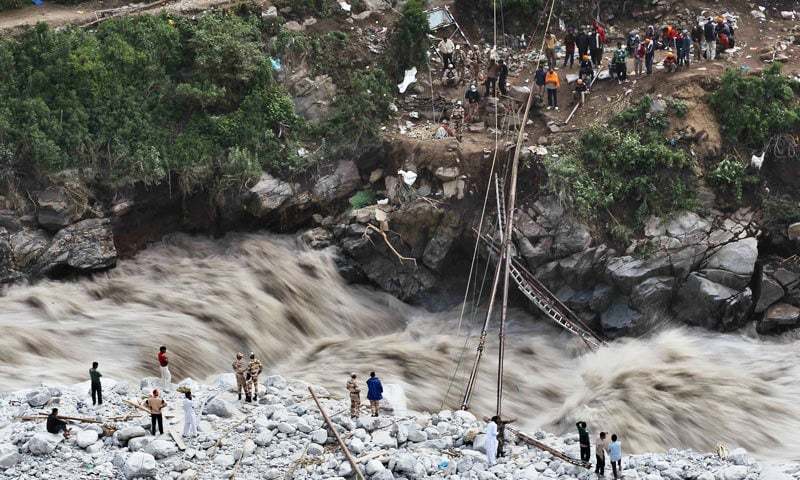
ISLAMABAD: Pakistan’s space agency has identified 130 glacial lakes capable of unleashing catastrophic floods on downstream communities, as the country simultaneously faces warnings of a weakened monsoon season, intensifying heatwaves and drought driven by the onset of El Niño.
The Space and Upper Atmosphere Research Commission, known as Suparco, compiled its latest assessment from satellite images captured on 31 May and 1 June this year, identifying the lakes — classified as Potentially Dangerous Glacial Lakes, or PDGLs — across Pakistan’s mountainous northern regions where glacial lake outburst floods, or GLOFs, have long posed a recurring and deadly threat.
Of the 130 lakes under scrutiny, only 24 are currently unfrozen and clearly visible from orbit. The remainder are still locked in ice — a condition that offers a measure of short-term reassurance, though scientists caution that the melting season is far from over. The 24 thawed lakes have had their surface extents precisely measured to gauge downstream risk, with the findings mapped using colour-coded satellite imagery distinguishing frozen from unfrozen bodies of water.
The agency has also quantified the human cost of a potential outburst event. Using a grid-based population exposure model — calculating the number of people living within every 100-by-100-metre area surrounding each monitored lake — Suparco has produced a granular picture of the communities most vulnerable to a sudden catastrophic release of glacial water. The maps identify nearby settlements that would lie directly in the path of any outburst flood.
The assessment draws on hazard inventories shared by the Provincial Disaster Management Authority of Khyber Pakhtunkhwa and the Gilgit-Baltistan Disaster Management Authority. A comparison between those earlier inventories and the updated dataset found 56 lakes common to both records, reflecting continuity in monitoring while also revealing shifts in the broader inventory as conditions on the ground evolve.
Mohammad Saleem Shaikh, the media spokesperson for Pakistan’s Ministry of Climate Change and Environmental Coordination, said the findings should be read as a call to action rather than a cause for alarm. “This is not a cause for panic, but a call for preparedness,” he said. “The fact that we are able to identify and continuously monitor these lakes demonstrates that Pakistan’s climate risk surveillance systems are becoming increasingly robust and science-driven.”
The ministry said it had strengthened hazard mapping, community adaptation programmes and early warning mechanisms in high-risk valleys in collaboration with Suparco, the National Disaster Management Authority and provincial bodies. International partnerships with Italy, the United Nations Development Programme and various scientific institutions have further bolstered the country’s environmental monitoring capacity, officials said.
Suparco has stressed that sustained satellite surveillance is now indispensable as climate change accelerates glacial retreat across Pakistan’s north, and that close coordination between scientific institutions and disaster management agencies remains the most effective safeguard for communities living in the shadow of these lakes.
El Niño compounds the threat
The glacial flood risk arrives against an already darkening meteorological outlook. Suparco has separately warned that Pakistan is likely to experience a weaker-than-normal monsoon season, more frequent heatwaves through spring and summer, prolonged drought conditions and an unusually warm winter — all linked to the emergence of El Niño.
The agency confirmed that the El Niño Southern Oscillation, known as ENSO, has entered its El Niño phase, marked by warmer-than-normal sea surface temperatures spreading across the central and eastern Pacific Ocean. The phenomenon is expected to exert significant influence over Pakistan’s weather during both the 2026 monsoon and the subsequent winter season.
El Niño is one of the most disruptive climate patterns on earth, shifting rainfall across entire continents. It typically suppresses precipitation across South and Southeast Asia, Australia and parts of Africa, while driving wetter conditions into the southern United States, East Africa and parts of South America. For Pakistan — already contending with glacial melt, extreme heat and recurring floods — the compounding effect of El Niño represents a further test of its climate resilience infrastructure at precisely the moment that infrastructure is being put to use.
Copyright © 2021 Independent Pakistan | All rights reserved