By Staff Reporter
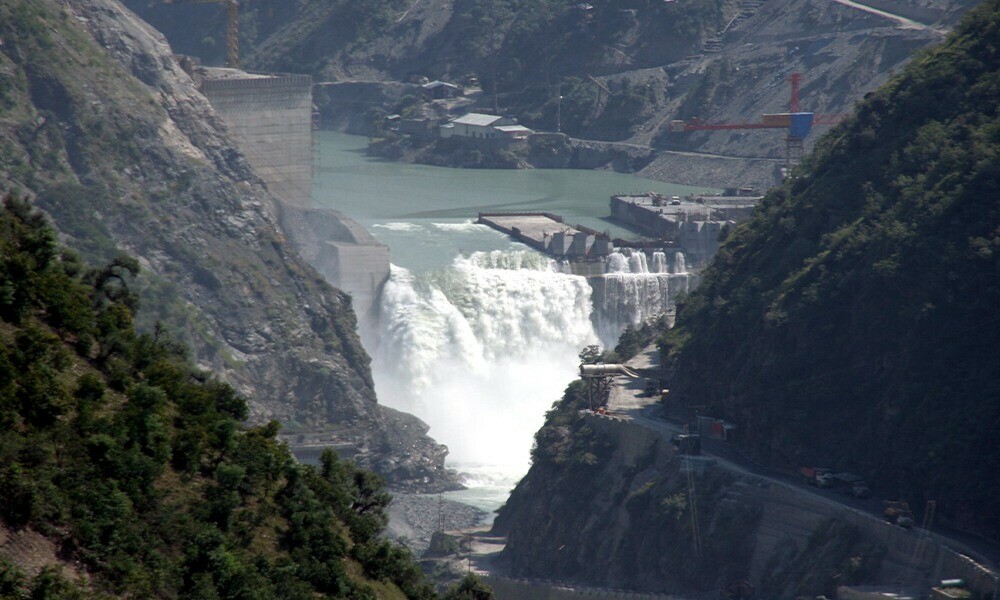
ISLAMABAD: Pakistan has accused India of actively pursuing at least 17 infrastructure projects on the Indus river system designed to give New Delhi “the tools for hydro-hegemony” — a striking charge that escalates a diplomatic confrontation over the two countries’ six-decade-old water-sharing agreement.
Deputy Prime Minister and Foreign Minister Ishaq Dar, in a pre-recorded address to a Brussels conference on transboundary water governance, said India had progressed well beyond making hostile statements and was now taking concrete steps that threatened the survival of the 1960 Indus Waters Treaty (IWT). Those steps, he said, included the construction of reservoirs, the expansion of existing structures, and — most gravely — diversion projects on the Indus, Chenab and Ravi rivers.
“It is important to underscore that our concerns are not merely based on Indian statements,” Dar told the seminar, titled Transboundary Water Resources: A Weaponised Global Common. “India has followed up its belligerent statements with illegal actions.”
The accusation lands at a moment of acute bilateral tension. India announced in April last year that it was holding its obligations under the IWT “in abeyance” — a move triggered by the killing of 26 tourists in Pahalgam, in occupied Kashmir, which New Delhi blamed on Islamabad without producing evidence. Pakistan denied any involvement and called for an independent investigation. In the months that followed, the two nuclear-armed neighbours fought a brief but intense military confrontation, during which Islamabad warned that any attempt to block or divert treaty-guaranteed flows would be treated as an act of war.
Dar’s address to the Brussels gathering hardened that position. Framing the issue not merely as a bilateral quarrel but as a test of the international legal order itself, he warned that India’s stated policy amounted to a “catastrophe in the making of unparalleled magnitude” — one that threatened to deliberately deprive 240 million Pakistanis of water they were legally entitled to receive.
‘A shared resource, a common responsibility’
The Indus Waters Treaty, brokered by the World Bank after nine years of negotiations and signed in 1960, is one of the world’s most studied examples of a durable transboundary water agreement. It divides the six rivers of the Indus system between the two countries: the eastern rivers — the Ravi, Beas and Sutlej — were allocated to India, while the western rivers — the Indus, Jhelum and Chenab — were largely reserved for Pakistan. The arrangement survived three full-scale wars, decades of hostility and repeated diplomatic crises, acquiring a near-mythical status among water diplomacy scholars as proof that existential disputes could be managed through legal frameworks.
That status is now under serious strain. When India declared the treaty in abeyance last year, Pakistan sought international arbitration. In June 2025, the Permanent Court of Arbitration issued a Supplemental Award of Competence, ruling that India could not unilaterally suspend its obligations. India has since argued that demographic pressures, technological change and climate adaptation warrant revisions to the original terms — a position Islamabad rejects, pointing to the arbitration ruling as definitive confirmation that the treaty remains in full force.
Dar told the Brussels conference that Pakistan had consistently sought resolution through legal channels — including by accepting arbitration outcomes that fell short of its own expectations. “At no stage,” he said, “was the outright unilateral abrogation of the treaty considered a viable course of action by the other side.”
He quoted the late UN secretary general Kofi Annan — “fierce national competition over water resources has prompted fears that water issues contain the seeds of violent conflict, but the water crises we face are more often crises of management and governance rather than absolute scarcity” — to argue that the path to stability lay through cooperation, not coercion.
“Water must never be viewed as an instrument of coercion,” Dar added. “It is a shared resource, a common responsibility and ultimately a prerequisite for human dignity and sustainable development.”
A global, not merely regional, concern
A notable strand in Dar’s address was his insistence that the crisis could not be contained within South Asia. Pointing to European cooperation on shared waterways as a workable model, he argued that the credibility of transboundary water agreements everywhere depended on how this dispute was resolved. He urged the international community to view Pakistan’s appeal not as one country’s grievance but as a question about whether treaty commitments retained any binding force at all.
“The sanctity of treaties is the bedrock of the international order,” he said. “Respect for treaty obligations is therefore not merely a regional concern but a global imperative.”
Pakistan has already taken that argument to the United Nations Security Council, warning that India’s conduct carries “grave peace and security, and humanitarian consequences” for the region. Whether the UNSC will engage substantively with a dispute that both sides characterise in starkly different terms remains to be seen.
Dar also drew attention to Pakistan’s broader climate vulnerability — the country ranked among the world’s most exposed nations to climate disruption despite contributing less than one per cent of global greenhouse gas emissions — arguing that the deliberate withholding of river flows would compound an already precarious situation.
“River systems are not merely waterways — they are lifelines,” he said. “They carry profound historical significance and serve as immediate sources of sustenance and survival.”
He closed with a call for what he described as the only durable solution: “Shared waters should unite nations rather than divide them, and cooperation — not coercion — must remain the guiding principle of transboundary water governance.”
Copyright © 2021 Independent Pakistan | All rights reserved