By Staff Reporter
The agreement signed on June 17 was presented to the world as the architecture of an enduring peace. Less than a fortnight later, it had become a vocabulary test — one that both Tehran and Washington are failing, or refusing to take. Each new drone strike, each fresh round of US airstrikes on Iranian coastal infrastructure, each Iranian missile falling on a Gulf Arab air base is now accompanied by the same claim from both capitals: the other side violated the memorandum of understanding first.
That is the precise nature of what is happening in and around the Strait of Hormuz. Not simply a breakdown of diplomacy, but something more structurally troubling: a framework whose deliberate ambiguity was mistaken, in the optimism of the signing ceremony, for diplomatic flexibility, and which is now being exploited by both sides as license for coercion.
The pattern of the past week has a mechanical quality. An Iranian drone strikes a tanker navigating what Washington calls the approved southern corridor near Oman’s coastline. US Central Command retaliates against Iranian surveillance systems, communications networks, air defence sites and drone storage facilities. Iran launches ballistic missiles and drones at American military installations in Kuwait and Bahrain. Both governments issue statements invoking the ceasefire — the IRGC to warn that US violations “will result in the complete halt of all diplomatic processes,” the Pentagon to insist that Iran had been given every chance to honour its commitments and chose not to. Each characterisation is, depending on which clause one reads, technically defensible.
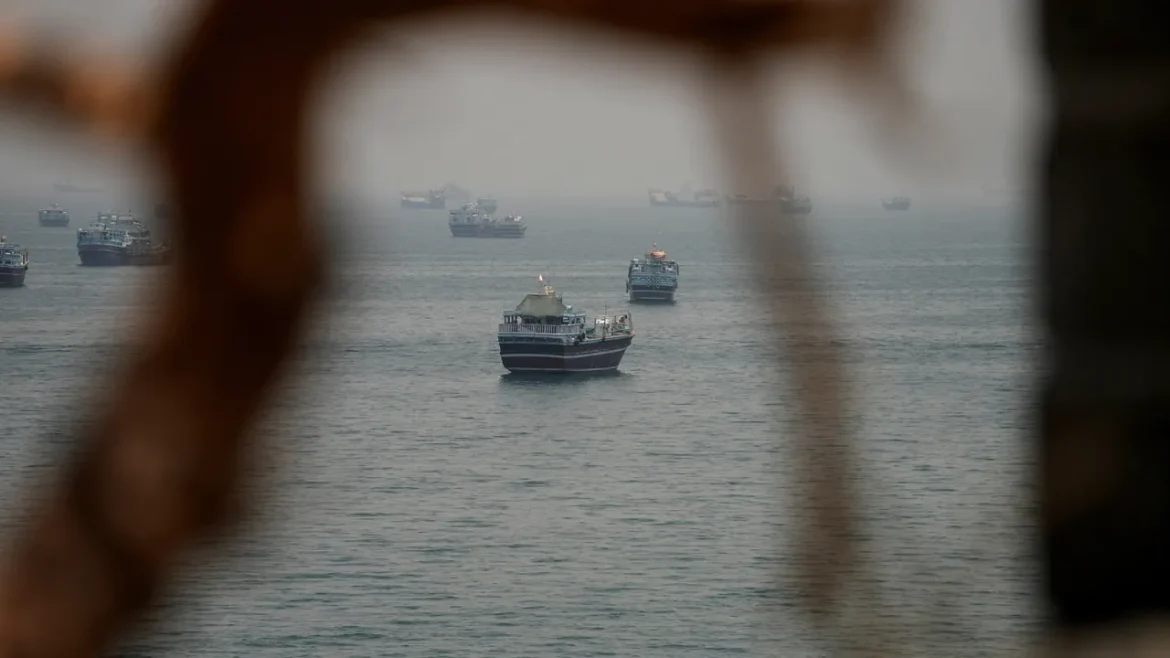
The underlying dispute has an almost territorial simplicity. Iran insists that vessels must transit the Strait through a northern lane running through waters it regards as under its authority. The United States has promoted a competing southern passage along the Omani coast and last week announced its expansion to handle both inbound and outbound traffic — a move almost certain to generate new Iranian drone activity. When vessels use the American route, the IRGC strikes them. When the IRGC strikes them, US aircraft bomb Iranian coastal positions. The cycle has no natural terminus, and both governments know it.
The text was built to be disputed
The memorandum’s language on the Strait was always a construct of political necessity rather than legal precision. Washington read the “no charge, for 60 days” provision as a sweeping prohibition on any form of Iranian transit fee or control mechanism. Tehran read the references to future “dialogue with Oman” on navigation administration and “maritime services and associated costs” as preserving its right — indeed, its sovereign entitlement — to eventually shape how passage through its territorial waters is managed. Those two readings are not reconcilable. The text was written to allow each government to claim victory at home while leaving the hard questions for later. That kind of diplomacy has a short shelf life.
The consequences materialised within the same week. Trump posted on Truth Social that Iran had assured him there would be “no tolls, no insurance costs and no other charges of any kind,” adding a warning that if this proved false, negotiations would end immediately. Iran’s chief negotiator Mohammad Baqer Ghalibaf told state-affiliated media that “everyone should know that the administration of the Strait of Hormuz will never go back to the way it was before the war.” Both statements came from parties formally bound by the same document, signed eleven days earlier.
The Oman-Iran joint statement issued after Muscat talks reinforced the suspicion that the two sides are not negotiating over whether Iran will eventually charge for passage, but over how to frame it. The statement stopped short of announcing tolls. It did not use the word. But its references to “services to be provided and the costs associated with them,” combined with its emphasis on coastal-state sovereignty, left sufficient room for both sides to argue indefinitely about where a legitimate maritime service fee ends and an illegal toll begins. That argument, unresolved, is now being settled by drones.
The internal veto
There is a structural problem inside Iran that no text can fully address. The Islamic Revolutionary Guard Corps does not answer to the foreign ministry negotiators who sign agreements; it answers to the Supreme Leader, and it has its own institutional equities in the strait. The IRGC Navy enforces the northern route. The IRGC aerospace force launches the one-way attack drones. When a vessel like the MT Kiku — carrying more than two million barrels of Qatari crude, bound for Fujairah — uses the Omani corridor, it is the IRGC, not Iranian diplomats in Muscat or Geneva, that decides whether to strike it.
A US State Department adviser, speaking to the Media Line under partial identification, put it plainly: Iran’s contradictory statements reflect “two governments performing for two different domestic and international audiences at the same time,” with an IRGC faction “actively spreading conflicting signals to undermine the negotiations.” If that assessment is accurate, the challenge is not persuading the Iranian government to comply with the MOU. It is persuading the IRGC that the deal serves its interests — a considerably harder task.
Washington carries its own internal tensions into the negotiating process. Vice President JD Vance, who led the Switzerland talks and has floated a genuinely new relationship with Tehran — going as far as disclosing that the US invited an Iranian intelligence official to serve as a deconfliction liaison at the Pentagon’s Qatar facility — has diverged publicly from Secretary of State Marco Rubio on the conflict’s regional architecture, particularly on Lebanon and Israel. Rubio defended Israeli military operations in Beirut during his Gulf tour; Vance suggested those same operations were undermining American peace efforts. The White House insists there is no daylight between them. Analysts at the American Enterprise Institute and elsewhere are less convinced. Both men are widely seen as 2028 presidential contenders, and each is calibrating to a different Republican constituency.
The Lebanon entanglement
The ceasefire was always a single-framework attempt to manage a multi-front war, and it shows. The Lebanon dimension remains unresolved in ways that matter directly to Tehran. Israel, which is not a party to the US-Iran MOU, has continued military operations in southern Lebanon. Hezbollah’s leader Naim Qassem rejected a US-brokered ceasefire deal as “humiliating” and a “surrender of sovereignty.” Israeli Prime Minister Benjamin Netanyahu called it “historic.” His far-right security minister called it “a big mistake.” This is not the architecture of durable de-escalation.
Iran has explicitly cited what it describes as US violations of commitments on Lebanon — specifically, Washington’s failure to restrain its Israeli ally — as justification for its own non-compliance in the Gulf. That linkage is convenient for Tehran. It is also not entirely manufactured. A ceasefire framework that formally requires Iran’s best efforts on shipping while informally relying on Israeli restraint it cannot guarantee was always operating on borrowed time.
The economic argument for survival
Iran’s domestic economic situation offers a blunt, structurally important argument for keeping the process alive. Annual inflation reached 88.6 percent in June, up from 68 percent in February, according to the country’s own statistics agency. The months-long closure of the Strait after February’s US-Israeli strikes deprived Tehran of the oil revenues that underwrite its budget. A US Treasury general licence issued on June 22 — allowing the production, delivery and sale of Iranian crude, petroleum products, and associated banking and insurance services through late August — could be worth up to $3 billion over two months, by some estimates. The economic incentive for pragmatists within the Iranian system to keep negotiations alive is genuine and measurable.
Whether that incentive can translate quickly into actual relief is a different question. Unwinding four decades of overlapping US, UN and EU sanctions involves executive orders Trump can rescind, congressional mandates he cannot, and OFAC delisting processes that former US sanctions officials say would take at least a year even under cooperative conditions. Banks, oil companies and insurers that have spent decades managing Iran exposure risk do not recalibrate overnight. Companies operating in the Iran trade still face litigation exposure under US law. “We’re not going to see massive multi-billion dollar commitments until things are far more cemented and politically stable,” one former sanctions adviser told Reuters. There is a long way to go.
What the market is telling you
Oil prices have fallen sharply in recent days — close to pre-war levels — on hopes that the Hormuz reopening will gradually stabilise. That price signal is worth pausing over. Commodity traders, who have to be right with real money, are collectively judging that full-scale resumption of US-Iran hostilities is unlikely, even as drones fall on Bahraini air bases and Trump posts on Truth Social that the Islamic Republic would “no longer exist” if America is forced to finish what it started.
Traders may be right. Trump has threatened annihilation before — including during his first term in office — and Tehran has learned to calibrate his rhetoric against the operational risk it implies. H.A. Hellyer of London’s Royal United Services Institute offered probably the most precise description of Iran’s current strategic posture: “limited, calibrated coercive activity in and around the Strait of Hormuz to create persistent pressure on international shipping without triggering a wider conflict.” Iran may also have its eye on November’s US congressional midterms, which, as Hellyer noted, give Washington “incentives for a quicker agreement,” while a “drawn-out negotiation accompanied by controlled pressure in the strait can work to its advantage.”
That calculus is coherent — and dangerous, because it assumes a degree of control over events that the IRGC’s recent actions have not demonstrated.
The question that remains
What the Islamabad memorandum could not resolve, and what sixty days of intensive diplomacy cannot easily settle, is the fundamental strategic question: whether the Strait of Hormuz will return to its pre-war status as an open, internationally governed chokepoint, or whether Tehran’s four-month closure has permanently shifted the terms on which passage through it is understood.
Ghalibaf’s statement — that the strait will never return to what it was before the war — may ultimately prove more durable than the ceasefire text itself. Not necessarily because Iran will begin extracting tolls in the coming weeks, but because the episode has demonstrated, at scale, that geography can be converted into leverage. That knowledge cannot be unlearned. It will shape every negotiation over the strait’s future status, every insurance premium, every routing decision made by every shipping company for years to come.
Commercial vessel transits through the strait were continuing as of Saturday, even as Iranian missiles activated Kuwaiti air defences and sirens sounded in Bahrain. The world’s most important energy corridor is open — in the same sense that a bridge remains open when traffic is still moving but the structural engineers have already logged the cracks. The question is not whether the next drone strike will fly. It is whether the one after that will be the one neither side can absorb without doing what both have spent the past week threatening.
The ceasefire survives. For now. Because both sides need it to.
Copyright © 2021 Independent Pakistan | All rights reserved