By Staff Reporter
MUZAFFARABAD: At least nine people were killed on Tuesday in clashes between security forces and supporters of a banned civil rights group, officials said, a day before the group had vowed to march on the region’s capital in defiance of a monthlong government crackdown, media reports said on Wednesday.
The dead included two law enforcement officers — one member of the paramilitary Rangers and one police constable — and seven activists or supporters of the Joint Awami Action Committee, the organisation at the centre of a bitter and increasingly violent dispute over electoral representation in Azad Jammu and Kashmir.
The clashes broke out in two locations in the region’s Poonch division and came as the government said it was moving to reopen highways the group had blockaded, disrupting the flow of food, fuel and medicine to communities across the territory.
The violence marked a sharp escalation in a confrontation that began, organisers say, as a campaign over electricity prices and economic grievances but has since narrowed into a fight over 12 legislative seats reserved for refugees from the Indian-administered side of Kashmir — seats the rights group says allow political parties based in Pakistan proper to effectively decide who governs the territory.
A raid, then a roadblock
The first clash unfolded Tuesday morning when law enforcement personnel raided a house in Mutyalmera, on the outskirts of the town of Rawalakot, acting on intelligence that a large cache of weapons and ammunition was stored there, officials said. They said they met armed resistance, and gunfire was exchanged.
Mutyalmera is one of roughly half a dozen small protest encampments that supporters of the rights group, known by JAAC, have maintained on the outskirts of Rawalakot in recent weeks. The group’s main sit-in, where its senior leadership has been based, has continued nearby at the Eidgah ground.
Sardar Waheed Khan, the divisional commissioner for Poonch, said one protester and one member of the Rangers were killed in the Mutyalmera exchange.
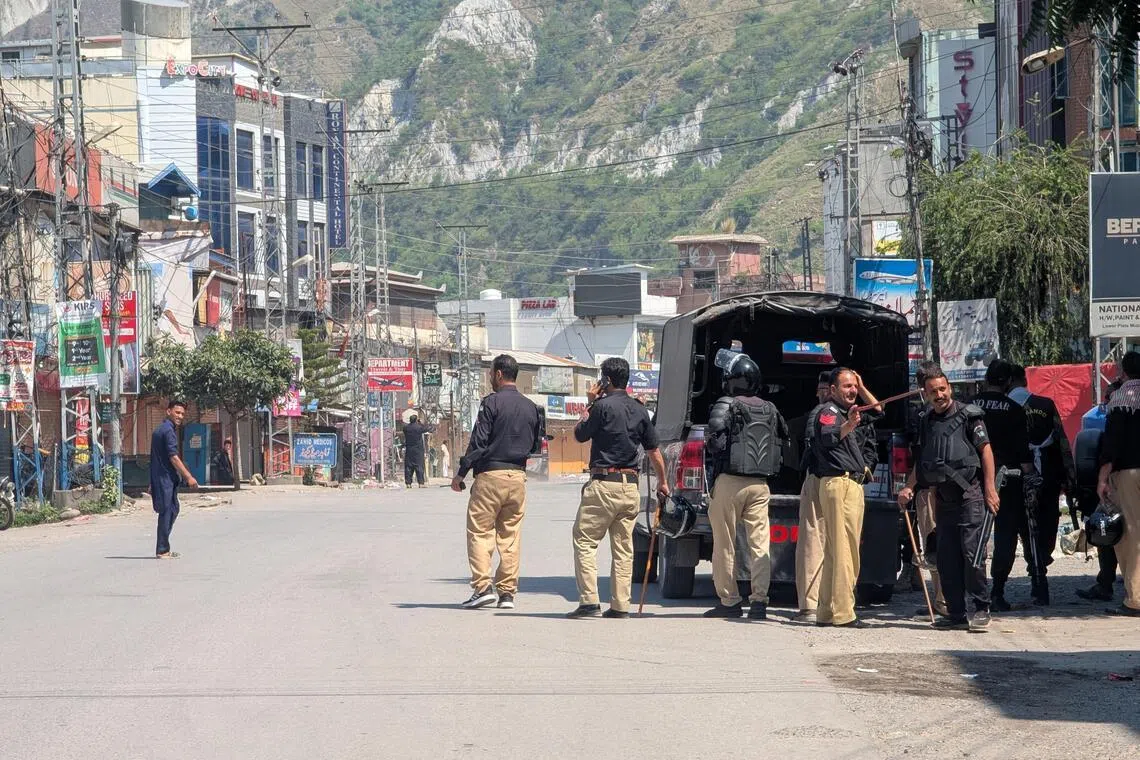
A second and far deadlier confrontation took place hours later in Baithak Baloch, a village in Sudhnoti district, after protesters — some of them armed, officials said — blocked a security convoy travelling toward the town of Trarkhal and pelted it with stones. Khan said the ensuing clash left one police officer and seven protesters dead. The identities of the dead protesters had not been made public.
In a statement issued later that day, police in Azad Kashmir said JAAC operatives had erected blockades at multiple points along the Kotli-Trarkhal highway, cutting off traffic and the movement of essential goods. Police said they had launched what they described as a clearance operation to reopen the route when “armed groups of the proscribed JAAC opened unprovoked and indiscriminate fire on security personnel.” The statement said one police constable was killed and roughly eight other officers, along with two employees of the region’s Public Works Department, were injured.
Police said the situation was under control by evening but that operations to clear blocked highways would continue.
Officials allege explosives, “human shields”
At a news conference in Muzaffarabad, the region’s capital, Azad Kashmir’s special home secretary, Chaudhry Guftar Hussain, gave a more detailed and pointed account of the day’s violence, accusing JAAC supporters of opening fire on police with automatic weapons and homemade explosives near the Matyal Mehra bus terminal in Rawalakot.
“As soon as the firing took place, police moved forward to restore law and order,” Hussain said, adding that paramilitary Rangers sent to assist police also came under attack. He said the group’s activists had planned to use women and students as “human shields” during future demonstrations, an allegation JAAC has not publicly addressed.
Hussain framed the day’s operations as part of a broader effort to reopen roads sealed by the group at entry and exit points across the region, and to restore what he described as normal economic, educational and commercial life.
“The state will not accept any threat or blackmail, and all blackmailers will be treated with an iron hand,” he said.
Hussain said JAAC’s leader, Khwaja Mehran, had issued a fresh 48-hour deadline demanding the closure of all entry points into the region. But Hussain argued that most residents had distanced themselves from the group, and that JAAC lacked the power to “paralyze the state.” He said medical colleges and other institutions of higher education had reopened, and that banking services, disrupted for weeks, were being restored.
Asked about JAAC’s planned march on Rawalakot, the Poonch commissioner said security forces were prepared to prevent protesters from entering the town, which has remained under curfew since early last month.
A dispute over refugee seats
The confrontation has its roots in a legal and political fight over the composition of the Azad Kashmir Legislative Assembly. Twelve of its seats are reserved for refugees who fled Indian-administered Kashmir, an arrangement the government says is constitutionally protected. JAAC contends the seats effectively give parties based in Pakistan disproportionate influence over who forms the regional government.
That dispute intensified last month after Pakistan’s Election Commission scheduled legislative elections for July 27. Weeks later, the Azad Kashmir Supreme Court ruled that the refugee seats could not be abolished without a constitutional amendment — a decision that hardened JAAC’s opposition and, organizers say, helped push the group toward more direct confrontation.
The regional government outlawed JAAC last month under anti-terrorism laws, accusing it of involvement in violent activity. The group has denied the allegation.
By local estimates cited by wire services, roughly 30 people have died in the broader unrest since it began in June — a toll that includes Tuesday’s dead and reflects a conflict that has, over six weeks, moved from street protest to open clashes involving firearms and explosives.
Elections to proceed, march still planned
Despite Tuesday’s bloodshed, the Azad Kashmir government said the July 27 elections would proceed on schedule. JAAC, for its part, said it intended to press ahead with its long march toward Muzaffarabad on Wednesday, having earlier given the government until July 14 — Tuesday — to meet its demands.
Elsewhere in the region, daily life continued with less disruption. Markets remained open Tuesday and drew a steady flow of shoppers, and the government allowed additional bank branches in select areas to resume operations, with customers lining up to conduct transactions. Internet service, however, remained suspended across Azad Kashmir, continuing to disrupt online education and the livelihoods of residents who depend on digital connectivity.
A two-judge bench of the Azad Kashmir High Court is scheduled to hear a pair of petitions on Thursday challenging the internet suspension.
Copyright © 2021 Independent Pakistan | All rights reserved