By Staff Reporter
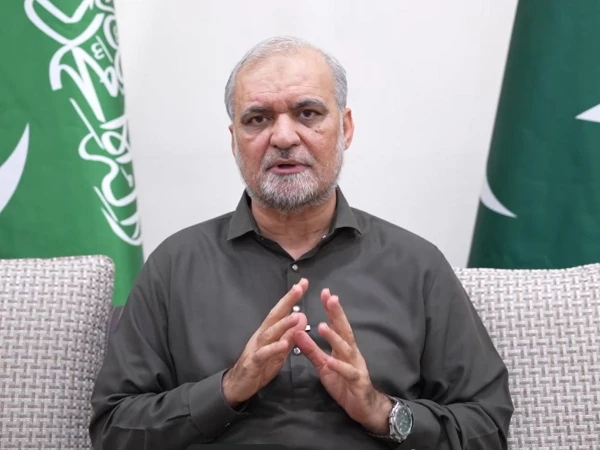
LAHORE: Jamaat-i-Islami has announced it will blockade major highways across Pakistan on 7 August, escalating a campaign against fuel prices and inflation that its leader has warned could tip into a movement against the government itself if authorities attempt to suppress it.
Hafiz Naeemur Rehman, the party’s emir, unveiled the second phase of the campaign at a press conference at JI’s headquarters in Mansoorah, Lahore, telling reporters that supporters would stage sit-ins on roads connecting districts in all four provinces. Only ambulances would be permitted through, he said, describing the demonstrations as peaceful.
In the run-up to the blockade, JI plans to hold 20,000 corner meetings across the country to build support, drawing in traders, industrialists, lawyers, students, religious scholars and young people. Rehman appealed directly to the country’s youth to bring their motorcycles onto the roads to reinforce the blockade.
The protest movement centres on the petroleum levy introduced by the government in June last year under the terms of its agreement with the International Monetary Fund. JI wants the levy scrapped entirely, along with what it regards as costly contracts with independent power producers, and is demanding action to bring down inflation and end power cuts.
Rehman’s press conference came days after the government moved to a daily fuel price review mechanism, a decision taken amid volatility in global oil markets following renewed hostilities in the Middle East. Under the new system, prices are set using a seven-day rolling average of international rates, with the Oil and Gas Regulatory Authority publishing updated figures on its website each day.
The JI chief dismissed the shift as a deception, questioning what jurisdiction Ogra actually held over the levy and other taxes charged on every litre of fuel sold. He accused the government of using the conflict as cover to raise prices, arguing that the levy and associated taxes had nothing to do with the war.
Were those charges lifted, he told reporters, petrol would sell for well under Rs250 a litre. He put the government’s annual take from the levy at around Rs1.8 trillion, and said the burden fell hardest on motorcyclists, labourers and the middle class. He went further, calling the levy “economic terrorism” and accusing the government of extracting money even from people who fall outside the formal tax system through indirect taxation.
Rehman said JI had no quarrel with defence spending, but took aim at the perks enjoyed by judges, senior military officers, bureaucrats and lawmakers, arguing that ordinary citizens were being squeezed by inflation while the country’s elite continued to draw state-funded benefits.
He reserved some of his sharpest criticism for the Punjab government, accusing Chief Minister Maryam Nawaz of having sold 11,000 schools while spending Rs11 billion of public money on an aircraft for her own use. He also alleged that basic health units and public schools were being sold off and rebranded to obscure what was happening, and said poverty in the province had risen by 41 per cent over the past six years under the current administration. Lawmakers in Khyber Pakhtunkhwa came in for criticism too, with Rehman accusing them of passing legislation to grant themselves unlimited benefits.
On electricity, Rehman called for transparency in the government’s agreements with independent power producers, asking why load-shedding persisted when the country’s installed generation capacity should be sufficient to meet demand. Consumers, he said, were effectively paying for electricity that was never produced.
The JI leader also addressed the deteriorating security situation in Balochistan and the southern districts of Khyber Pakhtunkhwa. He rejected the idea that the government could deflect blame onto foreign actors alone, arguing that if outside forces were involved, it remained the state’s responsibility to stop them. He said JI was already in contact with stakeholders on the Balochistan question and hoped a grand jirga could be convened soon to chart a long-term solution. On Azad Jammu and Kashmir, he welcomed reports of talks between state institutions and the Joint Action Committee, saying JI had long pushed for dialogue and had tried to facilitate negotiations itself, though he said the government had yet to respond to the party’s overtures.
Asked what would happen if the state tried to shut the protest down, Rehman said JI would press on with its campaign for public rights regardless of criticism, but repeated his warning that heavy-handed tactics risked turning what was currently an anti-inflation campaign into a movement against the government.
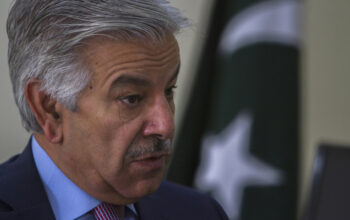
He also touched on domestic politics more broadly, saying the Pakistan Muslim League-Nawaz should take action over recent remarks by Defence Minister Khawaja Asif, and offered comments on the Pakistan Peoples Party, Maulana Fazlur Rehman and PTI founder Imran Khan. He described the PPP as the establishment’s “A-plus team” and challenged its chairman, Bilawal Bhutto-Zardari, to explain who had been in government in Azad Kashmir before making public statements on the issue.
Rehman confirmed the decision to launch the second phase of the campaign had followed internal party consultations, and said it would continue until the government met JI’s demands. The party has staged a series of protests over recent months against fuel and electricity prices, including demonstrations in Khyber Pakhtunkhwa this month and rallies across the province last month against increases in the cost of electricity, gas and fuel, as well as taxes introduced in the federal budget. In May, Rehman filed a petition with the Federal Constitutional Court challenging the petroleum levy, arguing the government had effectively given itself unchecked power to tax citizens through executive notifications without any parliamentary scrutiny.
Copyright © 2021 Independent Pakistan | All rights reserved