By Staff Reporter
ISLAMABAD: US forces struck Iran for an eleventh consecutive night early on Wednesday, as a widening war across the Middle East threatened to overwhelm a last-ditch attempt in Islamabad to revive a ceasefire that has already broken down once.
US Central Command said the latest wave of strikes, which began at 7pm Washington time on Tuesday, hit aircraft hangars and drone storage facilities, and was intended to keep “degrading Iran’s ability to threaten commercial shipping” through the Strait of Hormuz. The bombardment followed a warning from Donald Trump that American attacks were about to intensify, with the president signalling that US forces would soon strike close to one of Iran’s principal uranium enrichment sites.
As strikes continued into Wednesday morning, Iranian air defences were activated near Tehran, and the state-run IRNA news agency reported explosions in the provinces of Bushehr, East Azerbaijan, Hamadan, Hormozgan, Khuzestan, and Sistan and Baluchistan.
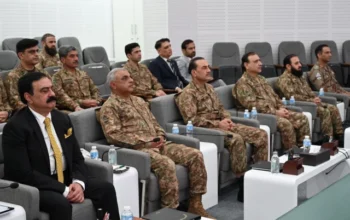
The renewed assault came even as Iran’s interior minister, Eskandar Momeni, travelled to Pakistan in search of a diplomatic opening. Momeni met the Pakistani army chief, Field Marshal Asim Munir, and later held talks with Prime Minister Shehbaz Sharif. In a statement, Sharif said he was deeply concerned by the escalation between Washington and Tehran, and called on all sides to show restraint. Pakistan, along with Munir in his capacity as both army chief and head of the country’s defence forces, had helped broker last month’s interim agreement between the US and Iran, and Islamabad has continued trying to coax both sides back to the table. What, if anything, might emerge from Momeni’s visit remained unclear.
Trump gave little encouragement to that effort. Speaking from the Oval Office on Tuesday, he said Iranian officials “want to desperately meet,” but added: “until they’re ready to meet in a meaningful way, we have no interest in meeting.” He said American forces would soon target the area around Pickaxe Mountain, a fortified underground facility in central Iran that Tehran declared to the International Atomic Energy Agency in 2020 as the intended site of an advanced centrifuge assembly plant.
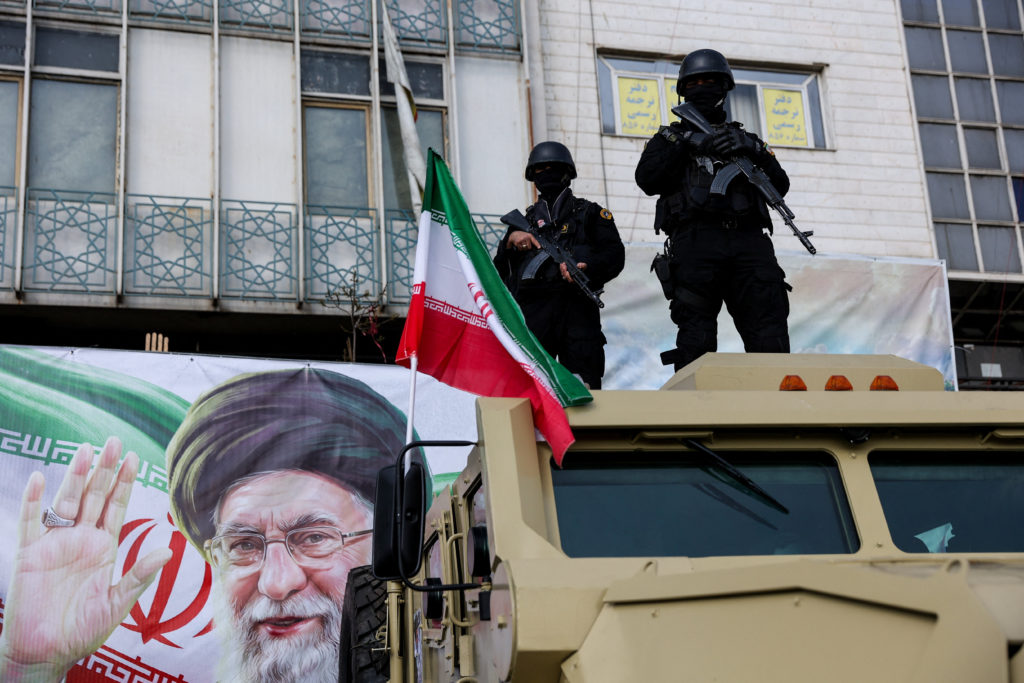
Iran’s military responded within hours. Khatam al-Anbiya Central Headquarters, the country’s main command, warned early on Wednesday that any American strike on nuclear or other sensitive sites would be treated as a significant expansion of the war, and that Tehran would retaliate with a “powerful attack” on US interests and those of its allies across the region. Iranian state media had earlier carried the warning as a direct response to Trump’s threat to strike the Isfahan facility “pretty soon.”
The mistrust between the two sides runs deep, and has hardened over more than a year of on-off confrontation. Iran was targeted in a surprise attack in June last year, and again in February, on both occasions while nuclear talks with Washington were still under way. The interim ceasefire that briefly held after the last round of diplomacy collapsed when Iran resumed strikes on shipping in the Strait of Hormuz — the very waterway the agreement had been designed to reopen.
That strait, through which around a fifth of the world’s crude oil and natural gas passed before the war, has become the war’s central battleground. Despite repeated American strikes, Iran has not loosened its grip on the passage. Britain’s United Kingdom Maritime Trade Operations centre reported that a tanker came under attack early on Tuesday in the strait off Oman, forcing its crew to abandon ship. Iran’s Revolutionary Guard claimed responsibility for that attack and for two others on vessels in the waterway the previous day. The route off Oman’s coast is the one the US military has been urging shipping to use in an effort to bypass Iranian control. Central Command said that, as of Tuesday, US forces had redirected eight commercial vessels attempting to enforce the blockade and disabled one more.
Iran has widened the confrontation well beyond the strait, launching attacks against Bahrain, Jordan and Kuwait. In Kuwait, the country’s Ministry of Electricity, Water and Renewable Energy said several power generation and water desalination plants were struck on Monday evening, sparking fires at multiple sites. A number of generating units were taken offline as a precaution to protect equipment and preserve the stability of the country’s power and water networks, the ministry said, though it did not disclose how many plants were affected, where they were located, or whether anyone had been hurt. Kuwaiti officials said the attacks were part of a pattern in which oil facilities and desalination plants have repeatedly come under fire.
Jordan reported intercepting three Iranian missiles on Tuesday and said it had brought down five drones launched from Iran overnight and into Tuesday morning. No casualties or damage were reported in either case.
Iran’s Islamic Revolutionary Guard Corps also said its forces had destroyed an early warning radar system and several tactical radars near the Ali Al Salem Air Base in Kuwait, along with a further radar installation on Bubiyan Island, according to a statement carried by the Guard’s Sepah News outlet late on Tuesday.
In northern Iraq, air defences at the US consulate in Erbil shot down four drones targeting the facility on Tuesday evening, a local security source told the Chinese news agency Xinhua, adding that there were no immediate reports of casualties. Erbil International Airport briefly suspended flights earlier in the day because of the wave of drone activity, though operations resumed soon afterwards. The consulate has come under repeated drone attacks in recent days; Central Command confirmed on Sunday that a US service member had been killed and another wounded during a controlled detonation of unexploded ordnance from a downed Iranian drone the day before.
Beyond the battlefield, Iran has been pressing a diplomatic campaign of its own. In Tehran, foreign ministry spokesman Esmaeil Baghaei warned Bulgaria against allowing the United States to use its territory for operations against Iran, after Bulgarian prime minister Rumen Radev disclosed that Washington had asked to station up to eight tanker aircraft at Bezmer Air Base, with Bulgaria’s Council of Ministers expected to seek parliamentary approval. Baghaei urged Bulgarian lawmakers to withhold that approval, warning that granting it would make the country “an accomplice of aggressors and criminals,” and cited a UN General Assembly resolution that defines allowing one state to use another’s territory to commit aggression against a third as itself an act of aggression.
Iran’s foreign minister, Seyed Abbas Araghchi, separately protested to his French counterpart, Jean-Noël Barrot, over what he described as the “unconventional” conduct of two French diplomats detained in Tehran on Sunday, telling Barrot by phone that their actions had been “in contradiction with diplomatic norms and unacceptable,” according to a statement from Iran’s foreign ministry. Araghchi said foreign missions were obliged to observe the laws of their host country and called on Paris to prevent any repeat of the episode. Barrot, for his part, said on Monday that the two embassy officials had been detained and mistreated, and interrogated for hours before being released; he called the episode “shocking” and warned Araghchi it would not be without consequences. The French foreign ministry summoned Iran’s chargé d’affaires in Paris on Tuesday. Araghchi also laid the closure of the Strait of Hormuz squarely at Washington’s door, describing it as a direct consequence of the US violating its commitments under the peace memorandum signed with Iran in June, alongside actions that have further inflamed regional tensions.
Elsewhere, Iran-backed Houthi rebels in Yemen opened a new front against Saudi Arabia, declaring a naval blockade of the kingdom and threatening a further blow to global oil supplies. With the Strait of Hormuz effectively closed, Saudi Arabia has been relying on a pipeline route to the Red Sea to keep oil moving to market — a route the blockade now puts at risk. SABA, the Houthi-run news agency in Yemen, said on Tuesday that six ships in the Red Sea had been forced to reroute after receiving warnings from the rebel group, a claim that could not immediately be verified. Three Houthi officials said the group had warned international shipping companies on Monday to avoid the Bab el-Mandeb Strait, the gateway to the Red Sea that sits on the far side of the Arabian Peninsula from Hormuz.
The financial toll of the conflict is mounting quickly. Testifying before a Senate budget hearing on Tuesday, US defence secretary Pete Hegseth put the cost of the war against Iran at $37.5 billion so far, and described supplemental funding for the conflict as “urgent” and “necessary.” “Without these funds, we face critical shortfalls,” he told senators, as the Trump administration and congressional Republicans push for approval of the president’s proposed $1.5 trillion defence budget. The figure marks a sharp rise from the roughly $30 billion estimate given in June by Russell Vought, director of the White House Office of Management and Budget. Hegseth was also questioned over reports that the Pentagon had delayed disclosing the scale of US military injuries sustained in the fighting; the department’s own figures show nearly 100 troops injured since 7 July.
A US official told the Associated Press that the number of wounded American personnel has climbed to well over 500, a figure significantly higher than the 482 currently logged on the Pentagon’s Defense Casualty Analysis System. The official said the tracking system suffers from a substantial lag in reporting injuries, which they described as a consequence of how the system is designed rather than any deliberate withholding of information.
The war’s economic ripples have reached far beyond the region. The international crude benchmark traded above $92 a barrel on Wednesday, while the average price of regular petrol in the United States climbed to $4 a gallon. In Asian trading, Brent crude rose 1.2 per cent to $92.09 a barrel — its highest intraday level in more than a month — while West Texas Intermediate, the main US benchmark, gained 1.1 per cent to reach $85.23, as markets reacted to Iran’s strikes on American radar and air defence installations in the Gulf.
Copyright © 2021 Independent Pakistan | All rights reserved