By Staff Reporter
ISLAMABAD: Pakistan has dismissed India’s criticism of ongoing elections in Azad Jammu and Kashmir as “baseless and politically motivated,” with a Foreign Office spokesperson saying that New Delhi has “neither the standing nor the moral authority” to comment on the democratic process in the region.
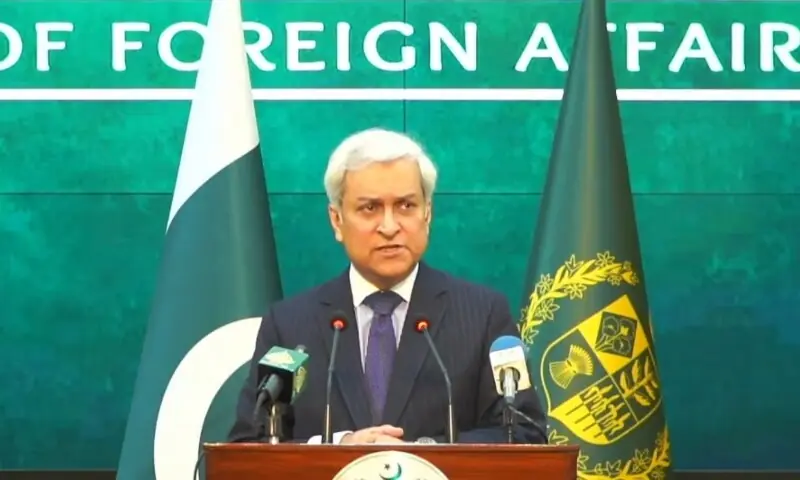
The sharply worded rebuke came during a weekly press briefing in Islamabad on Thursday, after Pakistan’s Foreign Office spokesperson, Tahir Andrabi, was asked to respond to remarks from India’s External Affairs Ministry, which had branded the elections a “farce” earlier in the week.
Voting for the AJK legislative assembly is taking place in phases, against a backdrop of security concerns and sporadic unrest in the region. India’s foreign ministry said on Tuesday that the polls amounted to a “hollow exercise” that could not obscure the underlying reality of the dispute, though it did not specify what it meant by that in its public remarks.
Andrabi rejected the characterisation outright. “Pakistan categorically rejects the baseless and politically motivated remarks of the Indian MEA regarding the ongoing legislative elections in the AJK,” he told reporters.
He suggested the timing of India’s comments was no accident, coming as they did on the eve of the seventh anniversary of New Delhi’s decision to revoke the special constitutional status of Jammu and Kashmir on 5 August 2019 — a move Islamabad continues to regard as illegal and unilateral. That action, Andrabi argued, violated relevant United Nations Security Council resolutions, international law, and commitments India itself had previously made.
By contrast, he insisted, the elections under way in AJK were being conducted “in a peaceful, transparent and orderly manner,” in line with the region’s constitutional and legal framework, and reflected the “democratic aspirations and political will” of its people.
“No standing to comment”
The spokesperson returned repeatedly to the theme of India’s own record in the territory it administers. Given what he described as India’s continued denial of fundamental political rights and democratic freedoms in occupied Kashmir, he said, New Delhi had no basis from which to criticise the electoral process on the Pakistani side of the Line of Control.
Andrabi said no amount of “misinformation and propaganda” could alter the legal status of occupied Kashmir, which Pakistan maintains remains disputed territory. Its ultimate status, he said, should be settled in accordance with UN Security Council resolutions and the freely expressed will of the Kashmiri people, through a UN-administered plebiscite — a position Pakistan has held consistently since the resolutions were passed in the late 1940s, though implementation has never materialised.
He also pushed back on what he called India’s “attempt to invoke misleading casualty figures,” arguing that such claims could not distract from New Delhi’s own conduct in the region. These statements, he said, were designed to draw international attention away from what Pakistan characterises as India’s continued violations of international human rights and humanitarian law, and its failure to meet its international obligations.
Andrabi called on India to reverse the measures it introduced on 5 August 2019 and to help create conditions conducive to a peaceful settlement, in line with Security Council resolutions.
Response to Dar’s Youm-i-Istehsal remarks
The briefing also touched on a separate exchange, after India’s foreign ministry criticised comments made by Pakistan’s Deputy Prime Minister and Foreign Minister, Ishaq Dar, on Youm-i-Istehsal — the day Pakistan marks in protest against India’s 2019 constitutional changes in Kashmir. India had accused Islamabad of “desperate peddling of falsehoods.”
Andrabi dismissed the Indian ministry’s statement as a “self-serving eulogy” for its own actions in occupied Kashmir. He argued that a sustained, heavy military presence in the region, combined with what he called draconian laws, was facilitating demographic change intended to alter the Muslim-majority character of the territory.
He further accused India of “systemic efforts” to suppress Kashmiri voices, adding that development programmes in the region could not substitute for the political and human rights of its people. Pakistan, he said, would remain committed to supporting a just resolution and again called on India to reverse what he described as its illegal and unilateral measures, end rights violations, and pursue a peaceful settlement of the Jammu and Kashmir dispute.
Pakistan’s continued role in US-Iran diplomacy
Away from Kashmir, Andrabi used the briefing to restate Pakistan’s involvement in efforts to de-escalate tensions between the United States and Iran, particularly over the Strait of Hormuz, the narrow waterway through which a significant share of the world’s oil exports pass.
He said Pakistan would continue to “actively pursue diplomatic engagements and support all sincere efforts aimed at achieving a comprehensive, just and lasting resolution to the conflict.”
Andrabi expressed hope that any agreement over the Strait would create space for renewed dialogue between Washington and Tehran, building on the framework set out in the Islamabad Memorandum of Understanding. “We hope that the agreement on the Strait will pave the way for continuing dialogue, particularly the resumption of technical-level talks between Iran and the US,” he told reporters, according to AFP.
He also praised Oman for what he called its “valuable and steadfast” efforts to support de-escalation, noting the Gulf state’s position as a littoral nation bordering the Strait of Hormuz.
Copyright © 2021 Independent Pakistan | All rights reserved