By Staff Reporter
ISLAMABAD: The military chiefs of Pakistan, Saudi Arabia and Turkey have agreed to move without delay to convert their recently signed defence pact into concrete military cooperation, following urgent talks in Riyadh prompted by a sustained Houthi bombing campaign against the kingdom.
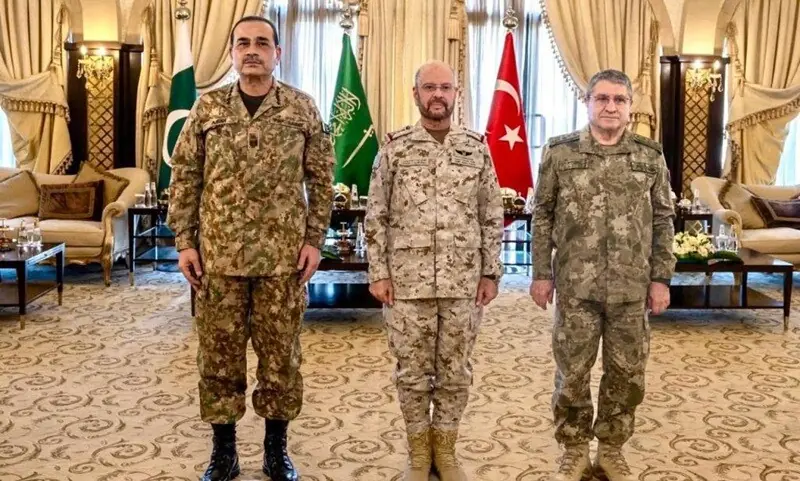
Field Marshal Asim Munir, Pakistan’s chief of defence forces and army chief, met his Saudi and Turkish counterparts, General Fayyadh bin Hamed Al-Ruwaili and General Selcuk Bayraktaroglu respectively, in the Saudi capital on Friday. It was the first meeting held exclusively between the three countries’ most senior military officers since they signed the Makkah Defence Alliance, formally known as the Makkah Joint Defence Agreement (MJDA), in the holy city on 7 August.
According to a statement from Inter-Services Public Relations (ISPR), the military’s media wing, the three sides discussed how to deepen cooperation between their armed forces, including sharper intelligence sharing, closer military coordination and the integration of their respective capabilities. Officials said such steps were intended to strengthen deterrence and bolster collective defence at a moment when Saudi Arabia is under mounting pressure from Yemen’s Houthi movement.
The talks took place against a backdrop of escalating violence in Yemen, where the Houthis have made rapid territorial advances in recent weeks against forces loyal to the internationally recognised, Saudi-backed government. The Iran-aligned group has seized the port city of Mocha and swathes of the Red Sea coastline, tightening its grip on the approaches to the Bab al-Mandeb strait, one of the world’s most strategically sensitive shipping chokepoints. The group has also declared a maritime blockade against Saudi Arabia and struck vessels in the Red Sea, while intensifying missile and drone attacks on Saudi cities and infrastructure.
Those attacks have grown more audacious in recent weeks. Saudi authorities said air defences intercepted six ballistic missiles aimed at Taif and Yanbu earlier this week, prompting emergency alerts across Mecca, Jeddah and Yanbu — the second time in a fortnight that a warning has been issued covering Islam’s holiest city. The Houthis claimed to have struck a “sensitive target” in Riyadh itself, as well as Saudi Aramco facilities in Yanbu, though the extent of any damage has not been independently verified.
According to the ISPR, the three military chiefs “strongly resented” the attacks on Mecca and on Saudi civilian and economic infrastructure, while praising the vigilance and professionalism of the kingdom’s armed forces in safeguarding its people and territory. The chiefs reaffirmed their commitment to collective defence, a stance the ISPR said underlined the resolve of all three countries to defend Saudi Arabia’s security, sovereignty and territorial integrity.
The statement went on to describe the Riyadh meeting as a reflection of the strength of the defence partnership binding the three nations, and of their shared determination to translate the commitments made under the Makkah agreement into “effective military cooperation” without delay. The participants also pointed to the longstanding relations and mutual trust between their peoples and armed forces.
Crucially, the meeting did not produce any public detail on what practical military assistance, if any, had been agreed. Whether the discussions in Riyadh will lead to specific troop deployments, equipment transfers or other forms of direct support remains unclear, and officials indicated that any such decisions would ultimately depend on what Saudi Arabia requests and what the three sides are able to agree collectively.
The gathering came only a day after the foreign ministers of the three countries met on the sidelines of the United Nations General Assembly in New York, where they agreed in principle to convene their military chiefs. Pakistan’s deputy prime minister and foreign minister, Ishaq Dar, held talks with Saudi Arabia’s Prince Faisal bin Farhan and Turkey’s Hakan Fidan, condemning what they called the “heinous attacks” on Mecca and on Saudi civilian and economic facilities, while affirming Riyadh’s right to defend itself under Article 51 of the UN Charter, which enshrines the right to individual and collective self-defence.
Notably, the public accounts each government gave of that New York meeting diverged in tone. The Saudi foreign ministry’s readout was framed squarely around the need for urgent military support. Pakistan’s account, posted by Dar on social media, spoke more cautiously of reviewing “institutional structures” under the agreement, while Turkish officials characterised the discussion as a review of technical negotiations. Neither Islamabad’s nor Ankara’s statements referred directly to the Houthi attacks that had prompted Riyadh’s request.
That caution reflects the delicate position both Pakistan and Turkey find themselves in. The Houthis have issued explicit threats to both countries should they become directly involved in the conflict, with a member of the group’s political bureau warning this week that Pakistan and Turkey would be met with an “iron fist” if their forces entered the war. Analysts have also pointed to practical constraints on both nations: Pakistan’s armed forces are already stretched by tensions on its border with Afghanistan and its long-running rivalry with India, alongside domestic security operations, while Turkey retains significant commitments to Nato and an unsettled border with Syria.
Still, both countries have signalled willingness to help meet the kingdom’s needs. Turkey’s foreign minister, Hakan Fidan, said last week that Ankara stood ready to assist with “military needs, especially on some technical issues”, while stressing that Turkey honours its commitments. Pakistan, for its part, has gone further rhetorically. Lieutenant General Ahmed Sharif Chaudhry, director general of the ISPR, said on 18 September that Islamabad would go to “any extent” to defend Saudi Arabia, describing its commitment to the kingdom’s security as unconditional. Prime Minister Shehbaz Sharif has separately pledged to stand “shoulder to shoulder” with Riyadh in safeguarding its sovereignty.
Pakistan already maintains a substantial military footprint in the kingdom under earlier bilateral arrangements, including advisers, trainers, logisticians and technicians, built on decades of defence cooperation dating back to the 1960s and 1970s. In April, Saudi Arabia confirmed the arrival of a Pakistani military contingent, including fighter and support aircraft, at King Abdulaziz airbase in the kingdom’s Eastern Province, under the countries’ bilateral Strategic Mutual Defence Agreement signed last September.
The Makkah Defence Alliance itself was signed on 7 August by Pakistan’s Prime Minister Shehbaz Sharif, Turkey’s President Recep Tayyip Erdogan and Saudi Arabia’s Crown Prince and Prime Minister Mohammed bin Salman. Under its terms, an attack on any one of the three signatories is to be treated as an attack on all — a clause that has taken on immediate significance amid the intensifying Houthi campaign.
The three countries have since been steadily building the institutional machinery behind the pact. At the first meeting of its Strategic Political and Defence Committee, held in Istanbul on 31 August, they agreed to establish a permanent secretariat in Riyadh and discussed a broader agenda encompassing military interoperability, defence-industry cooperation, joint production and research, and counterterrorism coordination. Pakistan subsequently appointed retired Lieutenant General Nauman Mahmood, a former senior officer with the Inter-Services Intelligence agency, as the alliance’s first secretary general, tasked with overseeing the secretariat for an initial three-year term.
In Turkey, the pact still awaits formal ratification. Parliament speaker Numan Kurtulmus said on Friday that the agreement had not yet been submitted to the Turkish parliament for approval, and he expected it to be formally tabled when the assembly returns from recess on 1 October. Under Turkey’s constitution, international agreements only take legal effect once ratified by parliament.
All three governments have insisted the alliance is defensive in character and not aimed at any particular state. Fidan has said the pact rests on respect for sovereignty, territorial integrity and non-interference, and remains open to other countries that share those principles.
The urgency in Riyadh has also been reflected in Saudi Arabia’s religious establishment. The kingdom’s Grand Mufti, Sheikh Saleh Al-Fawzan, called this week for forces to “stand united” against the Houthis, describing the defence of the kingdom’s borders as a duty demanding sacrifice. Days earlier, King Salman issued a rare public condemnation of the Houthis as a “terrorist militia”, accusing the group of attempting to target Mecca in what he called “a provocation to Muslims around the world”, according to the official Saudi Press Agency.
Beyond its regional allies, Saudi Arabia has also secured pledges of support from further afield. Britain agreed this week to refuel Saudi jets flying defensive missions, while France confirmed on Friday that it is deploying troops to help guard the oil terminal at Yanbu — the Red Sea port Riyadh has increasingly relied on to export crude since the Strait of Hormuz became a flashpoint following the war between the United States and Iran.
Despite that growing coalition of support, there is little sign the Houthis intend to relent. A regional diplomat, speaking on condition of anonymity, said the group had shown clear willingness and capability to strike both civilian and military targets inside Saudi Arabia, and appeared to be preparing for a sustained escalation that could bring further casualties. Fighting on the ground in Yemen, the diplomat added, remains more finely balanced than commonly assumed: coalition-backed forces suffered a significant setback in the loss of Mocha but continue to make gradual progress elsewhere, leaving the broader course of the conflict undecided.
Copyright © 2021 Independent Pakistan | All rights reserved