By Staff Reporter
KARACHI: Pakistan’s banking industry launched a cash-prize program on Friday that will pay out 16 billion rupees a year to households that receive remittances through official channels, a bid by the country’s lenders to keep foreign currency flowing through the formal financial system without dipping into public funds.
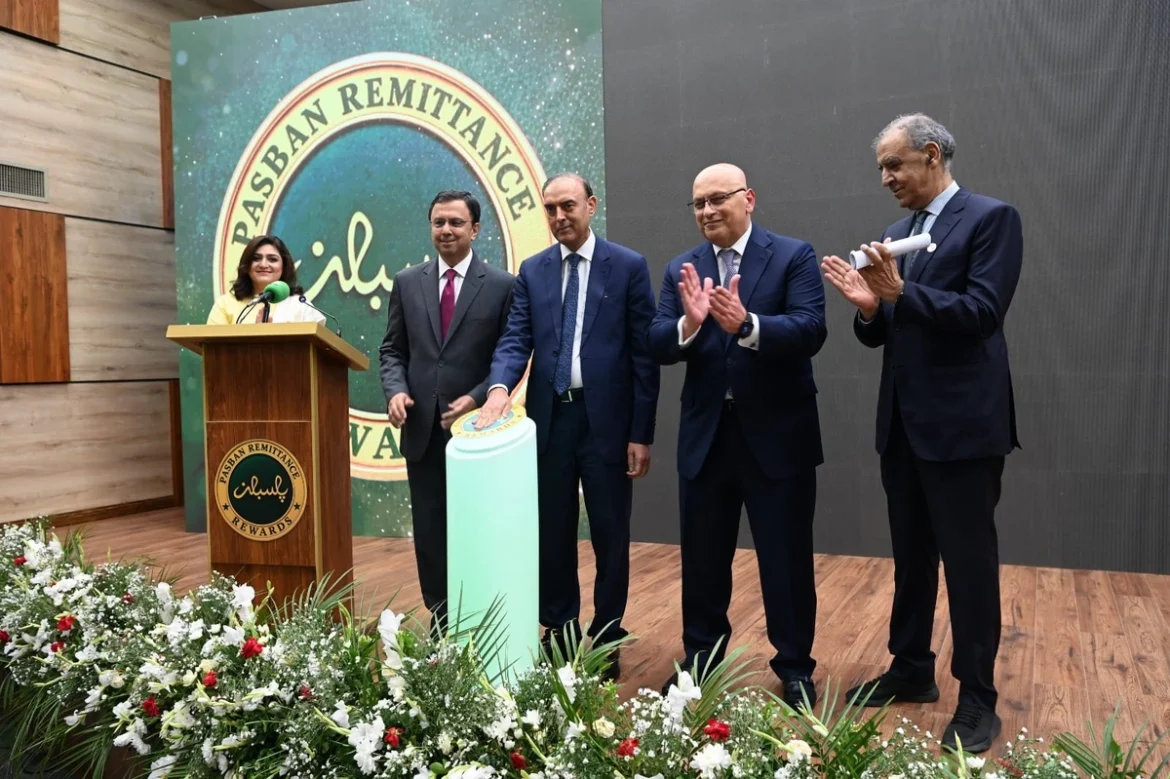
State Bank of Pakistan Governor Jameel Ahmad inaugurated the Pasban Remittance Reward Scheme at the central bank’s Karachi headquarters, with the leadership of the Pakistan Banks Association in attendance. The program, developed under the SBP’s patronage and financed entirely by commercial banks, will distribute 4 billion rupees every quarter to 2,521 winners, or more than 10,000 recipients over a full year.
The mechanics favour the people in Pakistan who collect the money, not those abroad who send it. Anyone who receives at least $100 in remittances each month for three straight months in a quarter, credited to a bank account or digital wallet, is automatically entered — no forms, no fees and no minimum balance. Larger transfers earn more entries: a $260 remittance generates three tickets, while $1,000 generates 10, with no cap on how many entries an account can accumulate.
Each quarterly draw will hand out one top prize of 100 million rupees, 20 prizes of 25 million rupees, 100 prizes of 10 million rupees and 2,400 prizes of 1 million rupees. Cash collected over the counter won’t qualify — the money has to land directly in an eligible account — and inflows through Roshan Digital Accounts or into foreign-currency accounts are excluded. The first qualifying quarter runs from Oct. 1 through Dec. 31, with the inaugural draw set for Jan. 15, 2027.
Prize allocation is weighted by geography, mirroring where Pakistan’s remittances actually originate. Half the pool outside the top prize is reserved for money sent from Gulf Cooperation Council countries, 15% each for the U.K. and continental Europe, and 10% each for North America and the rest of the world. The 100-million-rupee grand prize, however, is open to winners regardless of which country their remittance came from.
The draws will be run by 1LINK, the domestic payments network, using an automated random-selection process that the organisers say requires no manual intervention, with the entry and draw systems subject to independent audit. Prize money will sit in escrow at National Bank of Pakistan ahead of each draw, and winners will be notified through their banks, with results published without disclosing personal details. Payouts will be credited in rupees after verification, with withholding tax deducted at source.
Ahmad framed the launch against a sharp turnaround in Pakistan’s external accounts. The central bank’s foreign-exchange reserves have climbed to $21.4 billion, he said, up from less than $3 billion in February 2023, a buildup he attributed mainly to purchases from the interbank market rather than fresh external borrowing. Reserves are expected to exceed $20.2 billion by the end of December 2026.
Remittances have been central to that rebuilding. Overseas Pakistanis sent a record $41.6 billion home in the fiscal year ended June, up 9% from $38.3 billion the year before, according to SBP data — nearly double the $21.7 billion recorded in fiscal 2019. Saudi Arabia remained the largest single source at $9.78 billion, followed by the United Arab Emirates at $8.81 billion and the U.K. at $6.33 billion. The central bank is targeting $44 billion for the current fiscal year, a forecast some analysts consider ambitious given slowing outward migration and a maturing shift toward formal channels.
Pasban succeeds the Sohni Dharti Remittance Program, which was wound down alongside the Telegraphic Transfer Charges Incentive Scheme after the government stopped subsidising remittance incentives in July. Ahmad said that as those state-backed programs expanded and grew costlier over time, authorities began shifting toward what he called a more sustainable, market-oriented model funded jointly with the banking industry — a transition he described Pasban as extending. Points accumulated under Sohni Dharti will not carry over to the new scheme, according to its published terms.
Muneer Kamal, the PBA’s chief executive and secretary general, said Pasban builds on a separate remitter incentive that banks have funded since July, pushing the industry’s total annual commitment to remittance-related support to nearly 100 billion rupees. He added that banks also voluntarily cut the markup on the Export Refinance Facility by three percentage points to 4.5% this year on new loans and rollovers, within a 1.052 trillion-rupee facility limit, as part of a broader push to support export-led growth alongside financing from the Export-Import Bank for small and medium-sized exporters.
Zafar Masud, the PBA’s chairman, said Pakistan’s banks have taken on the remitter incentive, cut export refinancing costs, pushed private, agricultural and SME lending to record levels, and supported the resolution of circular debt in the power sector, and characterized Pasban as recognition of overseas Pakistanis’ contribution alongside those efforts.
The government has also widened the Roshan Digital Account program to admit foreign investors and Pakistani residents with declared foreign assets, in addition to overseas Pakistanis, part of a wider set of measures that includes export tax incentives and targeted financing schemes designed with input from industry stakeholders, Ahmad said.
Draw results will be published on a dedicated Pasban webpage as well as on the websites and social-media accounts of the PBA and individual banks.
Copyright © 2021 Independent Pakistan | All rights reserved