By Staff Reporter
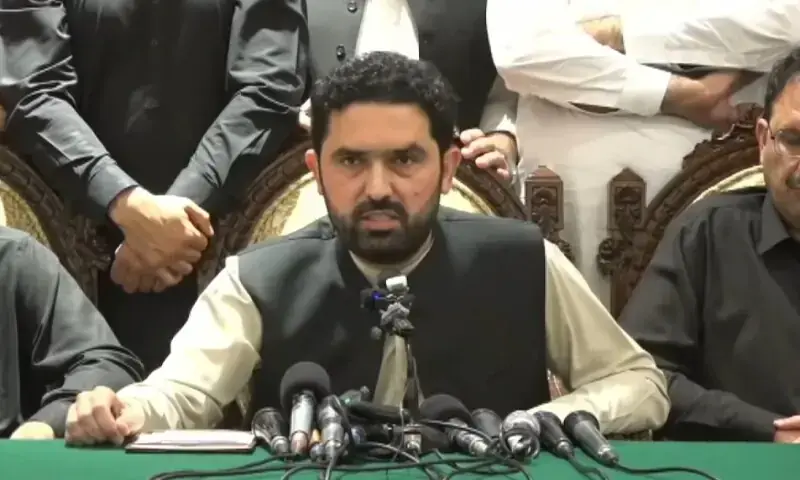
PESHAWAR: The chief minister of Khyber Pakhtunkhwa province warned on Saturday that any attempt by Islamabad to strip him of office would trigger a reaction “never witnessed” in the country’s history, as a stand-off between the opposition Pakistan Tehreek-e-Insaf and the PML-N led coalition government showed no sign of easing.
Sohail Afridi, the 37-year-old provincial leader who has emerged as one of the most combative voices in Imran Khan’s party since the former prime minister’s imprisonment, told journalists in Peshawar that neither his removal from office nor the imposition of direct federal rule over the province was something the government could afford. “Government means nothing to me, I am a soldier of Imran Khan,” he said, adding that should he cease to be chief minister, it would fall to the jailed party founder to name his successor.
His comments came at the end of a turbulent week in which the party’s long-threatened march on the capital — intended to press for Khan’s release from Adiala jail in Rawalpindi, where he has been held since 2023 — was postponed from 27 September to 4 October. Afridi described the delay as a matter of “strategy” rather than retreat, insisting that preparations for the march were complete and that convoys would set off from Peshawar regardless of the obstacles placed in their path. “We have to march no matter what,” he said.
The chief minister struck a notably conciliatory note alongside the defiance, repeating an offer to resolve the dispute through negotiation rather than confrontation. “If the federal government wants to resolve the issue within seven days, it should do so through mutual understanding,” he said, asking why ministers would insist on waiting until after the march to talk. “If negotiations have to be held after the long march, why not do them before?” He maintained that his party had never refused dialogue, and warned that the government had been given 52 days to weigh the PTI’s demands.
But the offer of talks was paired with an unmistakable threat. Afridi cautioned that any “misadventure” by the authorities — a term he did not define precisely but which is widely understood in political discourse to mean a crackdown, arrests or moves against the party’s leadership — could push the country to “a point of no return”, and that his supporters would be capable of mobilising “on 24-hour notice”. Should the march be brought forward in response to such a move, he said, it could begin even before the newly announced October date.
Demands centre on Khan’s treatment
At the heart of the party’s grievances is the continued detention of Khan, who has not been seen in public for an extended period, fuelling persistent speculation and concern among his supporters about his welfare. Afridi said the PTI’s demands were limited and specific: that the former prime minister be granted medical treatment at a private hospital in Islamabad, and that he be given access to his lawyers, relatives and the eighteen party members nominated by the courts to visit him. He said court orders mandating weekly meetings with Khan were not being honoured, and that he had exhausted other avenues — petitioning courts and writing directly to the federal government — before resorting to the call for a march.
The dispute has taken on an increasingly personal and provincial dimension. Afridi accused senior figures in the ruling coalition, naming Punjab’s chief minister, Maryam Nawaz, and the federal information minister, Attaullah Tarar, of unfairly singling out ethnic Pashtuns, alleging what he called a “well-hatched conspiracy” to divide the country along regional lines. “We are patriotic Pakistanis, and we are peaceful people,” he said. “We will not allow any conspiracy to succeed.”
The exchange has been sharpened further by disputes over Pakistan’s Afghanistan policy. Afridi renewed his criticism of the closure of the Pakistan-Afghanistan border, arguing it had cost the province roughly seven billion rupees in lost revenue this year against a potential ten billion rupees had crossings remained open, and that infiltration was continuing despite the restrictions regardless. He said he had presented the country’s military and civilian leadership with his own proposal to ease tensions with the Taliban administration in Kabul, including reopening the border and abandoning what he called the artificial distinction between “good” and “bad” Taliban factions, and called for a national jirga, or tribal council, to negotiate directly with Afghanistan.
Government dismisses criticism as cover for militancy
The information minister Tarar used a press conference in Islamabad to dismiss Afridi’s stance as cover for an unwillingness to confront extremism in the province. Speaking alongside the prime minister’s coordinator for Khyber Pakhtunkhwa, Ikhtiar Wali, he accused the chief minister of lacking credibility and branded him “a coward”, alleging without offering supporting evidence that the party functioned as an auxiliary of banned militant organisations. “He does not want to take ownership of operations against terrorists, nor does he believe in them,” Tarar said, arguing that the party had been steadily losing political ground.
Citing casualty figures for violence recorded so far this year, the minister said his government remained committed to eliminating militancy entirely and paid tribute to the sacrifices of police and security personnel. He was dismissive, too, of the PTI’s plans for next weekend, telling reporters that although the party could choose when to march, the decision to allow it into the capital rested with the state. “It is not your decision, and it is not your march,” he said.
Security lockdown remains in place
Whatever the rhetoric, the practical machinery of a security lockdown around the capital has not been dismantled by the postponement. Authorities in Punjab have banned public gatherings across the province until 5 October and prohibited incitement to unlawful assembly, while a parallel ban under Section 144 — legislation permitting the restriction of gatherings on public order grounds — has been in force in Islamabad for two months. The federal government has separately authorised the deployment of paramilitary Rangers across the capital and several Punjab districts from 20 September until 5 October, with the notification permitting troops to respond “appropriately” to threats encountered in the course of their duties.
Speculation over the province’s political future has intensified alongside the security build-up. Reports in recent days have suggested that the federal government is examining its legal options for imposing governor’s rule in Khyber Pakhtunkhwa — a constitutional mechanism that would allow Islamabad to suspend the provincial government and rule the province directly — with the interior ministry said to be consulting the law ministry on the matter. Afridi has consistently dismissed the prospect, telling reporters that his party’s reaction would be swift and severe. “They would not be able to afford my removal,” he said.
Afridi was elected chief minister of the province in October last year after Khan directed his predecessor, Ali Amin Gandapur, to step down, and has since positioned himself as one of the party’s most outspoken regional leaders during Khan’s continued absence from public life. The party’s information secretary in the province, Shaukat Yousafzai, said separately that the decision to delay the march had been forced in part by the scale of the security deployment around the capital, describing it as a recalibration of tactics rather than a retreat. “We support a peaceful struggle,” he said, while urging the federal government to move beyond what he characterised as “ego, stubbornness and the intoxication of political power” and negotiate in practical terms rather than through television appearances.
Copyright © 2021 Independent Pakistan | All rights reserved