By Staff Reporter
PESHAWAR: A suicide bomber detonated a vehicle packed with explosives at a police checkpost in north-western Pakistan on Saturday, killing at least 12 people and wounding around 30 others in an attack the Pakistani Taliban has claimed as its own.
The bomber rammed a tractor trolley loaded with explosives into the Aman Mela checkpost in the Darazinda area of Dera Ismail Khan district, a joint police and customs post used to monitor smuggling routes close to the mountainous border between Khyber Pakhtunkhwa and Balochistan provinces.
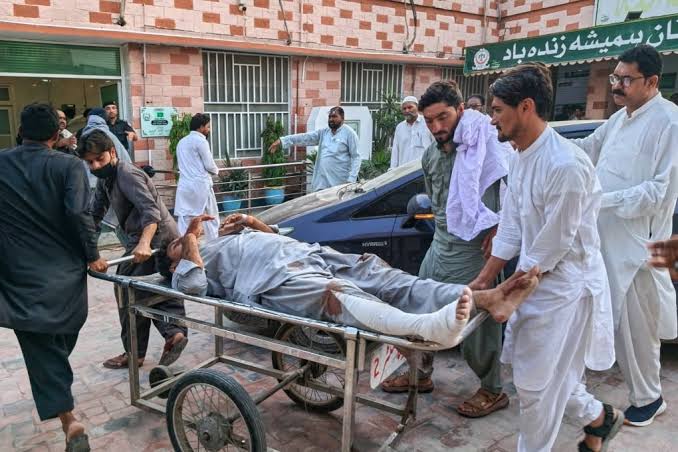
Ghulam Mubashir Maken, the regional police officer for Dera Ismail Khan, said an initial assessment put the death toll at 12, including personnel from law enforcement agencies, with 30 people injured. Among the dead were nine men, two women and a child, though the toll had climbed steadily through the day as rescue workers pulled more bodies from the rubble, with earlier tallies from Rescue 1122 putting the number of fatalities at 11.
The force of the blast tore through a large section of the checkpost and flattened a house standing next to it. Residents in the area said the explosion could be heard from a considerable distance, and was followed by sustained gunfire as security forces exchanged shots with the attackers in the aftermath.
Zulfikar Hameed, the inspector general of Khyber Pakhtunkhwa police, said officers, security forces and Counter-Terrorism Department teams reached the scene shortly after the blast and sealed off the area to begin a search and clearance operation. Bomb disposal experts were also sent to examine the site and establish the precise nature of the device used.
Rescue 1122, the province’s emergency service, said its Darazinda station team was first on the scene and began relief efforts immediately, later reinforced by ambulances and personnel sent from the neighbouring districts of Karak and Hangu. More than 25 rescuers, six ambulances and a fire engine were deployed, the service said, while four further ambulances were dispatched from Dera Ismail Khan on the orders of district emergency officer Muhammad Arif Khan. Eighteen of the wounded were moved to Mufti Mahmood Hospital and other medical facilities in Darazinda for treatment, with several described as being in critical condition.
Rescue worker killed as ambulance comes under fire
In a second attack that compounded the horror of the day, an ambulance carrying bodies recovered from the blast site was fired upon as it made its way from the scene. A Rescue 1122 worker, named as Shareefullah, was killed, and two colleagues, identified as Anees and Imtiaz, were seriously wounded. Paramedics treated the injured at the scene before rushing them to hospital. Despite coming under fire, rescue teams pressed on with the grim task of recovering and transporting the dead.
The Tehreek-e-Taliban Pakistan, the umbrella militant network also known as the Pakistani Taliban, claimed responsibility for the checkpost bombing in a statement reported by the Associated Press and Reuters. The group has stepped up attacks on Pakistani security forces this year, particularly in Khyber Pakhtunkhwa, where it operates alongside other militant factions from bases it is widely accused of maintaining across the border in Afghanistan.
A province under siege
Saturday’s bombing is the latest and among the bloodiest in a sharp escalation of violence that has gripped Khyber Pakhtunkhwa during the week. Just eight days earlier, on 18 September, a devastating assault on the old Police Lines compound in Kohat killed 23 people, among them 17 police officers and six civilians, when attackers stormed the site during Friday prayers at its mosque. Eight militants were killed when security forces mounted an overnight operation to clear the compound. Responsibility for that attack was claimed by the Ittihadul Mujahideen Pakistan, a faction led by the Afghanistan-based commander Hafiz Gul Bahadur.
Separately, a captain and a lieutenant were among six security personnel killed in an exchange of fire with militants in Hangu district, in which eight attackers also died.
The violence has hardened an already tense standoff between Islamabad and Kabul. In the days after the Kohat attack, Pakistan launched a “calibrated” airstrikes against militant hideouts along the Afghan border, saying the strikes and accompanying ground operations had killed more than 37 terrorists. Pakistani air defences also brought down eight drones that crossed into the country’s airspace from Afghanistan, with four intercepted near the Torkham crossing and four more in mountainous terrain close to Kohat. Islamabad has since said it carried out further “precision” air and drone strikes against ten locations inside Afghanistan.
The Afghan Taliban administration has repeatedly denied that armed groups are allowed to operate from Afghan territory, insisting that militancy remains an internal matter for Pakistan to resolve. That denial has done little to ease tensions, with Pakistani and Afghan Taliban forces reported to have exchanged fire along the frontier in recent days.
Figures compiled by the Pakistan Institute for Conflict and Security Studies underline the scale of the deterioration: mainland Khyber Pakhtunkhwa, excluding its merged tribal districts, recorded 54 terrorist attacks in August, up 50 percent on the 36 recorded the previous month. Earlier this month, police said they had foiled a separate attempt by TTP militants to storm a checkpost in the Daraban area of Dera Ismail Khan, with no casualties reported.
Political reaction
News of the bombing prompted a wave of condemnation from Pakistan’s political leadership. President Asif Ali Zardari said targeting civilians and law enforcement personnel was “highly condemnable” and ordered that the injured receive the best available medical care, while calling for operations against militant networks to be intensified.
Prime Minister Shehbaz Sharif said the sacrifices of “the nation’s protectors” in the fight against militancy would not be allowed to go in vain, pledging that his government remained determined to eliminate the threat.
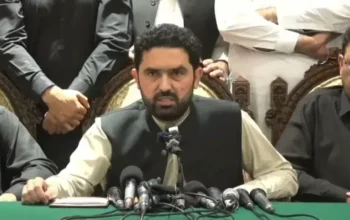
Khyber Pakhtunkhwa’s chief minister, Sohail Afridi, struck a markedly more pointed note, describing the bombing as part of a “new wave of terrorism” claiming Pashtun lives on a near daily basis. “We cannot carry any more coffins, and we cannot watch any more blood being shed,” he said in a video statement, calling for an urgent change of policy and warning that his administration had long warned against what he called a strategy of resettling former militants. He said the province had raised its police budget to 191 billion rupees for the coming fiscal year, and appealed for armoured vehicles and other equipment to be provided to officers he said were fighting militants “on the front line” without adequate resources.
Copyright © 2021 Independent Pakistan | All rights reserved